221382424602


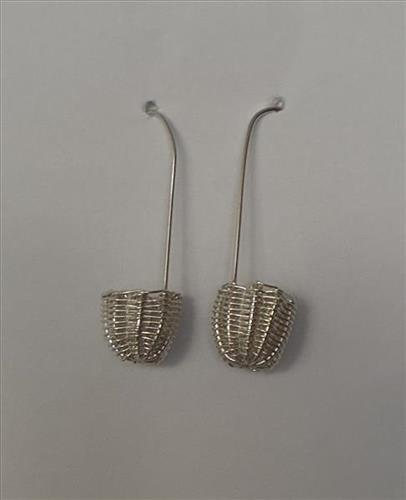
Handwoven Dillybag Earrings, Silver 925

Wagilak Yapa Watj (Wagilak Sisters) range –
exclusive jewellery from Indigenous women of Beswick. Developed in studio workshops with jeweller Kate Sale and weaver Fiona Gavino, traditional fibre artists are translating their skills into a series of fine woven wire earrings and pendants. Hand woven in sliver, gold and copper, traditional forms are transformed as delicate interpretations of string and dilly bags, baskets and mats.

Featuring sterling silver, 9ct gold and copper (all nickel-free work).
111982424771


An-gujechiya (Fish Trap)

To make fish traps and fish net fences artists firstly get vine (mirlarl) from the jungle and they put it in water for one night to make it soft. Next they start weaving it; they make rings for the inside to keep the fish trap’s shape. Artists work for three or four weeks on the fish trap. They also make string from kurrajong (burdaga) to attach the hibiscus (bardainy) rings and to tie the conical end of the fish trap. This fish trap is used in saltwater and freshwater. People also use fish net fences called mun-dirra. A long time ago they would put the mun-dirra across rivers and creeks. In the middle they would place the an-gujechiya. They also used small things like sticks, rocks, mud and grass to block the fish from going through. People would then catch fish like saltwater barramundi rajarra, freshwater barramundi (janambal), small black freshwater catfish (buliya), bonefish (an-guwirrpiya), and sand bass (dalakan) in these fish traps.

111982424770


An-gujechiya (Fish Trap)

To make fish traps and fish net fences artists firstly get vine (mirlarl) from the jungle and they put it in water for one night to make it soft. Next they start weaving it; they make rings for the inside to keep the fish trap’s shape. Artists work for three or four weeks on the fish trap. They also make string from kurrajong (burdaga) to attach the hibiscus (bardainy) rings and to tie the conical end of the fish trap. This fish trap is used in saltwater and freshwater. People also use fish net fences called mun-dirra. A long time ago they would put the mun-dirra across rivers and creeks. In the middle they would place the an-gujechiya. They also used small things like sticks, rocks, mud and grass to block the fish from going through. People would then catch fish like saltwater barramundi rajarra, freshwater barramundi (janambal), small black freshwater catfish (buliya), bonefish (an-guwirrpiya), and sand bass (dalakan) in these fish traps.

111982424769


Borndok (Spear Thrower)

The Borndok (Spear Thrower) is used to help propel a spear. These items are used for hunting and highly decorative pieces are used in ceremony. Also known as woomera; a flat type of spear thrower. The borndok is held in one hand, with the spear placed in the hook at the top of the borndok.

Like spears and boomerangs, borndok’s are more commonly used by men. In the West Arnhem region are exclusive to ‘men’s business’, meaning women are forbidden to use. If touched or held by women, women will be cursed to have bad luck or in some cases infertility.

111982424767


Borndok (Spear Thrower)

The Borndok (Spear Thrower) is used to help propel a spear. These items are used for hunting and highly decorative pieces are used in ceremony. Also known as woomera; a flat type of spear thrower. The borndok is held in one hand, with the spear placed in the hook at the top of the borndok.

Like spears and boomerangs, borndok’s are more commonly used by men. In the West Arnhem region are exclusive to ‘men’s business’, meaning women are forbidden to use. If touched or held by women, women will be cursed to have bad luck or in some cases infertility.

111982424766


Borndok (Spear Thrower)

The Borndok (Spear Thrower) is used to help propel a spear. These items are used for hunting and highly decorative pieces are used in ceremony. Also known as woomera; a flat type of spear thrower. The borndok is held in one hand, with the spear placed in the hook at the top of the borndok.

Like spears and boomerangs, borndok’s are more commonly used by men. In the West Arnhem region are exclusive to ‘men’s business’, meaning women are forbidden to use. If touched or held by women, women will be cursed to have bad luck or in some cases infertility.

111982424765


Borndok (Spear Thrower)

The Borndok (Spear Thrower) is used to help propel a spear. These items are used for hunting and highly decorative pieces are used in ceremony. Also known as woomera; a flat type of spear thrower. The borndok is held in one hand, with the spear placed in the hook at the top of the borndok.

Like spears and boomerangs, borndok’s are more commonly used by men. In the West Arnhem region are exclusive to ‘men’s business’, meaning women are forbidden to use. If touched or held by women, women will be cursed to have bad luck or in some cases infertility.

111982424763


Borndok (Spear Thrower)

The Borndok (Spear Thrower) is used to help propel a spear. These items are used for hunting and highly decorative pieces are used in ceremony. Also known as woomera; a flat type of spear thrower. The borndok is held in one hand, with the spear placed in the hook at the top of the borndok.

Like spears and boomerangs, borndok’s are more commonly used by men. In the West Arnhem region are exclusive to ‘men’s business’, meaning women are forbidden to use. If touched or held by women, women will be cursed to have bad luck or in some cases infertility.

111982424755


Garnawarra (frog) and Jima Jima (Waterlily)

Jimi jima is similar to what is commonly known as a waterlily (monochoria australasica). The plant is mainly associated with a waterhole named Yalija, but also other sacred waterholes in the Wurdeja area. This painting of jima jima depicts the lily as it exists naturally in wet water areas at Wurdeja. They have an edible root, which is brownish and bitter when raw, but once roasted on coals it is deliciously sweet. They are only found in sacred waterholes in the Wurdeja area, including Yalija, and humans and spirits live off them. They are a bright blue flowering plant.

Fiona Steele is the daughter of the late Tommy Gondorra Steele, the last male member of the Garnawula Niya clan who lived at Wurdeja outstation, about four kilometres east of the Blyth River, and who was the traditional owner of that area. Wurdeja is surrounded by a series of sacred waterholes and it is these waterholes, which provide the subject matter for Steele’s art.

111982424754


Kunkurra (The Spiralling Wind)

‘Kunkurra’, the spiralling wind is associated with several sites in the Kardbam clan estate. On one level, this painting can be interpreted as a depiction of the kinds of mini-cyclones common during the wet season in Arnhem Land, where the artist lives. In this painting, Kunkurra also relates specifically to a site called Bilwoyinj, near Mankorlod.

At this site, two of the most important Kuninjku creation beings, a father and son known as na-korrkko, are believed to have hunted and eaten a goanna. They left some of the goanna fat behind at the site, which turned into the rock that still stands there today. The word Bilwoyinj, which is the name of this site, also refers to the fat of the goanna. Bilwoyinj site is also a ceremonial ground for a ceremony called Yabbaduruwa, a major ceremony owned by the Yirridja patrimoiety. The Yabbaduruwa ceremony is primarily concerned with initiation, land ownership and promoting the cyclical regeneration of the human and natural worlds.