Kayawa (baby floor mat) and Lorrkon
Baby floor mat
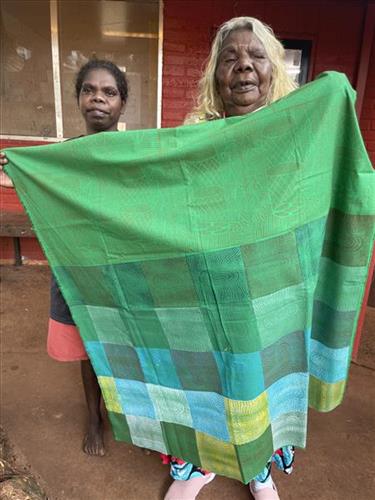
Baby floor mat
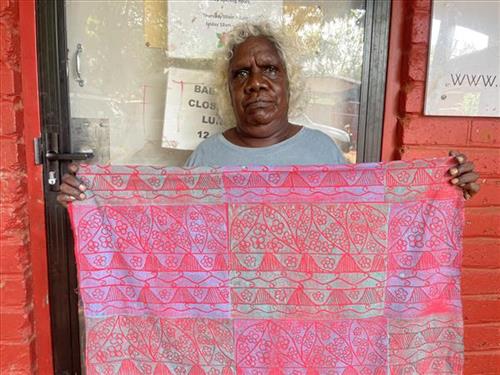
This is a Kune word that refers to the flattening out of items stones, flat leaves and kunbad (money).
This design shows different items that have flattened out. Carol designed this for her grandkids to show them the tradition of Welebme.
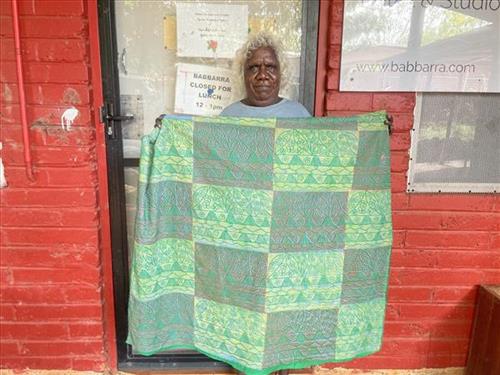
This is a Kune word that refers to the flattening out of items stones, flat leaves and kunbad (money).
This design shows different items that have flattened out. Carol designed this for her grandkids to show them the tradition of Welebme.
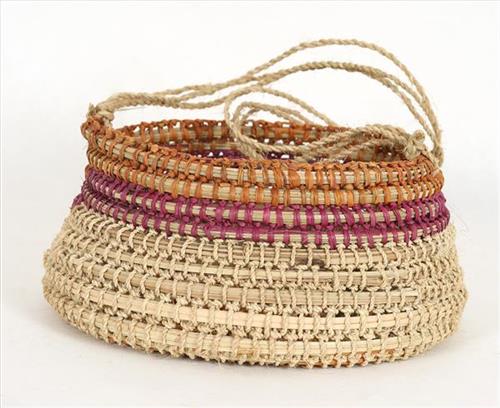
Coil basketry is a well-established fibre art form in the Maningrida region, especially for women from the Kuninjku, Rembarrnga, Ndjebbana and Nakkara language groups.
Artists make coiled baskets of many shapes and sizes, ranging from small round baskets to large oval baby baskets, and made mostly from pandanus fibre that is dyed with natural pigments. Bundles of fibre are formed into coils which are covered and stitched together with strands of fibre threaded onto a needle. Artists combine colours and patterns to obtain intricate new graphic patterns.
These techniques are believed to have been introduced to Arnhem Land by Greta Matthews, a missionary on Goulburn Island in the 1920s. She had probably learnt coil basketry from Aboriginal people in the south-east of Australia, possibly the Murray River people such as the Yorta Yorta or the coastal Ngarrindjeri.
The coiling technique spread quickly from Goulburn Island to people on mainland Arnhem Land.
The images in this painting refer to a site in the clan estate of the artist, at a place called Dirdbim which literally means ‘image of the moon’. The site is a large, unusually round hole in sandstone, residual on the plain not far from the Mann River. Mick Kubarkku is an artist well known for his paintings of the full and new moons, the sun and the stars. He also taught several family members to paint this important dreaming. Here Lulu Laradjbi, Mick Kubarrkus’s wife, has painted the full and new moon called dird bukkulurl and lirrk kurrmeng in the Eastern Kunwinjku language.
The large hole is said to be the full moon created by the rainbow serpent Ngalyod, who pierced the rock in times of the ‘dreaming’ and left the shape of the full moon. Dirdbim is not far from the artists’ residence today at Yikarrakkal and the area is rich in rock art and old camping sites. As well there are numerous human remains, bones wrapped up in paper bark and older remains lying in clefts of sandstone shelters. The Eastern Kunwinjku people of the district have always used Dirdbim as a mortuary site because of the mythological history of the area which is connected to the moon story. This is because the mythology of the moon ancestor relates how his adversary, the spotted quoll, argued with the moon over the fate of humanity. The quoll decided he would die once and once only but the moon took his place in the sky to be reborn each lunar month. Because of this Kubarkku often painted this subject with bones or murrngno surrounding the image, just as human bones surround the actual site at Dirdbim.
The techniques of bark painting are usually handed down from one generation to the next, as are the rights of each artist to a particular site or ‘dreaming’. The similarity between this painting by Laradjbi, and some of her husband’s paintings is a reflection of this process of transmission.
The rainbow serpent is a powerful mythological figure for all Aboriginal people throughout Australia. Characteristics of the rainbow serpent vary greatly from group to group and also depending on the site. Often viewed as a female generative figure, the rainbow serpent can sometimes also be male. She has both powers of creation and destruction and is most strongly associated with rain, monsoon seasons and of course the colour seen in rainbows which arc across the sky like a giant serpent. For Aboriginal people in Northern Australia, the rainbow serpent is said to be active during the wet season.
Known as Ngalyod in the Kuninjku language of western central Arnhem Land, the rainbow serpent is mostly associated with bodies of water such as billabongs, creeks, rivers and waterfalls where she resides. Therefore she is responsible for the production of most water plants such as water lilies, water vines, algae and palms, which grow near water. The roar of waterfalls in the escarpment country is said to be her voice. Large holes in stony banks of rivers and cliff faces are said to be her tracks. She is held in awe because of her apparent ability to renew her life by shedding her skin and emerging anew. Aboriginal myths about the rainbow serpent often describe her as a fearful creature that swallows humans only to regurgitate them, transformed by her blood. The white ochre used by artists to create the brilliant white paint for bark paintings, body decoration and in the past, rock art, is said to be the faeces of the rainbow serpent.
Aboriginal people today respect and care take sacred sites where the rainbow serpent is said to reside. Often certain activities are forbidden at these places for fear that the wrath of the great snake will cause sickness, accidents and even tempests. This is not always the case however and there are many rainbow serpent sites today where people may enter to hunt, fish or swim. By painting this figure on bark today, Aboriginal people are carrying on the longest uninterrupted mythological tradition in the world, which has been the subject of art and ceremony for possibly thousands of years.
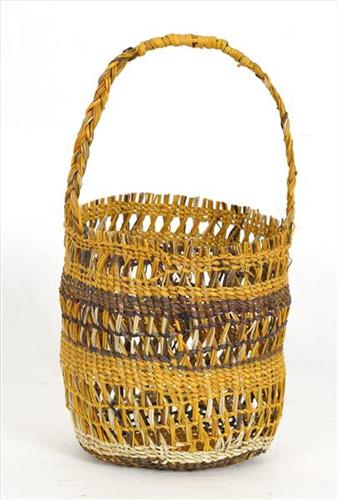
Burlupurr, or dilly bag, is a large woven collecting basket. These large bags are often made from the vine ‘Malasia scandens’, a strong pliable plant which grows along the floor and into the canopy of monsoon vine thickets. The bags are used to collect any kind of large numbers of heavy foods such as fish caught in conical fish traps or large collections of yams.
They can also be made from Pandanus spiralis, a plant which grows in many areas of Arnhem Land. These dilly bags are a tightly woven collecting basket, very finely made. These dilly bags are often used to collect sugarbag, the native honey
As well as being of practical use, dilly bags are also of religious significance to Arnhem Land people. Dilly bags are said to be totemic objects and associated with particular sites in the landscape.
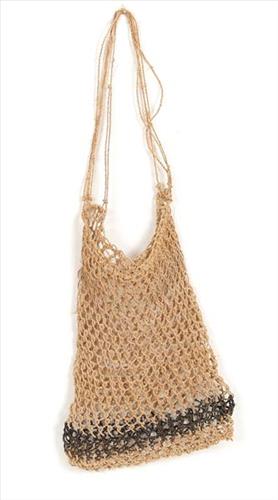
String bags can vary greatly. Artists commonly use a mix of naturally dyed and undyed fibre to create a striking variation of coloured bands. Some artists also incorporate different types of looping to produce different patterns and textured finishes. Each type of fibre bag, mat, basket and dilly bag has its own name in the various languages spoken in the Maningrida region.
Phil W Art
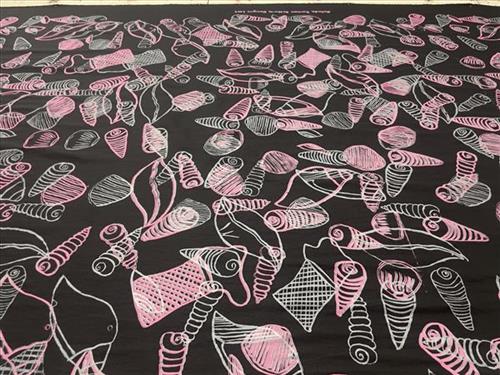
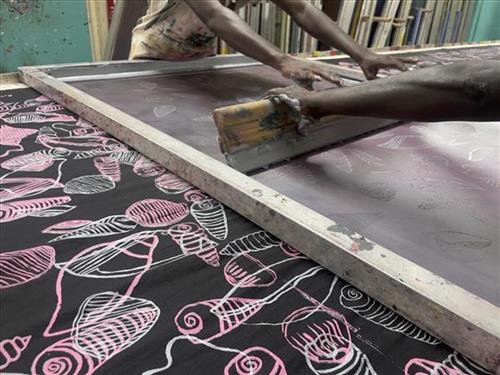
‘Sometimes when we go down to the beach in Maningrida we pick all these shells up. Some family make necklaces and earrings. In the olden days they used to collect shells and put them in the dilly bags. The old people used to carry dilly bags when they went hunting. They used the dilly bag for bush food. My design shows mud muscle and long bum and cockles.’ Belinda Kernan 2022
Belinda’s mother is from Eastern Arrernte country near Alice Springs, the community of Ltyentye Apurte (Santa Teresa), and her father’s country is Maningrida. Belinda speaks languages from both sides of her family, as well as various languages belonging to Central Arnhem Land. She lives in Maningrida and prints lino at the women centre. Belinda is also a strong leader for young people in her community.