111982263912


An-gujechiya (Fish Trap)

To make fish traps and fish net fences artists firstly get vine (mirlarl) from the jungle and they put it in water for one night to make it soft. Next they start weaving it; they make rings for the inside to keep the fish trap’s shape. Artists work for three or four weeks on the fish trap. They also make string from kurrajong (burdaga) to attach the hibiscus (bardainy) rings and to tie the conical end of the fish trap. This fish trap is used in saltwater and freshwater. People also use fish net fences called mun-dirra. A long time ago they would put the mun-dirra across rivers and creeks. In the middle they would place the an-gujechiya. They also used small things like sticks, rocks, mud and grass to block the fish from going through. People would then catch fish like saltwater barramundi rajarra, freshwater barramundi (janambal), small black freshwater catfish (buliya), bonefish (an-guwirrpiya), and sand bass (dalakan) in these fish traps.
111982263911


An-gujechiya (Fish Trap)

To make fish traps and fish net fences artists firstly get vine (mirlarl) from the jungle and they put it in water for one night to make it soft. Next they start weaving it; they make rings for the inside to keep the fish trap’s shape. Artists work for three or four weeks on the fish trap. They also make string from kurrajong (burdaga) to attach the hibiscus (bardainy) rings and to tie the conical end of the fish trap. This fish trap is used in saltwater and freshwater. People also use fish net fences called mun-dirra. A long time ago they would put the mun-dirra across rivers and creeks. In the middle they would place the an-gujechiya. They also used small things like sticks, rocks, mud and grass to block the fish from going through. People would then catch fish like saltwater barramundi rajarra, freshwater barramundi (janambal), small black freshwater catfish (buliya), bonefish (an-guwirrpiya), and sand bass (dalakan) in these fish traps.
111982263910


Jima Jima (Waterlily)

Jimi jima is similar to what is commonly known as a waterlily (monochoria australasica). The plant is mainly associated with a waterhole named Yalija, but also other sacred waterholes in the Wurdeja area. This painting of jima jima depicts the lily as it exists naturally in wet water areas at Wurdeja. They have an edible root, which is brownish and bitter when raw, but once roasted on coals it is deliciously sweet. They are only found in sacred waterholes in the Wurdeja area, including Yalija, and humans and spirits live off them. They are a bright blue flowering plant.

Fiona Steele is the daughter of the late Tommy Gondorra Steele, the last male member of the Garnawula Niya clan who lived at Wurdeja outstation, about four kilometres east of the Blyth River, and who was the traditional owner of that area. Wurdeja is surrounded by a series of sacred waterholes and it is these waterholes, which provide the subject matter for Steele’s art.

115682264182


Woven Mat

Traditionally, Nganiyal (conical mats) were used as an insect screen when erected, and as a sitting mat when folded. They are used in Ceremony as well as a functional item. 

Nowadays, artists weave many different shapes including flat, round and oblong. 

377810582263956


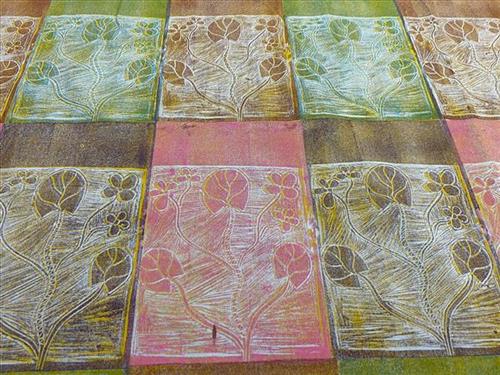
Wayuk

Wayuk (Waterlily) Nymphaea violacea. 

The stem of wayuk is a popular bushfood and the beautiful flower is enjoyed across Arnhem Land. 

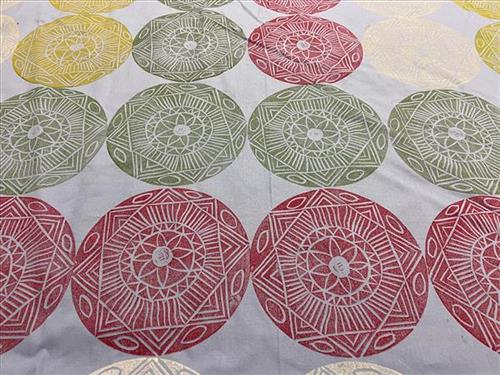
This fabric was created using the linocut printing technique. The lino tile has been carved by the artist in Maningrida, and has been printed by hand using a variety of colours and layers. The linocut technique ensures each textile piece is a one-off, limited edition piece. Bábbarra Women’s Centre supports the economic independence of Indigenous women in the Arnhem Land community of Maningrida, Northern Territory, Australia. Designs created by the women at Bábbarra reflect strong cultural knowledge, which is passed down to younger generations through their textile design practice.

377810582263955


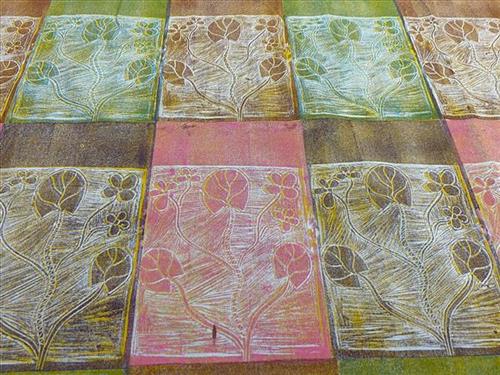
Wayuk

Wayuk (Waterlily) Nymphaea violacea. 

The stem of wayuk is a popular bushfood and the beautiful flower is enjoyed across Arnhem Land. 

This fabric was created using the linocut printing technique. The lino tile has been carved by the artist in Maningrida, and has been printed by hand using a variety of colours and layers. The linocut technique ensures each textile piece is a one-off, limited edition piece. Bábbarra Women’s Centre supports the economic independence of Indigenous women in the Arnhem Land community of Maningrida, Northern Territory, Australia. Designs created by the women at Bábbarra reflect strong cultural knowledge, which is passed down to younger generations through their textile design practice.

377810582263947


Romolo

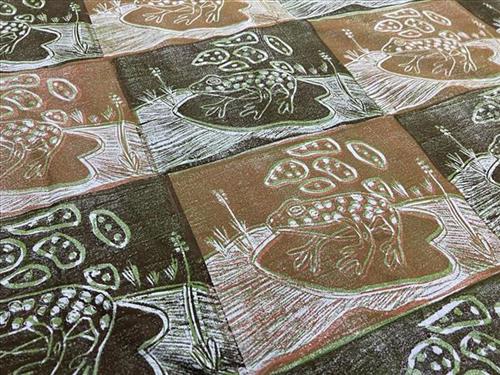
One of Lucy’s latest linocut designs, Romolo, green frog.

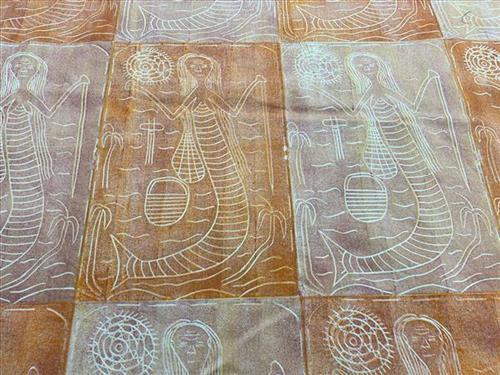
Lucy is an experienced textile artist at Bábbarra Women’s Centre. Lucy often references her ancestral stories in her textile work, including Bawaliba (Djinkarr spirit woman), with various lino and screen prints depicting this same narrative.

Lucy is from the Gurr.goni language group – one of the least commonly spoken languages in Arnhem Land. Lucy also speaks another eight Maningrida languages.