Bathi (Pandanus Basket)
Bathi are woven from the split leaves of the Screw Palm (Pandanus Spiralis). Coil weaving was introduced to Arnhem Land in the 1930s. It was adapted from techniques used by Indigenous women throughout South East Australia.
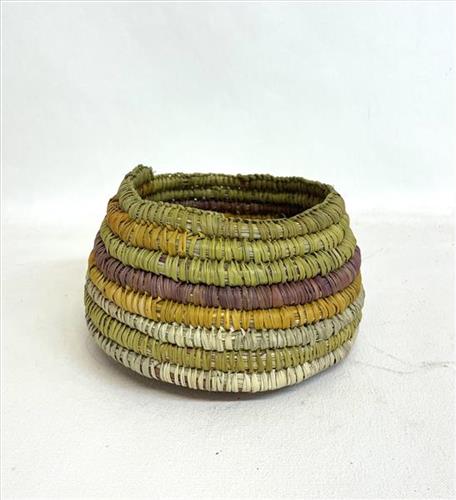
Bathi are woven from the split leaves of the Screw Palm (Pandanus Spiralis). Coil weaving was introduced to Arnhem Land in the 1930s. It was adapted from techniques used by Indigenous women throughout South East Australia.
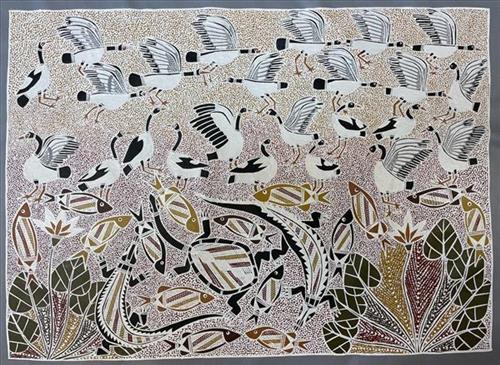
The Yolngu people of Arnhem Land originate from a spiritual source, fixed in a particular place in their land or the sea. These ‘Spiritual Reservoirs’ are often in the form of special waterholes made by Wangarr (Creative Beings) long ago close to the beginning of time.
The creator beings moved across the country side, shaping the land and implanting in each tract of country, the spiritual life force for the people who were to own it. These Creative Spirits took many forms. When they gave the land to each group they also gave songs, dances, ceremony, the associated laws and language. The Creation story for Ganalbingu people took place near the middle section of the Glyde River where it becomes the Goyder River. Their land, Ngaliyindi, sits astride the Arafura Swamp in Central Arnhem Land.
In this painting, the artist has depicted Gumang (magpie geese), which are sacred to the Ganalbingu people. To the east of the Arafura Swamp is a freshwater billabong which is said to have been made by the Goose Spirit and is in the shape of a goose nest. As a result, geese, their eggs and their nests are sacred.
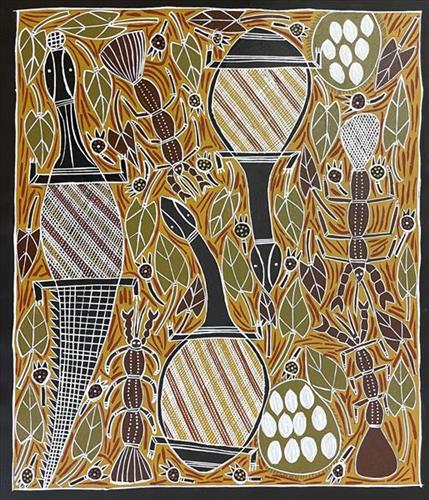
All Aboriginal people originate from a spiritual source, fixed in a particular place in their land or the sea. These ‘spiritual reservoirs’ are often in the form of special waterholes made by Wangarr (creative spirits) that were created long ago close to the beginning of time. These creator beings moved across the countryside, shaping the land and implanting in each tract of country, the spiritual life force for the people who were to own it. These creative spirits took many forms and when they gave the land to each group, they also gave songs, dances, ceremony, the associated laws and language.
The creation story for Ganalbingu people took place near the middle section of the Glyde River where it becomes the Goyder River. Their land, Ngaliyindi, sits astride the Arafura Swamp in Central Arnhem Land. Many Ganalbingu artists paint totemic species significant to their clan. These can include baru (crocodile), banda (long necked turtle), buliya (catfish), yalman (waterlilies), gumang (magpie geese), dakawa (fresh water yabby), ratjuk (barramundi), warrnyu (flying fox) and more.
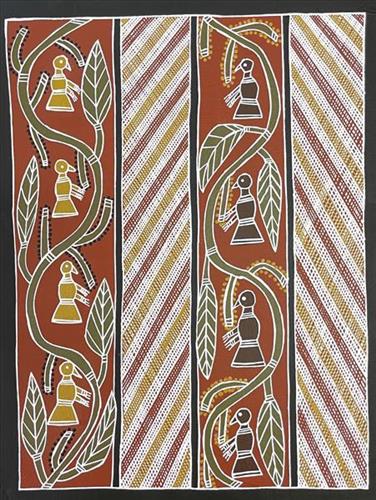
This artwork represents totemic finches. These birds herald the beginning of the dry season and are associated with the Ganalbingu clan. Lidji Lidji are also represented in ceremonial song and dance.
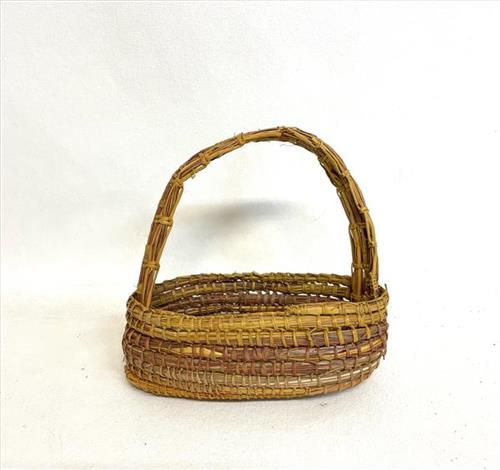
Bathi are woven from the split leaves of the Screw Palm (Pandanus Spiralis). Coil weaving was introduced to Arnhem Land in the 1930s. It was adapted from techniques used by Indigenous women throughout South East Australia.
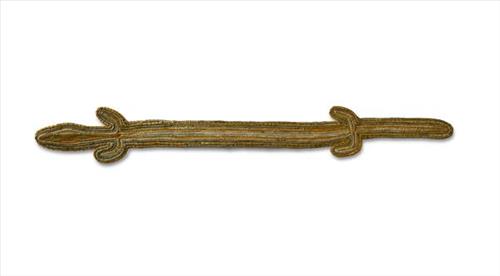
Djarrka is a freshwater goanna that can be found in small inland creeks and feeds on small crabs and yabbies. People hunt this goanna for food and they can be very delicious to eat, like other meats you can find around and in the creek. Djarrka is a Dhuwa water goanna and it plays a big part in some ceremonies. In nearly all Liyagawumirr Dhuwa ceremony like Djungguwan, Ngulmarrk, and Liyagalawumirr Ngarra, Djarrka is represented. The ceremonies are very secret to both women and children and those not in this group and unconnected to Yolngu lifestyle and their beliefs. It is very taboo to speak about.
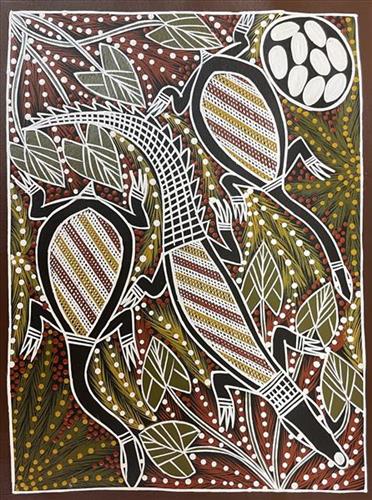
Baru (the crocodile man), was from the Gumatj clan. People usually call him Gurdu Gurdu or Baru which means crocodile. He lived his life at a place called Yirrkala. Living near him were other people, and when Baru didn’t have enough to eat he began to kill and eat these other people. After a while others noticed that some people were missing. When Baru went to the toilet, the people could smell this strong smell, so they knew that he ate the other people. Some men went to get help and they took message sticks to the other tribes. Some were sending smoke signals. When they came to Baru’s camp they started to spear him in the left side of his ribs. He dropped into the fire and burnt his left hand and maybe his right hand. He then ran into the bush and yelled to his countrymen – the animals, birds and fish that live on the land and in the sea. He stopped and he named the tribes and clans and also the places until he came to a place called Gamarru/Guyurru. There he took a rest and said to himself “This is where I stop and call this place Gamarru/Guyurru”. Baru, still in pain from the fire, then jumped into the water and turned himself into a crocodile. The fire left scars on his back. Baru paintings belong to Gumatj and Warrawarra and also the Marpi clan. This painting is used at death ceremonies or initiations and it normally is painted on the belly, which means the person the design is painted on is part of Gurdu Gurdu (the crocodile people).
Aboriginal bark paintings have a long cultural tradition, believed to extend back many thousands of years.
In northern Australia, paintings on bark shelters in the Kimberley and Arnhem Land were stylistically similar to rock shelter paintings. The Aboriginal bark paintings were used to convey and illustrate stories which were told to the clan when holed up in the shelter for long periods in the wet season. In Kimberly, the Aboriginal bark paintings by Lily karadada resemble ancient rock art Wandjina paintings which are themselves many, many thousands of years old.
Bark paintings with deep cultural and ritual significance still feature in the Aboriginal sacred ceremonies of northern Australia and they, along with some coastal inhabitants are the only indigenous Aborigines still making traditional bark paintings.
The process of making a bark painting begins with choosing a suitable stringybark eucalyptus tree, preferably in the wet season when the sap is rising and the bark is fairly supple and easy to grip. After finding a section of bark that is devoid of knots and termite damage, cuts are made top and bottom and after some encouragement by tugging and prying, a hollow open cylinder of bark is removed. The bark sheet is trimmed and a fire made ready, over which the bark will be cured to drive out any moisture. The bark is then flattened to the ground with feet and then held down with heavy weights to ensure that it doesn’t curl or warp.
The Aboriginal bark painters of Arnhem Land adhere to four basic pigments – red, black, white and yellow. The reds and yellows come from ochres, crushed and powdered rocks. White comes from pipeclay and black generally comes from charcoal. Sometimes natural fixatives are mixed in to bind the pigments and which includes wax, yolk of eggs, resins and the sap of orchid plants. The paint can then be applied to the bark with perhaps a rarrk design by using a wood comb, or with brushes made from human hair or even feathers.
Aboriginal bark paintings have a long cultural tradition, believed to extend back many thousands of years.
In northern Australia, paintings on bark shelters in the Kimberley and Arnhem Land were stylistically similar to rock shelter paintings. The Aboriginal bark paintings were used to convey and illustrate stories which were told to the clan when holed up in the shelter for long periods in the wet season. In Kimberly, the Aboriginal bark paintings by Lily karadada resemble ancient rock art Wandjina paintings which are themselves many, many thousands of years old.
Bark paintings with deep cultural and ritual significance still feature in the Aboriginal sacred ceremonies of northern Australia and they, along with some coastal inhabitants are the only indigenous Aborigines still making traditional bark paintings.
The process of making a bark painting begins with choosing a suitable stringybark eucalyptus tree, preferably in the wet season when the sap is rising and the bark is fairly supple and easy to grip. After finding a section of bark that is devoid of knots and termite damage, cuts are made top and bottom and after some encouragement by tugging and prying, a hollow open cylinder of bark is removed. The bark sheet is trimmed and a fire made ready, over which the bark will be cured to drive out any moisture. The bark is then flattened to the ground with feet and then held down with heavy weights to ensure that it doesn’t curl or warp.
The Aboriginal bark painters of Arnhem Land adhere to four basic pigments – red, black, white and yellow. The reds and yellows come from ochres, crushed and powdered rocks. White comes from pipeclay and black generally comes from charcoal. Sometimes natural fixatives are mixed in to bind the pigments and which includes wax, yolk of eggs, resins and the sap of orchid plants. The paint can then be applied to the bark with perhaps a rarrk design by using a wood comb, or with brushes made from human hair or even feathers.