111982222355


Wak Wak

This painting depicts a sacred site at ‘Kurrurldul’, an outstation south of Maningrida.

The ‘rarrk’, or abstract crosshatching, on this work represents the design for the crow totem ancestor called ‘Djimarr’. Today this being exists in the form of a rock, which is permanently submerged at the bottom of Kurrurldul Creek. The ‘Djimarr’ rock in the stream at Kurrurldul is said to move around and call out in a soft hooting tone at night. Both the stone itself and the area around it are considered sacred.

The imagery represents the rock mentioned above at the bottom of Kurrurldul creek, which is the final transmutation of the dreaming ancestor ‘Djimarr’. Finally, the pattern used here is also the crow design used in the sacred ‘Mardayin’ ceremony, which is a large regional patri-moiety ceremony now rarely conducted in central and eastern Arnhem Land.
111982222353


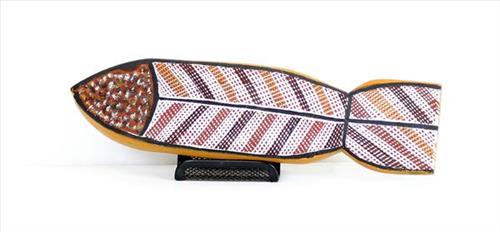
Birlmu or Namarnkorl (Barramundi)

It is well known that Aboriginal art often depicts images of sacred totems or dreamings of Aboriginal culture. However, the world of the non-sacred also provides a rich source of subject matter for Aboriginal art. Much of the rock art of western Arnhem Land for example features secular topics such as common food animals and plants, depicted because of their economic importance but also merely because of their existence in the environment. The artist has painted ‘birlmu’ or ‘namarnkorl’ (Barramundi [Lates calcarifer]). During the dry season the barramundi is an important food source for inland Aboriginal people. These fish are caught throughout the artist’s clan estate, either in fishtraps woven from pandanus or sedge grass, or else hunted with spears and fishing lines in billabongs and streams where they shelter from the sun under fallen logs or amongst the leaves of water plants.

377810582222352


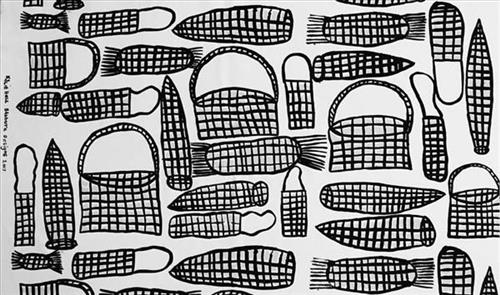
Gunga (Pandanus)

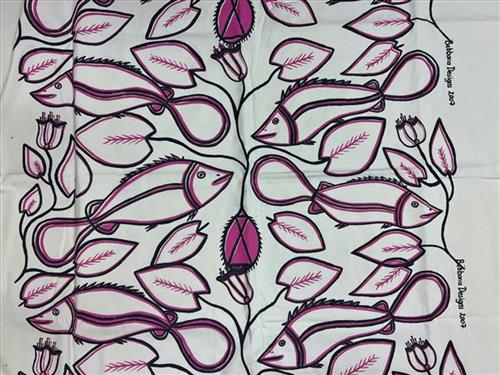
Gunga refers to the weaving and production of goods from pandanus leaves and natural fibres. This design depicts fibre art from her homeland Galiwinku, Elcho Island.

The fish trap, basket, string bag and pandanus mats are objects as well as ancestral spirits and are significant to the artists as together they relate to her djang (Aboriginal religious belief).

Fish traps are woven by hand using the milirl (Burney vine, Trophis scandens) from the jungle, which is soaked overnight to make it soft. Fish traps are used by both saltwater and freshwater hunters. Baskets and pandanus mats are made from pandanus leaves, which are collected using long hooks, stripped, dried, boiled in natural dye, then woven.

111982222348


Birlmu or Namarnkorl (Barramundi)

It is well known that Aboriginal art often depicts images of sacred totems or dreamings of Aboriginal culture. However, the world of the non-sacred also provides a rich source of subject matter for Aboriginal art. Much of the rock art of western Arnhem Land for example features secular topics such as common food animals and plants, depicted because of their economic importance but also merely because of their existence in the environment. The artist has painted ‘birlmu’ or ‘namarnkorl’ (Barramundi [Lates calcarifer]). During the dry season the barramundi is an important food source for inland Aboriginal people. These fish are caught throughout the artist’s clan estate, either in fishtraps woven from pandanus or sedge grass, or else hunted with spears and fishing lines in billabongs and streams where they shelter from the sun under fallen logs or amongst the leaves of water plants.

111982222346


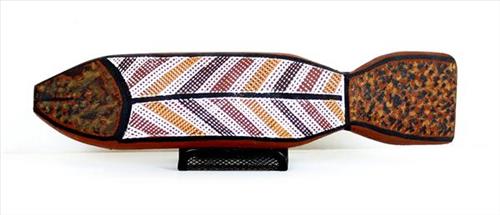
Ngaldadmurrng

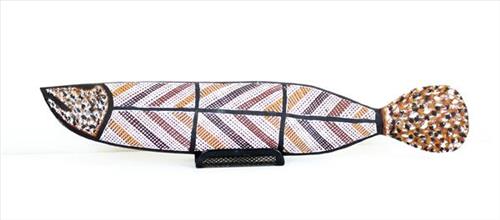
This is a painting of ngaldadmurrng ‘Saratoga fish’ (Scleropages jardini) sometimes also called the Northern Spotted Barramundi.

Saratoga are commonly found in creeks, rivers and billabongs around the artist’s clan estate. The animal depicted is on one level easy to recognise and it’s meaning is easily accessible. On a deeper level the animal is depicted with intense rarrk ‘cross hatched’ infill, which creates a reference to Mardayin ceremonial mysticism. 

Saratoga makes their nests on the bottom of riverbeds in the sand by digging with their tails and fins and lay eggs into these depressions. During mortuary rituals the Kuninjku imitate these nests in sand sculpture. At the end of funerals all those who have attended the funeral are required to stand in the ‘saratoga’s nests’ and they are doused with water to be cleansed from the polluting effects of the deceased. A large meteorite crater near Mumeka in the Liverpool River district is said to be the nest of the saratoga which now stands in the landscape as djang ‘a sacred site’. 

In painting this image Marawarr is continuing a long tradition of figurative artistic practice carried out by Arnhem Land.


111982222344


Ngaldadmurrng

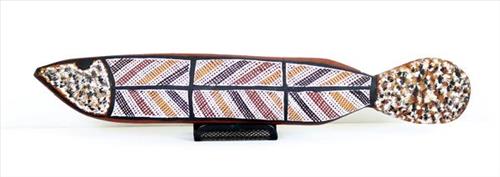
This is a painting of ngaldadmurrng ‘Saratoga fish’ (Scleropages jardini) sometimes also called the Northern Spotted Barramundi.

Saratoga are commonly found in creeks, rivers and billabongs around the artist’s clan estate. The animal depicted is on one level easy to recognise and it’s meaning is easily accessible. On a deeper level the animal is depicted with intense rarrk ‘cross hatched’ infill, which creates a reference to Mardayin ceremonial mysticism. 

Saratoga makes their nests on the bottom of riverbeds in the sand by digging with their tails and fins and lay eggs into these depressions. During mortuary rituals the Kuninjku imitate these nests in sand sculpture. At the end of funerals all those who have attended the funeral are required to stand in the ‘saratoga’s nests’ and they are doused with water to be cleansed from the polluting effects of the deceased. A large meteorite crater near Mumeka in the Liverpool River district is said to be the nest of the saratoga which now stands in the landscape as djang ‘a sacred site’. 

In painting this image Marawarr is continuing a long tradition of figurative artistic practice carried out by Arnhem Land.


111982222343


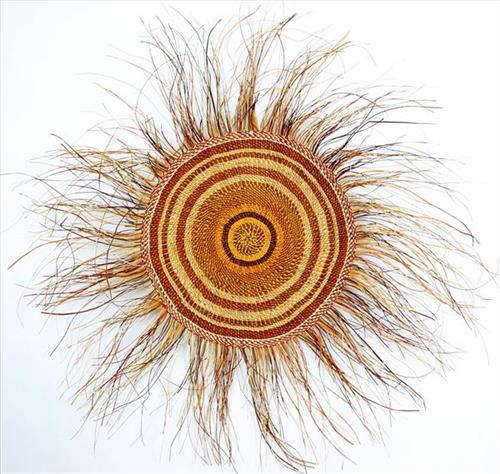
Mat

Mats can vary greatly. Artists commonly use a mix of naturally dyed and undyed fibre to create a striking variation of coloured bands. Some artists also incorporate different types of looping to produce different patterns and textured finishes. Each type of mat, fibre bag, basket and dilly bag has its own name in the various languages spoken in the Maningrida region.

377810582222341


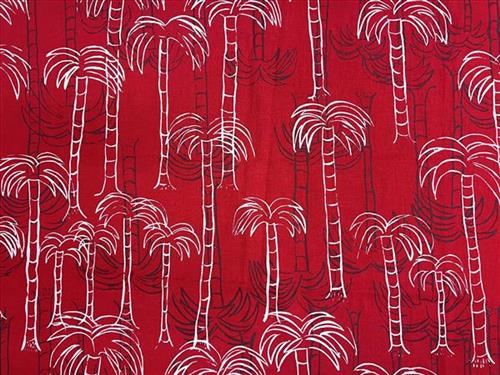
Ngarndúma (palm tree)

ngarndúma   1) a kind of tall palm tree with one straight trunk; Kentia palm. Gronophyllum ramsayi; Carpentaria acuminata. Gender: djíya; Moiety: Yírriddjanga. N A. Karlakkalóddjarra márdba ka-rénjdjeya. The new shoot is sweet. The growing tip of young palms eaten raw; large palms are not eaten. The fruits are toxic to people but eaten by fruit pigeons. 

111982222339


Ngaldadmurrng

This is a painting of ngaldadmurrng ‘Saratoga fish’ (Scleropages jardini) sometimes also called the Northern Spotted Barramundi.

Saratoga are commonly found in creeks, rivers and billabongs around the artist’s clan estate. The animal depicted is on one level easy to recognise and it’s meaning is easily accessible. On a deeper level the animal is depicted with intense rarrk ‘cross hatched’ infill, which creates a reference to Mardayin ceremonial mysticism. 

Saratoga makes their nests on the bottom of riverbeds in the sand by digging with their tails and fins and lay eggs into these depressions. During mortuary rituals the Kuninjku imitate these nests in sand sculpture. At the end of funerals all those who have attended the funeral are required to stand in the ‘saratoga’s nests’ and they are doused with water to be cleansed from the polluting effects of the deceased. A large meteorite crater near Mumeka in the Liverpool River district is said to be the nest of the saratoga which now stands in the landscape as djang ‘a sacred site’. 

In painting this image Marawarr is continuing a long tradition of figurative artistic practice carried out by Arnhem Land.