111982181656


Bush Jewellery – Necklace

The women of Maningrida and surrounding homelands use a combination of locally found seeds, bone and shells to make a variety of jewellery including necklaces. earrings and bracelets.  Many of the artists use complex patterns and designs to make their beautiful creations.

111982181654


Bush Jewellery – Necklace

The women of Maningrida and surrounding homelands use a combination of locally found seeds, bone and shells to make a variety of jewellery including necklaces. earrings and bracelets.  Many of the artists use complex patterns and designs to make their beautiful creations.

111982181652


Bush Jewellery – Necklace

The women of Maningrida and surrounding homelands use a combination of locally found seeds, bone and shells to make a variety of jewellery including necklaces. earrings and bracelets.  Many of the artists use complex patterns and designs to make their beautiful creations.

377810282174362


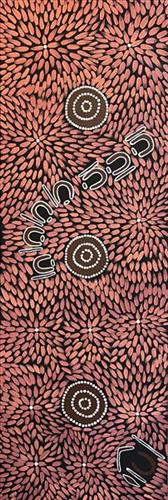
Kungkarangkalpa (Seven Sisters)

The Seven Sisters Creation Story is of great significance to the Pitjantjatjara and Yankunytjatjara people. The sisters travelled a long time ago through the artist’s traditional country in South Australia’s North West and the south west corner of the Northern Territory. 

A man called Wati Nyiru was chasing the sisters trying to court one of them. He used all kinds of trickery in pursuit of them but through the skill of the eldest, they always managed to keep one step ahead of him. The sisters finally escaped to a far away place so they could stay together safe from the clutches of Wati Nyiru. 

To this day the seven stars of the sisters followed by the bright star of Wati Nyiru following can be seen in the night sky in the constellations known as the Pleiades and Orion. 

Within the traditions of Tjukurpa or Creation Law are coded life survival skills. There is inma or ceremony for the Kungkarangkalpa in order to teach and celebrate; for people to learn where they fit within both the environment and social systems. 

Anangu feel strongly about continuing to teach and learn Tjukurpa and their art is important and vital work. It sustains them economically, physically and culturally. It keeps the stories and traditions alive. 

Walkatjara Art is the Aboriginal owned and governed art centre belonging to Mutitjulu community, located in the Uluru-Kata Tjuta National Park, NT.

www.facebook.com/walkatjaraart        www.walkatjara.com

377810282174359


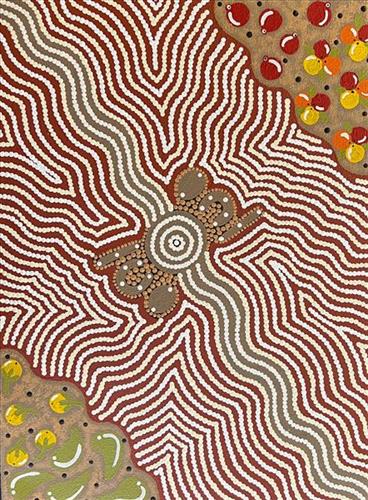
Mai Wiru (Bush Foods)

Minyma tjuta ankupai putikutu piti wanatjara. Paluru tjana mai kutjupa kutjupa tjuta mantjilpai tjitji tjutaku. Waltjangku wirura palyara nyinantjaku.’

The women go out into the bush with their bowls and digging sticks. They collect all sorts of bush foods for the children.

Some of the delicious fruits found out bush include:

Unturngu –  The bush banana. It is a slender creeper whose fruits are eaten raw when young, or baked when older.

Kaliny-Kalinypa – The honey grevillea is a hardy yellow desert flower that grows in sandy spinifex plains. The tasty honey-like nectar of the flower is often collected towards the end of the hot summer, and can be either mixed with water for a sweet cordial-like drink, or sucked straight off the plant!

Kampurarpa – The bush tomato plant, fruits after good rains and have a piquant spicy taste. They and can be eaten fresh from the bush or after they have dried and dropped to the ground. The dried fruits can also be ground and mixed with a little water to form a ‘fruit patty’. 

Mangata – The fruit of the Quandong tree (Santalum acuminatum). It is sometimes called bush peaches are sweet and deep red in colour when they are ready for picking in spring. The fruits have a hard seed inside which Anangu women paint beautiful designs on.  These are then used to make bracelet and necklaces. Traditionally the kernel inside this seed could be used both medicinally and as a hair conditioner.

Ili – The ili is a delicious, sweet fruit, very high in vitamin C. It can be found growing naturally around Uluru and in rocky gullies throughout the central desert. It can be easily spotted when the fruit turns yellow, but is ripe and ready to eat when it turns a deep purplish red. 

Arnguli – The flowers of the arnguli are small, creamy-white with four petals.The fruit which follow are olive-like, start off green, then change to purple then black as they ripen. They are flourish after rain and are an important bush food plant for Anangu. The fruit are eaten fresh or reconstituted in water if dry. Sometimes the kernels were roasted then ground to make an edible paste. The paste from the ground kernels was also used as a medical liniment.  Another use for the fruit is as a dye.

Tjanmata – Bush Onions-The small bulbs of the bush onion are baked in hot sand and ashes then eaten, once the papery covering (nyiri) is removed.

Anangu say that by painting and talking about bush foods it guarantees that supplies will be plentiful all year round!  
377810282174153


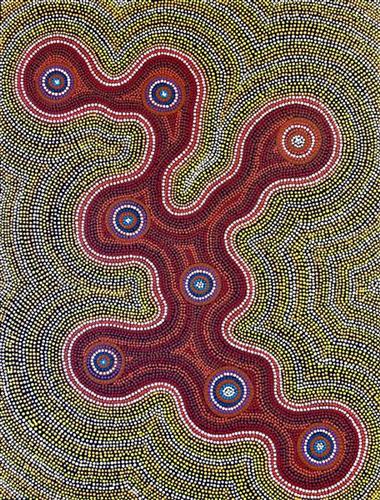
Kungkarangkalpa (Seven Sisters)

The Seven Sisters Creation Story is of great significance to the Pitjantjatjara and Yankunytjatjara people. The sisters travelled a long time ago through the artist’s traditional country in South Australia’s North West and the south west corner of the Northern Territory. 

A man called Wati Nyiru was chasing the sisters trying to court one of them. He used all kinds of trickery in pursuit of them but through the skill of the eldest, they always managed to keep one step ahead of him. The sisters finally escaped to a far away place so they could stay together safe from the clutches of Wati Nyiru. 

To this day the seven stars of the sisters followed by the bright star of Wati Nyiru following can be seen in the night sky in the constellations known as the Pleiades and Orion. 

Within the traditions of Tjukurpa or Creation Law are coded life survival skills. There is inma or ceremony for the Kungkarangkalpa in order to teach and celebrate; for people to learn where they fit within both the environment and social systems. 

Anangu feel strongly about continuing to teach and learn Tjukurpa and their art is important and vital work. It sustains them economically, physically and culturally. It keeps the stories and traditions alive. 

Walkatjara Art is the Aboriginal owned and governed art centre belonging to Mutitjulu community, located in the Uluru-Kata Tjuta National Park, NT.

www.facebook.com/walkatjaraart        www.walkatjara.com

111982174430


Mimih Spirit

The mimih spirit exists in a realm that runs parallel to and mirrors many facets of human life, also demonstrating the deep sense of time and place understood by Aboriginal and Torres Strait Islander people. Such spirits feature importantly in relation to Aboriginal spirituality, cosmology, social and moral tales as well as ritual. As is true with the multiple mediums employed by artists of West Arnhem Land, the development of artistic style and form is in line with an awareness by the artist that the work produced is predominantly made for a broader audience. Whether show in a national or international context these works communicate and exist in a particular space that is cross-cultural and simultaneously so particular to the Arnhem region.


The mimih sits within a complex and important pedagogical and religious body of knowledge which links Kuninjku people to their distinctive escarpment homelands. Young Kuninjku artists, or apprentices, employ the mimih as an important exercise for the practice of the rarrk technique, as it could be achieved on a smaller surface area before, being attempted in larger scale, on pieces of bark. The mimih serves a purpose for those young artists first learning to carve in a social space of sharing and innovating. The initial mimih manifestation was a large form that almost mirrored the anatomy of a human and at this stage the sculptures have been likened to morkuy carvings visible in eastern Arnhem Land. Contemporaneously, mimih are depicted in a refined, slender, even emaciated form with a broad range of facial expressions giving both individual character to, and denoting the potential volatility and humour that mimih spirits are notable for in their interaction with bininj (humans). The sculptures are frequently carved from the thin trunks of softwoods such as kapok (bombax ceiba or cottonwood) kurrajong, beach hibiscus or leichardt and are painted with earth pigments for their colouring and design.

A leading figure engaging the spirit in visual storytelling was Crusoe Kuningbal, a Kuninjku man, who while traveling was familiarised with carving styles from the east of Arnhem at the mission in Milingimbi pre-dating World War II. This showing a notable connection and interaction of different language groups across such space. As well as travel and the development of art forms being informed by cross cultural dialogues within northern Aboriginal language groups. The mimih became a valued inclusion in performance and public ceremony by Kuninjku people like Kuningbal. At times these ceremonies were performed for extended language groups in the local region.


Now a familiar and broadly depicted figure of iconography, it is important to acknowledge the development of this quite recent sculptural tradition. The depiction of this particular spirit being, once used as an addition to the sharing of song cycles and ceremony, has since been elevated to a prominent form and subject of contemporary sculpture. Variation in the creation of
mimih acts as an indication of the individualism of each artist and their stylistic markers. Additionally significant to note is that in the space of the past thirty years the mimih has begun being produced by multiple language groups residing in the Maningrida area including the traditional owners of Maningrida, the Ndjébbana, speaking Kunibidji as well as Gurrgoni people who have strong ties to Kuninjku.

________
*Maningrida Arts & Culture acknowledge the work of many academic and non-academic voices when writing on this topic, it is important to note Luke Taylor, who’s broad research has informed this text.

111982174428


Mimih Spirit

The mimih spirit exists in a realm that runs parallel to and mirrors many facets of human life, also demonstrating the deep sense of time and place understood by Aboriginal and Torres Strait Islander people. Such spirits feature importantly in relation to Aboriginal spirituality, cosmology, social and moral tales as well as ritual. As is true with the multiple mediums employed by artists of West Arnhem Land, the development of artistic style and form is in line with an awareness by the artist that the work produced is predominantly made for a broader audience. Whether show in a national or international context these works communicate and exist in a particular space that is cross-cultural and simultaneously so particular to the Arnhem region.


The mimih sits within a complex and important pedagogical and religious body of knowledge which links Kuninjku people to their distinctive escarpment homelands. Young Kuninjku artists, or apprentices, employ the mimih as an important exercise for the practice of the rarrk technique, as it could be achieved on a smaller surface area before, being attempted in larger scale, on pieces of bark. The mimih serves a purpose for those young artists first learning to carve in a social space of sharing and innovating. The initial mimih manifestation was a large form that almost mirrored the anatomy of a human and at this stage the sculptures have been likened to morkuy carvings visible in eastern Arnhem Land. Contemporaneously, mimih are depicted in a refined, slender, even emaciated form with a broad range of facial expressions giving both individual character to, and denoting the potential volatility and humour that mimih spirits are notable for in their interaction with bininj (humans). The sculptures are frequently carved from the thin trunks of softwoods such as kapok (bombax ceiba or cottonwood) kurrajong, beach hibiscus or leichardt and are painted with earth pigments for their colouring and design.

A leading figure engaging the spirit in visual storytelling was Crusoe Kuningbal, a Kuninjku man, who while traveling was familiarised with carving styles from the east of Arnhem at the mission in Milingimbi pre-dating World War II. This showing a notable connection and interaction of different language groups across such space. As well as travel and the development of art forms being informed by cross cultural dialogues within northern Aboriginal language groups. The mimih became a valued inclusion in performance and public ceremony by Kuninjku people like Kuningbal. At times these ceremonies were performed for extended language groups in the local region.


Now a familiar and broadly depicted figure of iconography, it is important to acknowledge the development of this quite recent sculptural tradition. The depiction of this particular spirit being, once used as an addition to the sharing of song cycles and ceremony, has since been elevated to a prominent form and subject of contemporary sculpture. Variation in the creation of
mimih acts as an indication of the individualism of each artist and their stylistic markers. Additionally significant to note is that in the space of the past thirty years the mimih has begun being produced by multiple language groups residing in the Maningrida area including the traditional owners of Maningrida, the Ndjébbana, speaking Kunibidji as well as Gurrgoni people who have strong ties to Kuninjku.

________
*Maningrida Arts & Culture acknowledge the work of many academic and non-academic voices when writing on this topic, it is important to note Luke Taylor, who’s broad research has informed this text.

111982174427


Mimih Spirit

The mimih spirit exists in a realm that runs parallel to and mirrors many facets of human life, also demonstrating the deep sense of time and place understood by Aboriginal and Torres Strait Islander people. Such spirits feature importantly in relation to Aboriginal spirituality, cosmology, social and moral tales as well as ritual. As is true with the multiple mediums employed by artists of West Arnhem Land, the development of artistic style and form is in line with an awareness by the artist that the work produced is predominantly made for a broader audience. Whether show in a national or international context these works communicate and exist in a particular space that is cross-cultural and simultaneously so particular to the Arnhem region.


The mimih sits within a complex and important pedagogical and religious body of knowledge which links Kuninjku people to their distinctive escarpment homelands. Young Kuninjku artists, or apprentices, employ the mimih as an important exercise for the practice of the rarrk technique, as it could be achieved on a smaller surface area before, being attempted in larger scale, on pieces of bark. The mimih serves a purpose for those young artists first learning to carve in a social space of sharing and innovating. The initial mimih manifestation was a large form that almost mirrored the anatomy of a human and at this stage the sculptures have been likened to morkuy carvings visible in eastern Arnhem Land. Contemporaneously, mimih are depicted in a refined, slender, even emaciated form with a broad range of facial expressions giving both individual character to, and denoting the potential volatility and humour that mimih spirits are notable for in their interaction with bininj (humans). The sculptures are frequently carved from the thin trunks of softwoods such as kapok (bombax ceiba or cottonwood) kurrajong, beach hibiscus or leichardt and are painted with earth pigments for their colouring and design.

A leading figure engaging the spirit in visual storytelling was Crusoe Kuningbal, a Kuninjku man, who while traveling was familiarised with carving styles from the east of Arnhem at the mission in Milingimbi pre-dating World War II. This showing a notable connection and interaction of different language groups across such space. As well as travel and the development of art forms being informed by cross cultural dialogues within northern Aboriginal language groups. The mimih became a valued inclusion in performance and public ceremony by Kuninjku people like Kuningbal. At times these ceremonies were performed for extended language groups in the local region.


Now a familiar and broadly depicted figure of iconography, it is important to acknowledge the development of this quite recent sculptural tradition. The depiction of this particular spirit being, once used as an addition to the sharing of song cycles and ceremony, has since been elevated to a prominent form and subject of contemporary sculpture. Variation in the creation of
mimih acts as an indication of the individualism of each artist and their stylistic markers. Additionally significant to note is that in the space of the past thirty years the mimih has begun being produced by multiple language groups residing in the Maningrida area including the traditional owners of Maningrida, the Ndjébbana, speaking Kunibidji as well as Gurrgoni people who have strong ties to Kuninjku.

________
*Maningrida Arts & Culture acknowledge the work of many academic and non-academic voices when writing on this topic, it is important to note Luke Taylor, who’s broad research has informed this text.

111982174409


Mimih Spirit

The mimih spirit exists in a realm that runs parallel to and mirrors many facets of human life, also demonstrating the deep sense of time and place understood by Aboriginal and Torres Strait Islander people. Such spirits feature importantly in relation to Aboriginal spirituality, cosmology, social and moral tales as well as ritual. As is true with the multiple mediums employed by artists of West Arnhem Land, the development of artistic style and form is in line with an awareness by the artist that the work produced is predominantly made for a broader audience. Whether show in a national or international context these works communicate and exist in a particular space that is cross-cultural and simultaneously so particular to the Arnhem region.


The mimih sits within a complex and important pedagogical and religious body of knowledge which links Kuninjku people to their distinctive escarpment homelands. Young Kuninjku artists, or apprentices, employ the mimih as an important exercise for the practice of the rarrk technique, as it could be achieved on a smaller surface area before, being attempted in larger scale, on pieces of bark. The mimih serves a purpose for those young artists first learning to carve in a social space of sharing and innovating. The initial mimih manifestation was a large form that almost mirrored the anatomy of a human and at this stage the sculptures have been likened to morkuy carvings visible in eastern Arnhem Land. Contemporaneously, mimih are depicted in a refined, slender, even emaciated form with a broad range of facial expressions giving both individual character to, and denoting the potential volatility and humour that mimih spirits are notable for in their interaction with bininj (humans). The sculptures are frequently carved from the thin trunks of softwoods such as kapok (bombax ceiba or cottonwood) kurrajong, beach hibiscus or leichardt and are painted with earth pigments for their colouring and design.

A leading figure engaging the spirit in visual storytelling was Crusoe Kuningbal, a Kuninjku man, who while traveling was familiarised with carving styles from the east of Arnhem at the mission in Milingimbi pre-dating World War II. This showing a notable connection and interaction of different language groups across such space. As well as travel and the development of art forms being informed by cross cultural dialogues within northern Aboriginal language groups. The mimih became a valued inclusion in performance and public ceremony by Kuninjku people like Kuningbal. At times these ceremonies were performed for extended language groups in the local region.


Now a familiar and broadly depicted figure of iconography, it is important to acknowledge the development of this quite recent sculptural tradition. The depiction of this particular spirit being, once used as an addition to the sharing of song cycles and ceremony, has since been elevated to a prominent form and subject of contemporary sculpture. Variation in the creation of
mimih acts as an indication of the individualism of each artist and their stylistic markers. Additionally significant to note is that in the space of the past thirty years the mimih has begun being produced by multiple language groups residing in the Maningrida area including the traditional owners of Maningrida, the Ndjébbana, speaking Kunibidji as well as Gurrgoni people who have strong ties to Kuninjku.

________
*Maningrida Arts & Culture acknowledge the work of many academic and non-academic voices when writing on this topic, it is important to note Luke Taylor, who’s broad research has informed this text.