111582122057


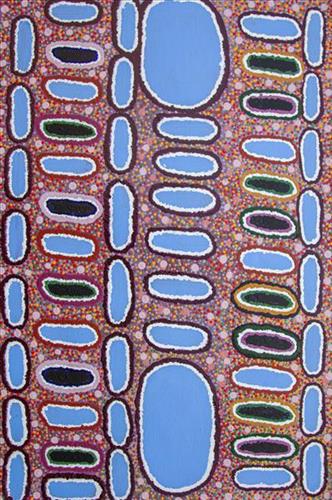
Parnngurr Rockhole

“Bugai [Whyoulter] told us to go back towards Parnngurr [with the intention of going into Jigalong mission], and we all went together along the track towards Parnngurr. In the afternoon we were going along, getting water for ourselves and walked over a sandhill. On the other side of the sandhill were a lot of vehicles: there was a bulldozer in front, then a grader and then several Land Rovers. We dropped everything and started to run. Old Man Biljabu [Jakayu’s husband] stopped and got ready to kill the whitefellas with his maparn [invisible power]. The whitefellas were waving in a friendly way and we all called out to Old Man Biljabu, “Stop! Stop! Don’t do it!” Jakayu and her husband started to walk towards the whitefellas. Everyone else followed behind them, starting to walk slowly.

We went and met the whitefellas and started talking to them, but they couldn’t understand us… The whitefella told us to go back to our camp and he would come and bring us food. After a time, he came and gave us a whole sheep, and some flour, sugar, bread and fruit. We threw the sheep away [for fear it might be poisoned] and left all the other food except for the sugar. We didn’t boil the sugar in the water with the tea, we just stirred it into warm water and drank it, like we did with bush tucker [edible botanical gum]. We used some of the flour to make a wet dough and drizzle it onto the ashes, the way we cooked seed damper. We didn’t finish eating the food – we just got up and went to Wiirnukurrujunu for pencil yams. We saw other Martu family groups pass by on the far side.

[Later, ] the whitefella followed us and found us where we were asleep… He went back to the mission to get Martu people who could translate. He went back to Jigalong and told Bob Ward, an old man, Sam Kelly’s father. He and Mr. Ward tracked us all the way to Yulpu and got there in the afternoon.

That day, everyone had gone hunting, and when we came back to our camp, there were four or five Land Rovers there. Mum had gone hunting early in the morning, carrying water with her. All us kids had gone west from Yulpu, and we had got one big goanna between all of us. When we came back in the afternoon, we saw that the whitefellas were in our camp, waiting for us. Us kids walked over slowly… When we came closer, Mr Ward opened a box and gave us blankets, clothes and food. He asked us where the others were, and we told him that they had gone over the hill. He told us to follow them and to call them back, and to come back all together and to wait at the road building camp. We agreed to do this. He told all us kids, “This is one blanket for all of you, you have to share it.” But we didn’t take the blanket. We kept walking with no clothes on, we left it there, no clothes, no blanket, didn’t even take the dresses.

We followed our parents over the hill… We spent the night with them and then went back to the place where we had been spotted [originally, at Parnngurr rockhole]. We waited there for the whitefellas to come back. When they arrived, they said that they had left their truck in between Parnngurr and Jigalong because it couldn’t go over the sandhills. The whitefellas were coming to get us in the Land Rover, taking three of us at a time, over to where the truck was waiting. From there they were carting all the people back to the truck. We all got in the truck and went right up to Old Jigalong, got there in the night time. That’s all.”

– Ngamaru Bidu, as translated by Ngalangka Nola Taylor

Parnngurr rockhole is located just south of Parnngurr Aboriginal community. This site lies within Ngamaru’s ngurra (home Country, camp), the area which she knew intimately and travelled extensively with her family in her youth. For many Martu, including Ngamaru, Parnngurr also signifies the location at which their nomadic bush life came to an end. Poignantly described here by Ngamaru, it was here that a group of 29 Martu were picked up by the Native Welfare Department to be taken to Jigalong Mission in 1963. Collectively the group had come to the decision to move to the mission as a result of an extended drought, which had caused a scarcity in food and water resources. The group also wanted to join their families, who had already moved to Jigalong.

At the junction of three linguistic groups; Manyjilyjarra, Kartujarra, and Warnman, Parnngurr rockhole was a critical and permanent source of water during the pujiman (traditional, desert born) era that supported many ritual large gatherings. During this nomadic period families stopped and camped here depending on the seasonal availability of water and the corresponding cycles of plant and animal life on which hunting and gathering bush tucker was reliant. At Parnngurr and other similarly important camp sites families would meet for a time before moving to their next destination. Parnngurr and its surrounds are physically dominated by distinctively red tali (sandhills), covered sparingly with spinifex and low lying shrub.

Parnngurr is also an important site chronicled in the epic Jukurrpa (Dreaming) story of the Jakulyukulyu, or Minyipuru (Seven Sisters). The sisters stopped to rest on Parnngurr Hill before continuing on their long journey east. Minyipuru is a central Jukurrpa narrative for Martu, Ngaanyatjarra, Pitjantjatjara and Yankunytjatjara people that is associated with the seasonal Pleiades star constellation. Relayed in song, dance, stories and paintings, Minyipuru serves as a creation narrative, a source of information relating to the physical properties of the land, and an embodiment of Aboriginal cultural laws. Beginning in Roebourne on the west coast of Western Australia, the story morphs in its movement eastward across the land, following the women as they walk, dance, and even fly from waterhole to waterhole. As they travel the women camp, sing, wash, dance and gather food, leaving markers in the landscape and creating landforms that remain to this day, such as groupings of rocks and trees, grinding stones and seeds. During the entirety of their journey the women are pursued by a lustful old man, Yurla, although interactions with other animals, groups of men, and spirit beings are also chronicled in the narrative.

377810582122223


Yawkyawk in Stone Country

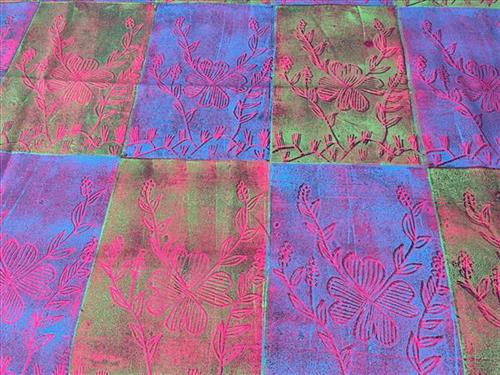
Yawkyawk is a word from the Aboriginal Kunwinjku/Kunwok language, meaning ‘young woman’ and ‘young woman spirit being’.

Sometimes compared to the European notion of mermaids, yawkyawks are usually depicted with the tails of fish. They have long hair, associated with trailing blooms of algae, typically found in Arnhem Land streams and rock pools.

White and gun metal ink on a bright light blue linen.

Hand Screen Printed by Publisher, Sydney Australia

377810582122222


Mandjabu (Fish Trap) – Susan Marawarr

“In old times people would make these mandjabu (fish traps) to go fishing. They are made with vine we find in the jungle. That old man, Anchor Gulunba, he showed me how to make these fish traps. I would sit there and watch him making them. We catch barramundi, catfish, all kinds of fish.” – Helen Lanyinwanga

Kuninjku people traditionally make two sorts of conical fish traps. One called mandjabu made from a vine called milil, and another smaller one called manylik mandjabu, made from the grass manylik. The mandjabu conical fish trap is bigger and stronger and used in tidal reaches of creeks to catch large fish. The smaller, lighter manylik trap is used in freshwater flowing creeks to catch smaller fish and freshwater prawns. Traditionally, only men were involved in the construction of the large fish traps, but children would often crawl inside and assist.

To make fish traps and fish net fences artists firstly get vine (milil) from the jungle and they put it in water for one night to make it soft. Next they start weaving it; they make rings for the inside to keep the fish trap’s shape. Artists work for three or four weeks on the fish trap. They also make string from kurrajong (burdaga) to attach the hibiscus (bardainy) rings and to tie the conical end of the fish trap. This fish trap is used in saltwater and freshwater. People also use fish net fences called mun-dirra. A long time ago they would put the mun-dirra across rivers and creeks. In the middle they would place the an-gujechiya. They also used small things like sticks, rocks, mud and grass to block the fish from going through. People would then catch fish like saltwater barramundi rajarra, freshwater barramundi (janambal), small black freshwater catfish (buliya), bonefish (an-guwirrpiya), and sand bass (dalakan) in these fish traps.

111582122466


Woman hunting Wantiji (Goanna)

Depicted in this work are animals hunted for bush tucker, their habitats, and different hunting methods. During the pujiman (traditional, desert dwelling) period, Martu would traverse very large distances annually in small family groups, moving seasonally from water source to water source, and hunting and gathering bush tucker as they went. Whilst desert life has moved away from mobile hunter-gatherer subsistence throughout the course of the twentieth century, bush tucker continues to be a significant component of the modern Martu diet. Hunting and gathering bush tucker remains equally valuable as an important cultural practice that is passed on intergenerationally.

Typically, animals hunted for their kuwiyi (meat) include kirti-kirti (euro kangaroo) and marlu (plains kangaroo), parnajarrpa (sand goanna), kipara (Australian bustard, bush turkey) and karlaya (emu). Lunki (witchetty grub) and wuukurta (honey ants) are dug from tree and bush trunks, or from underground nests. Tuulpara (spring) is considered by Martu as the principal hunting season, when resources are productive and the weather conducive to hunting activities requiring a high degree of stamina. 

Traditional tools used for hunting were carved from wanari (mulga), mulunturu (desert oak), yurungkura (river red gum) and mijarrpa (bloodwoods), and included kurlata (spears), jurna (hitting sticks), and karli (boomerangs). Today, animals are most typically hunted using vehicles and rifles. Nonetheless, carved objects retain enormous social and ceremonial importance in Martu life. Though hunting and gathering implements have been modernised, traditional methods of tracking and the use of fire burning to drive animals from their retreats are still commonly practiced today.

111582122455


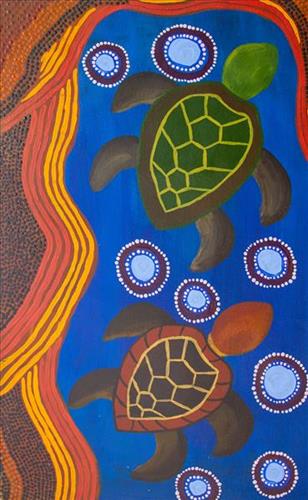
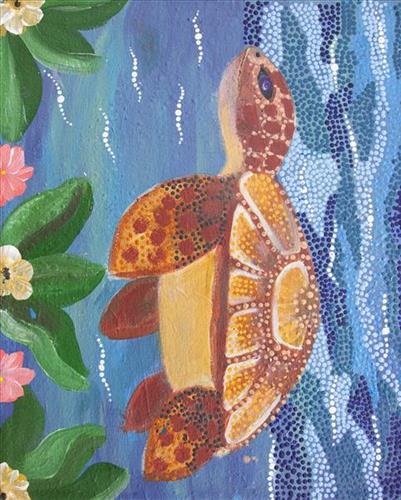
Reef Turtle

Bidyadanga is a community located on the Kimberley coast in Western Australia, where the Great Sandy Desert meets the sea. The word Bidyadanga is derived from pijarta/ bidyada (emu watering hole).

111582122450


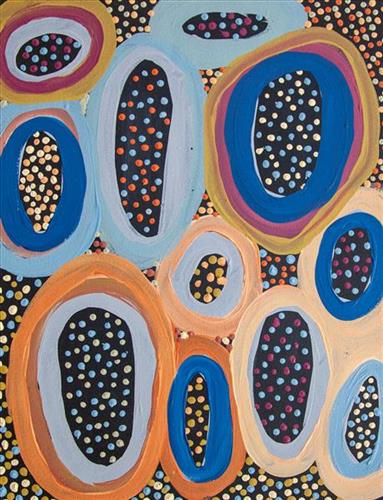
Dreaming of the Kapi (water)

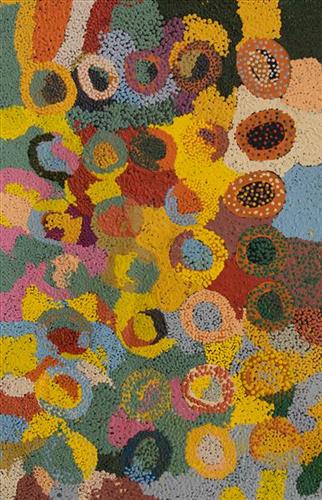
“This one here is a story form the Old Man [Wokka Taylor (dec.)]. It’s a story about bringing the kapi (water, rain). He told me this story, for me to tell now he’s gone. It was last year [2021], here in Parnngurr. We were sitting down in the ngurra (home), in the camp, and that old man he was singing, singing. Sitting down softly singing. I said, “hey Old Man, why you singing out there? For the kids?” You know I thought he was singing for the kids, to make them feel happy, make them laugh. Playing around [laughs]. But he said “No, I’m singing out for the kapi. Singing out for these clouds. Make him rain.” You know- fill up all the waterholes look after the Country. He was a Rain Maker that old fella, he knew this Country, could ask for the rains to come, fill everything up. Yeah, I’m painting this one here now for him, now he’s gone. Keep his stories going. Keep the kapi coming.”

– Emily Bumba, Parnngur 2022

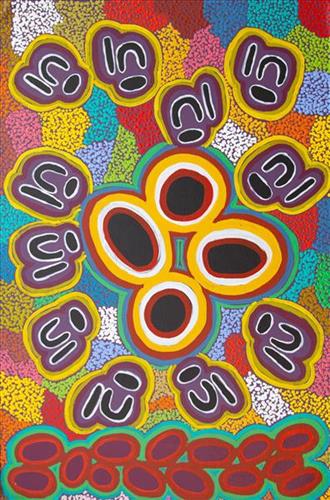
Depicted in this work are sources of kapi (water) within the artists’ ngurra (home Country, camp), typically represented with circular forms. During the pujiman (traditional, desert dwelling) period, knowledge of water sources was critical for survival, and today Martu Country is still defined in terms of the location and type of water. Each of the hundreds of claypans, rockholes, waterholes, soaks and springs found in the Martu desert homelands is known through real life experience and the recounting of Jukurrpa (Dreaming) narratives by name, location, quality and seasonal availability. This encyclopedic knowledge extends even to the nature and movement of arterial waterways, and sustained Martu as they travelled across their Country, hunting and gathering, visiting family, and fulfilling ceremonial obligations. They would traverse very large distances annually, visiting specific areas in the dry and wet season depending on the availability of water and the corresponding cycles of plant and animal life on which hunting and gathering bush tucker was reliant.

111582122363


Three Rockholes

This work depicts a waterhole within the artists’ ngurra (home Country, camp), typically represented with circular forms. Waterholes are sites that require maintenance, including digging to increase flow, clearing out surrounding growth, and cleaning up after sullying by camels or cattle.

During the pujiman (traditional, desert dwelling) period, knowledge of water sources was critical for survival, and today Martu Country is still defined in terms of the location and type of water. Each of the hundreds of claypans, rockholes, waterholes, soaks and springs found in the Martu desert homelands is known through real life experience and the recounting of Jukurrpa (Dreaming) narratives by name, location, quality and seasonal availability. This encyclopedic knowledge extends even to the nature and movement of arterial waterways, and sustained Martu as they travelled across their Country, hunting and gathering, visiting family, and fulfilling ceremonial obligations. They would traverse very large distances annually, visiting specific areas in the dry and wet season depending on the availability of water and the corresponding cycles of plant and animal life on which hunting and gathering bush tucker was reliant.

111582122361


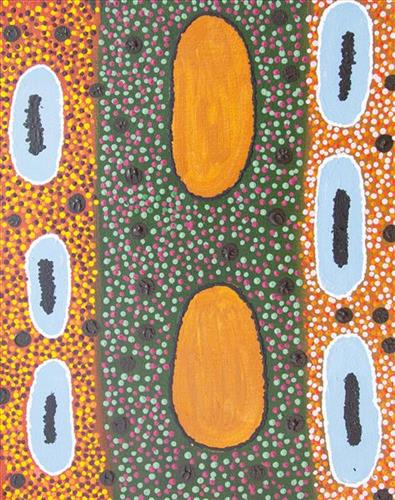
Wiirnukurrujunu

Wiirnukurrujunu is a spring located southeast of Parnngurr Aboriginal community. Described by Ngamaru is her first encounter with whitefells, occurring nearby. Shortly after this meeting Ngamaru, along with the other 28 Martu she had been travelling with, was picked up by the Native Welfare Department to be taken to Jigalong Mission in 1963. Collectively the group had come to the decision to move to the mission as a result of an extended drought, which had caused a scarcity in food and water resources. The group also wanted to join their families, who had already moved to Jigalong.

Wiirnukurrujunu also features as a site in two central Jukurrpa (Dreaming) narratives; Minyipuru (Jakulyukulyu, Seven Sisters) and Wati Kujarra (Two Goanna Men). The Wati Kujarra existed as half men, half goanna, and were responsible for the creation of many land features in Martu Country and beyond as they travelled, hunted and burned Country together. Wati Kujarra is a ngurlu (sacred, taboo) men’s story, and for this reason much of the content is only shared with initiated men. Minyipuru is an important Jukurrpa narrative for Martu, Ngaanyatjarra, Pitjantjatjara and Yankunytjatjara people that is associated with the seasonal Pleiades star constellation. Beginning in Roebourne on the west coast of Western Australia, the story morphs in its movement eastward across the land, following the women as they walk, dance, and even fly from waterhole to waterhole. As they travel the women camp, sing, wash, dance and gather food, leaving markers in the landscape and creating landforms that remain to this day. During the entirety of their journey the women are pursued by a lustful old man, Yurla.

111582122359


Reef Turtle

Bidyadanga is a community located on the Kimberley coast in Western Australia, where the Great Sandy Desert meets the sea. The word Bidyadanga is derived from pijarta/ bidyada (emu watering hole).