111982120764


Namarrkon the Lightning Spirit

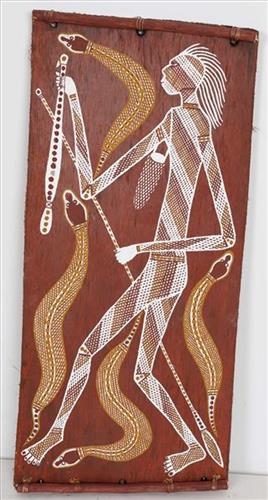
Namarden or Namarrkon are Eastern Kunwinjku names for the Lightning Spirit. This entity, which is responsible for lightning and thunder, is painted on both stone and bark in a form described as ‘like a grasshopper’. Namarrkon is said to have made Ngaldjurr – Leichardt’s or the spectacular grasshopper [Petasia ephippigera]. The species emerges, mates and is most active and visible in the season known as Kunemeleng, between October and December when there are intense electrical storms. Ngaldjurr is then said to be ‘looking for’ Namarrkon. Namarrkon makes lightning and thunder by striking out with kurlbburru – stone axes which protrude from its joints. Today, the Kuninjku will not leave axes lying out in the open during an electrical storm as the axes act as an attraction to the destructive force of Namarrkon. The lines emanating from Namarrkon’s head are said to be mardno or lightning bolts of power.

There is a dreaming site for the lightning spirit on the Liverpool River. The site, Kukkurrh, is a high undercut red gravel bank on a bend in the river. The rest of the country along the river is either flat grassy plains or thick mangrove forest. The red cliffs are in startling contrast to the rest of the landscape. The Kuninjku tell of a lightning man who grew angry and began making a terrifying and destructive storm. A lightning woman began to feel sorry for the human beings who were being killed by the storm. The man and woman stood as ‘cousin’ to each other in tribal relationship – this relationship between men and women is one of restraint and avoidance. When the lightning woman grabbed her cousin to calm him down he immediately became quiet and let people live. So it is today, say the Kuninjku, if a man is fighting and no one can calm him, he will become quiet if his cousin tries to restrain him
111982120763


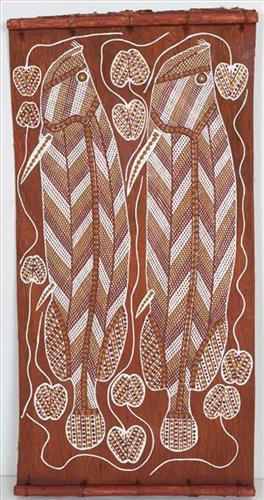
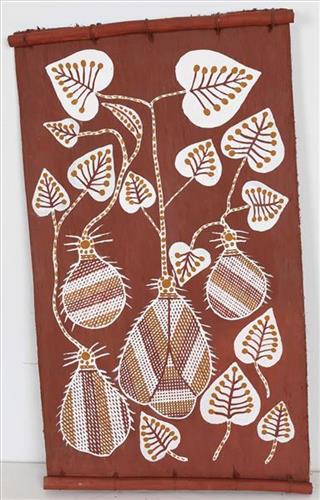
Man-ngalinj (bush potato)

Man-ngalinj is a root vegetable often described as ‘bush potato’. It’s duwa, the artist’s moiety. It has a bulbous root and a long thin vine with small flowers that grows across the ground or up the trunks of nearby trees. Large crops can be found near the artist’s outstation, Bolkdjam. Man-ngalinj are harvested after the Wet season in the early Dry

111982120761


Ngaldadmurrng

This is a painting of ngaldadmurrng ‘Saratoga fish’ (Scleropages jardini) sometimes also called the Northern Spotted Barramundi.

Saratoga are commonly found in creeks, rivers and billabongs around the artist’s clan estate. The animal depicted is on one level easy to recognise and it’s meaning is easily accessible. On a deeper level the animal is depicted with intense rarrk ‘cross hatched’ infill, which creates a reference to Mardayin ceremonial mysticism. 

Saratoga makes their nests on the bottom of riverbeds in the sand by digging with their tails and fins and lay eggs into these depressions. During mortuary rituals the Kuninjku imitate these nests in sand sculpture. At the end of funerals all those who have attended the funeral are required to stand in the ‘saratoga’s nests’ and they are doused with water to be cleansed from the polluting effects of the deceased. A large meteorite crater near Mumeka in the Liverpool River district is said to be the nest of the saratoga which now stands in the landscape as djang ‘a sacred site’. 

In painting this image Marawarr is continuing a long tradition of figurative artistic practice carried out by Arnhem Land.


111982121335


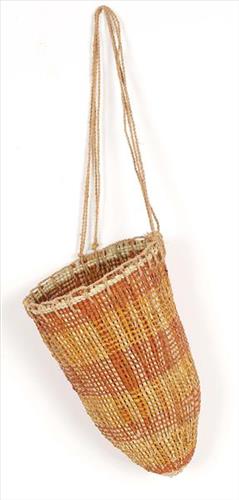
Burlupurr – large dillybag

Burlupurr, or dilly bag, is a large woven collecting basket. These large bags are often made from the vine ‘Malasia scandens’, a strong pliable plant which grows along the floor and into the canopy of monsoon vine thickets. The bags are used to collect any kind of large numbers of heavy foods such as fish caught in conical fish traps or large collections of yams.

They can also be made from Pandanus spiralis, a plant which grows in many areas of Arnhem Land. These dilly bags are a tightly woven collecting basket, very finely made. These dilly bags are often used to collect sugarbag, the native honey 

As well as being of practical use, dilly bags are also of religious significance to Arnhem Land people. Dilly bags are said to be totemic objects and associated with particular sites in the landscape.

111982121353


Gomarla (Egret bird)

The artist has carved the ‘Gomarla’, which in the Burarra word for Egret. This bird is native to the country of Yilan, which is the coastal region North West of Maningrida Community.