111982093122


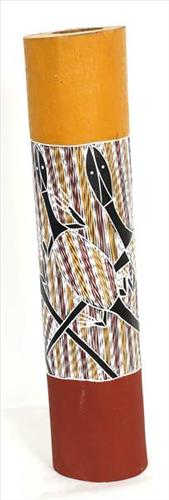
Lorrkon (Hollow Log)

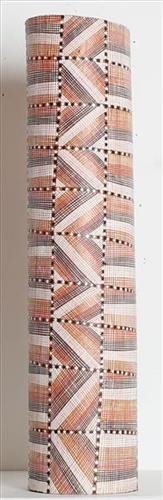
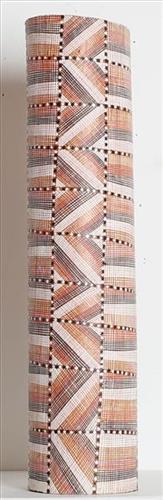
The Lorrkon or bone pole coffin ceremony was the final ceremony in a sequence of mortuary rituals celebrated by the people of Arnhem Land. This ceremony involves the placing of the deceased’s bones into a hollow log which was decorated with painted clan designs and ceremonially placed into the ground where it remained until it slowly decayed over many years.

The log is made from a termite hollowed Stringybark tree (Eucalyptus tetradonta) and is decorated with totemic emblems. The western Arnhem Land version of the Lorrkon ceremony involves the singing of sacred songs to the accompaniment of karlikarli, a pair of sacred boomerangs used as rhythm instruments. During the final evening of the ceremony, dancers decorate themselves with kapok down, or today, cotton wool and conduct much of the final segments of the ceremony in the secrecy of a restricted mens’ camp. The complete ceremony may stretch over a period of two weeks, but on the last night the bones of the deceased, which have been kept in a bark container or today wrapped in cloth and kept in a suitcase are taken out, are painted with red ochre and placed inside the hollow log. This ceremony may take place many years after the person has died.

At first light on the final morning of the Lorrkon ceremony, the men appear, coming out of their secret bush camp carrying the pole towards the women’s camp. The two groups call to each other using distinct ceremonial calls. The women have prepared a hole for the pole to be placed into and when it is stood upright, women in particular kinship relationships to the deceased dance around the pole in a jumping/shuffling motion. The Lorrkon is then often covered with a tarpaulin and left to slowly decay.
111982094946


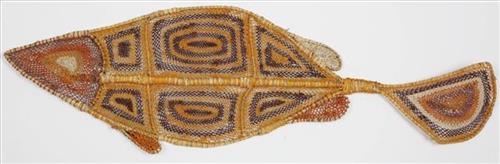
Birlmu or Namarnkorl (Barramundi)

It is well known that Aboriginal art often depicts images of sacred totems or dreamings of Aboriginal culture. However, the world of the non-sacred also provides a rich source of subject matter for Aboriginal art. Much of the rock art of western Arnhem Land for example features secular topics such as common food animals and plants, depicted because of their economic importance but also merely because of their existence in the environment. The artist has painted ‘birlmu’ or ‘namarnkorl’ (Barramundi [Lates calcarifer]). During the dry season the barramundi is an important food source for inland Aboriginal people. These fish are caught throughout the artist’s clan estate, either in fishtraps woven from pandanus or sedge grass, or else hunted with spears and fishing lines in billabongs and streams where they shelter from the sun under fallen logs or amongst the leaves of water plants.

111982094520


Gomarla (Egret bird)

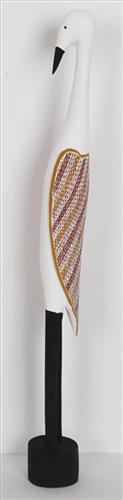
The artist has carved the ‘Gomarla’, which in the Burarra word for Egret. This bird is native to the country of Yilan, which is the coastal region North West of Maningrida Community. 

111982096980


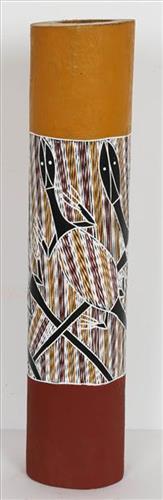
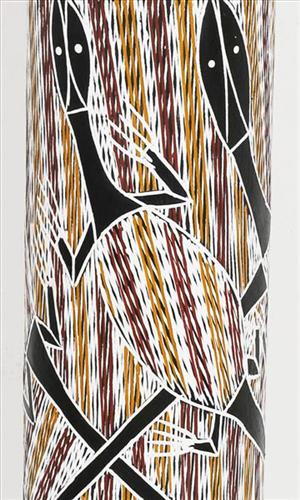
Wak Wak

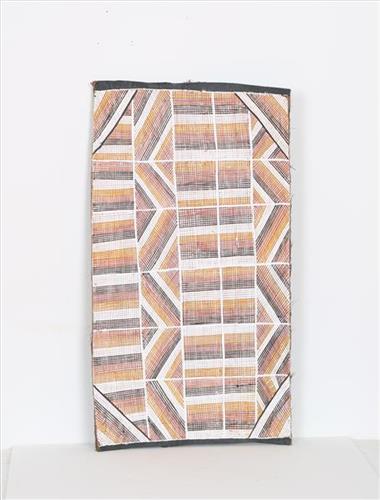
This painting depicts a sacred site at ‘Kurrurldul’, an outstation south of Maningrida.

The ‘rarrk’, or abstract crosshatching, on this work represents the design for the crow totem ancestor called ‘Djimarr’. Today this being exists in the form of a rock, which is permanently submerged at the bottom of Kurrurldul Creek. The ‘Djimarr’ rock in the stream at Kurrurldul is said to move around and call out in a soft hooting tone at night. Both the stone itself and the area around it are considered sacred.

The imagery represents the rock mentioned above at the bottom of Kurrurldul creek, which is the final transmutation of the dreaming ancestor ‘Djimarr’. Finally, the pattern used here is also the crow design used in the sacred ‘Mardayin’ ceremony, which is a large regional patri-moiety ceremony now rarely conducted in central and eastern Arnhem Land.

111982100940


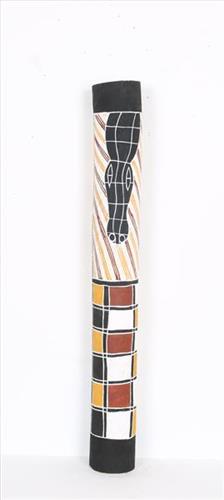
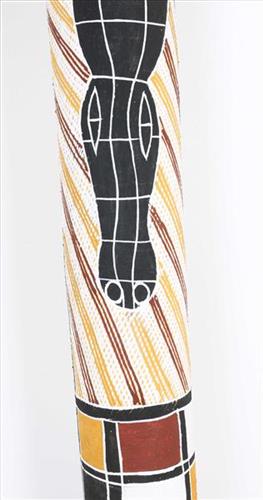
Kinga (Crocodile)

This is a painting of kinga, also known as namanjwarre, the saltwater crocodile (crocodylus porosus). These animals are totems for people of Yirridjdja moiety, one of the two patrimoieties of Arnhem Land aboriginal cultures. Crocodiles are rarely killed for food but their eggs are keenly sought after during the wet season when the females are nesting.

A major crocodile sacred site exists near the outstation of Kurrindin, in the Liverpool River district.

111982101347


Warraburnburn

In Burarra and Gun-nartpa languages the figure represented in this artwork is generally known as a wangarra ‘ghost spirit’. For the Warrawarra clan ghost spirits have their own particular characteristics and their own name – Warraburnburn.

The Warraburnburn and the closely related Galabarrbarr spirit (owned by the Balkarranga clan) are also manikay song topics.  The spirits are related to each other as maternal grandparent and grandchild, just as the people of Warrawarra and Balkarranga are. The dancing of the two ghost spirit figures forms the finale performance for funerals, and is the final goodbye to a deceased family member.

In many ways the Warraburnburn and Galabarrbarr ghost spirits are like people. They emerge from the patches of jungle on Warrawarra and Balkarranga country in the late afternoon and go hunting in family groups of men, women and children. They stay in contact with each other by calling out as the men hunt for fish and the women walk with their dillybags looking for vegetable food. 

The ghost spirits are associated closely with white ochre and artists commonly paint the bodies of carved figures in white. Different types of ghost spirit wear different patterns. Warraburnburn is decorated with uniform white dots while others are painted white all over. Some ghost spirits are shown with a design painted on their chest infilled with rarrk ‘cross-hatching’, the same designs that are painted onto japi an-guyinda ‘male initiations’. 

They also have supernatural characteristics including superhuman size (jarra anbaykarda ‘super tall’). They know the country intimately – some are malevolent towards humans and will lead people astray, taking them to unfamiliar and dangerous places. These malevolent spirits are likened to an-muburda ‘sorcerers’ and can conduct dangerous rituals that cause harm to people. Others are benign and will lead humans back to familiar paths and their own camps.


111982101874


Wak Wak

This painting depicts a sacred site at ‘Kurrurldul’, an outstation south of Maningrida.

The ‘rarrk’, or abstract crosshatching, on this work represents the design for the crow totem ancestor called ‘Djimarr’. Today this being exists in the form of a rock, which is permanently submerged at the bottom of Kurrurldul Creek. The ‘Djimarr’ rock in the stream at Kurrurldul is said to move around and call out in a soft hooting tone at night. Both the stone itself and the area around it are considered sacred.

The imagery represents the rock mentioned above at the bottom of Kurrurldul creek, which is the final transmutation of the dreaming ancestor ‘Djimarr’. Finally, the pattern used here is also the crow design used in the sacred ‘Mardayin’ ceremony, which is a large regional patri-moiety ceremony now rarely conducted in central and eastern Arnhem Land.

111982103249


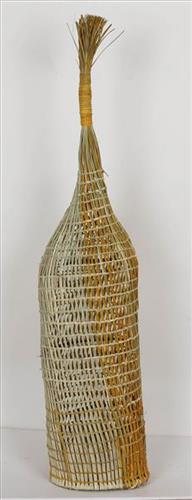
An-gujechiya (Fish Trap)

To make fish traps and fish net fences artists firstly get vine (mirlarl) from the jungle and they put it in water for one night to make it soft. Next they start weaving it; they make rings for the inside to keep the fish trap’s shape. Artists work for three or four weeks on the fish trap. They also make string from kurrajong (burdaga) to attach the hibiscus (bardainy) rings and to tie the conical end of the fish trap. This fish trap is used in saltwater and freshwater. People also use fish net fences called mun-dirra. A long time ago they would put the mun-dirra across rivers and creeks. In the middle they would place the an-gujechiya. They also used small things like sticks, rocks, mud and grass to block the fish from going through. People would then catch fish like saltwater barramundi rajarra, freshwater barramundi (janambal), small black freshwater catfish (buliya), bonefish (an-guwirrpiya), and sand bass (dalakan) in these fish traps.