111580587219


Untitled

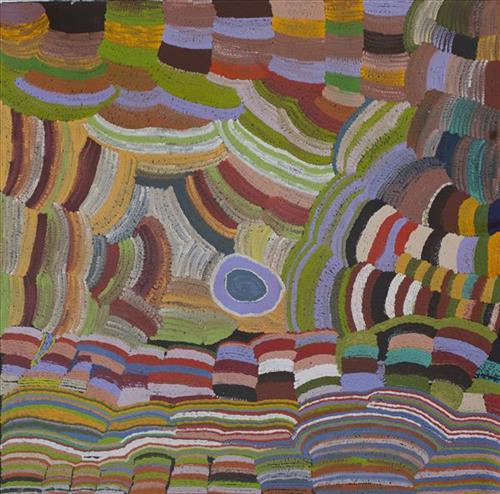
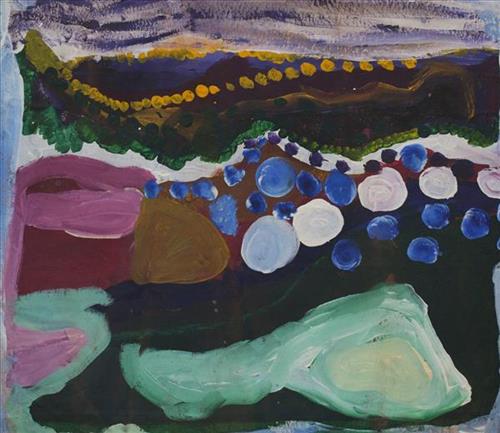
This is Wurta Amy French’s Country- her ‘ngurra’ (home Country, camp). People identify with their ngurra in terms of specific rights and responsibilities, and the possession of intimate knowledge of the physical and cultural properties of one’s Country. Painting ngurra, and in so doing sharing the Jukurrpa (Dreaming) stories and physical characteristics of that place, has today become an important means of cultural maintenance. 

Wurta’s ngurra encompasses the Country that she and her family walked in the pujiman (traditional, desert-dwelling) era. At this time Wurta travelled nomadically with her own and other family groups. The Country they traversed encompassed an enormous tract of land, all around the Karlamily (Rudall River) region and through to Tiwa (Canning Stock Route Well 26) .

Wurta was born at Wantili (Warntili, Canning Stock Route Well 25). She grew up, walked and hunted primarily around water sources Pangkartal, Yalpalpa, Walirrlirri, Yanytikuji, Wartararra, Tintinmarran, Pimurlu, Raarki (Canning Stock Route Well 27), and Tiwa. Her family continued to live nomadically before eventually deciding to move to Jigalong Mission along with many other relatives following an extreme and prolonged drought in the 1960s. 

Portrayed in this work are features of Wurta’s ngurra, such as the hills, gorges and valleys, warta (trees, vegetation), and the individually named water sources she and her family camped at. Rock holes, waterholes, soaks and springs were all extremely important sites for Martu people during the pujiman period, and are generally depicted with circular forms. 

The encyclopaedic knowledge of the location, quality and seasonal availability of the hundreds of water bodies found in one’s Country sustained Martu as they travelled across their Country, hunting and gathering, visiting family, and fulfilling ceremonial obligations. They would traverse very large distances annually, visiting specific areas in the dry and wet season depending on the availability of water and the corresponding cycles of plant and animal life on which hunting and gathering bush tucker was reliant. As they travelled and hunted they would also burn areas of Country, generating a greater diversity of plant and animal life.
221776385675


Jillynbeng

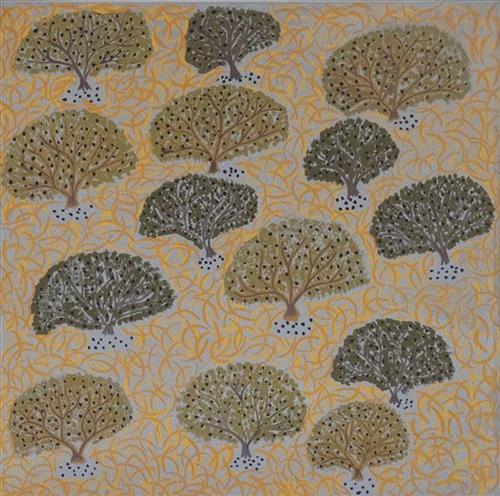
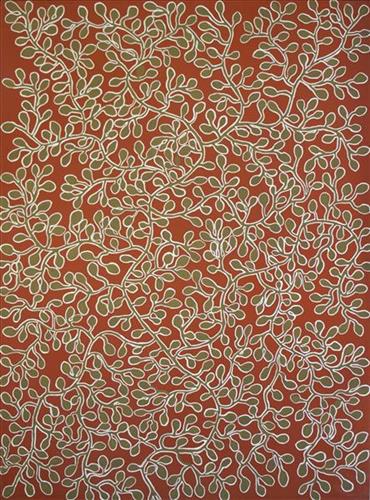
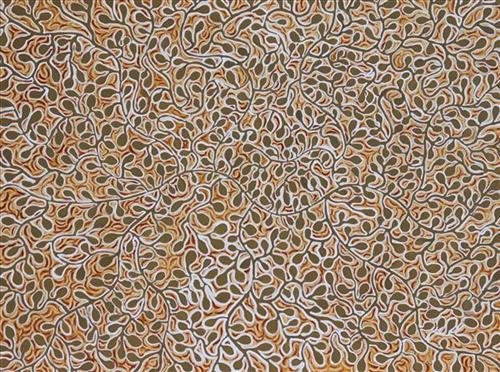
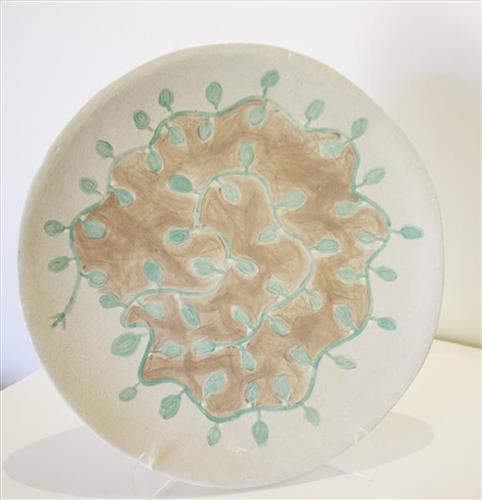
In this artwork Peggy has depicted a bush tucker known as Jilinybeng or “bush cucumber”. This plant grows as a vine and you have to search for it amongst the grasses. Typical of the artist’s recent work the background is flecked with strokes of paint representing the spinifex and grasses being blown by the wind. For the artist this movement of the grasses as the wind blows across the country is evidence that the spirit of culture is alive because “you can see it.” The bush lemon fruit is a grey/green colour that ripens in the wet season and is collected either from the vine directly or on the ground where the fruit has dropped. “This fruit can be eaten when raw but if you eat too much it makes your tongue bright red and hurts your lips. You can also boil the fruit and drink the liquid.  Jilibnybeng is very good for you because it is high in Vitamin C.”

111581637506


Untitled

“This is my Country. My little brother was born here in pujiman (traditional, desert-dwelling) times. I was a big girl, no man yet. We were walking a long way. In the painting you can see the tali (sand hills) and the burning Country.”

– Nyanjilpayi (Ngarnjapayi) Nancy Chapman

This is Nyanjilpayi’s Country- her ‘ngurra’ (home Country, camp). People identify with their ngurra in terms of specific rights and responsibilities, and the possession of intimate knowledge of the physical and cultural properties of one’s Country. Painting ngurra, and in so doing sharing the Jukurrpa (Dreaming) stories and physical characteristics of that place, has today become an important means of cultural maintenance. 

Nyanjilpayi’s ngurra encompasses the Country that she and her family walked in the pujiman  era. Nyanjilpayi was born at Jarntinti, a large claypan at the southern end of Nyayartakujarra (Lake Dora) and within the Karlamilyi (Rudall River) region. She grew up, walked and hunted primarily around the Country extending across the Punmu, Kunawarritji (Canning Stock Route Well 33) and Karlamilyi (Rudall River) regions. Following the death of both their parents, Nyanjilpayi and her sisters travelled alone between Punmu and Kunawarritji, occasionally meeting with other family groups. They continued to live nomadically before eventually deciding to move to Jigalong Mission along with many other relatives following an extreme and prolonged drought in the 1960s. 

Portrayed in this work are features of Nyanjilpayi’s ngurra, such as the dominant permanent red tali (sandhills), warta (trees, vegetation), and the individually named water sources she and her family camped at. These include Jarntinti, Yaralalu, Januwa, Jilankujarra, Karlajarntu, Kartungu, Kularti, Kumpupajanu, Kunalimpi, Kunarra, Marnakarti, Pangkapirni, Wilunganinya, Wurur-wururna, Yilyara, and Yirrajarra Rock holes, waterholes, soaks and springs were all extremely important sites for Martu people during the pujiman period, and are generally depicted with circular forms. 

The encyclopaedic knowledge of the location, quality and seasonal availability of the hundreds of water bodies found in one’s Country sustained Martu as they travelled across their Country, hunting and gathering, visiting family, and fulfilling ceremonial obligations. They would traverse very large distances annually, visiting specific areas in the dry and wet season depending on the availability of water and the corresponding cycles of plant and animal life on which hunting and gathering bush tucker was reliant. As they travelled and hunted they would also burn areas of Country, generating a greater diversity of plant and animal life.
222281950398


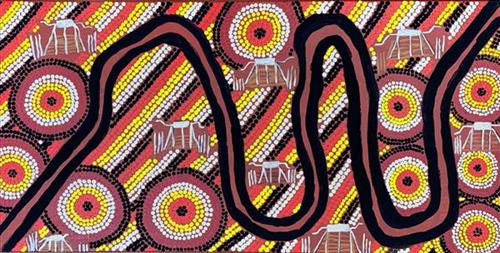
Well on Number 6

This painting depicts the story of the Well number 6 where cattles and bullocks were rested for their riders to pump out water. The journey was to bring the bullocks from Halls Creek.

221782093144


Jilinybeng

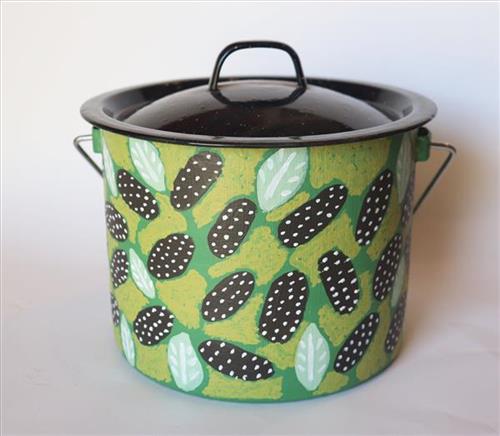
In this artwork Peggy has depicted a bush tucker known as “bush cucumber”. This plant grows as a vine and you have to search for it amongst the grasses. The bush cucumber, more like a bush lemon fruit, is grey/green in colour and ripens in the wet season.  It is collected either from the vine directly or on the ground where the fruit has dropped. “This fruit can be eaten when both unripe and ripe, but if you eat too much it makes your tongue bright red and hurts your lips.”

111982105409


Djomi

There are two Dreaming ladies at Bábbarra billabong – Djómi and Bábbarra. These two are sisters: one freshwater ‘mermaid’ and one saltwater one. Big long head, big stomach and very skinny legs that Bábbarra.

Their mother is the crocodile who lives in the Bábbarra billabong.

Both sisters will give people babies through the drinking water at Bábbarra. That’s why men stay away and Bábbarra is a sacred women’s site. Too strong our Dreaming – even men can get that baby in their tummies!

When it rains at Bábbarra, or when a cyclone comes, it’s because our Dreaming is too strong. There are lots of women spirits. When the storms come, the spirits go in the underground rivers and hide safely.

If you go fishing in our country, you have to be careful not to catch the Bábbarra and Djómi ‘mermaids’. Some people catch them thinking they are barramundi, but they are actually the ‘mermaid’ spirits. You will know, because they have white hair.

Lena Djabibba, djungkay (mother’s country and ceremonial manager of Bábbarra) and Joy Garlbin (landowner for Bábbarra)

Text courtesy of Bábbarra Women’s Centre copyright 2017