111581652868


Warralong

Doreen first learned to paint alongside her mother, beginning her artistic career with Martumili Artists in March 2009 when she and the other women of Punmu painted a large collaborative artwork to raise funds for the community. Doreen is now an established artist in her own right, known for her loose, uninhibited painting style. As a deaf woman, painting is an important means of communication and expression for Doreen. As a deaf woman, painting is an important means of communication and expression for Doreen.

Doreen likes to paint the comings and goings of community life- the motorcars, aeroplanes and critters that populate her homes of Warralong, Punmu and Port Hedland.

111981655514


Bamagora

A ‘bamagora’ is a Burarra word for a traditional woven tent-like structure. A bamagora was woven to create a shelter for a child or adult when sleeping.

111981692774


Wyarra

Wayarra/Wyarra is a spirit in the darkness that makes people very frightened. It is unseen but you feel scared when he is near you. It is something that you can’t normally see; but you can see skeleton shapes of the Wayarra/Wyarra if you are a witch doctor. It floats around at night and can appear as a floating white skeleton. They take their skin off to wash. These spirits can be frightening in appearance, however they usually stay away from humans.
A result of being a ‘clever man’ or a traditional healer, is they can commune with the Wayarra/Wyarra. It is also believed that the Wayarra/Wyarra can endow humans with the power to heal.

The ghost-like spirits are an integral part of Aboriginal cosmology in the western and central parts of Arnhem land. Some of the clans have the Wayarra/Wyarra as their clan totem and there are also dreaming sites for Wayarra/Wyarras and if you break or move rocks on those sites, there will be Wayarra/Wyarras everywhere. Wayarra/Wyarras prefer darkness.
Arnhem land is divided into clans or moieties. All living things, lands, clans, people, the natural and supernatural are classed as either one or the other of two moieties in Kununjku. duwa or yirridjdja. The duwa patrimony Wayarra cant walk around if the moon is shining. If they see the thin crescent just after the new moon, they have to put their heads down so they cant see the moon or their necks break. The yirridjdja patrimoiety Wayarra behave differently, they can walk about anytime.

You can hear them calling at night sometimes, they sound like the Curlew or they may even visit you! They look after you if you are lost by yourself. They can even follow you home until you are close to your home before they let you go.

111581711123


Untitled

This painting portrays physical elements of Martu Country, such as the dominant tali (sandhills), warta (trees, vegetation), and water sources. Rock holes, waterholes, soaks and springs were all extremely important sites for Martu people during the pujiman (nomadic bush) era, with many important jukurrpa (dreamtime stories) chronicling the creation of these landmarks. In the past the Martu lived nomadically, moving from water source to water source, and hunting and gathering bush tucker as they went. They would traverse very large distances annually, visiting specific areas in the dry and wet season depending on the availability of water. As they travelled and hunted they would also burn areas of country creating a larger diversity of plant and animal life.

111581733969


Chinaman Pool

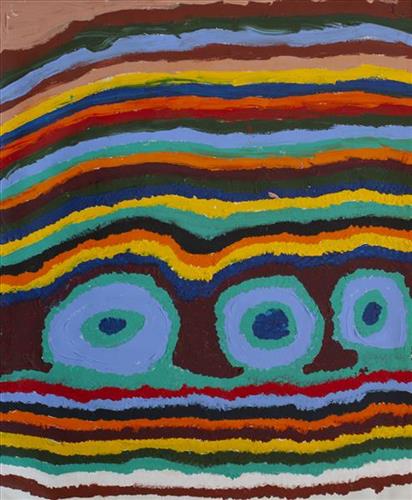
This work depicts a waterhole within the artists’ ngurra (home Country, camp), typically represented with circular forms. Waterholes are sites that require maintenance, including digging to increase flow, clearing out surrounding growth, and cleaning up after sullying by camels or cattle.

During the pujiman (traditional, desert dwelling) period, knowledge of water sources was critical for survival, and today Martu Country is still defined in terms of the location and type of water. Each of the hundreds of claypans, rockholes, waterholes, soaks and springs found in the Martu desert homelands is known through real life experience and the recounting of jukurrpa (dreamtime) narratives by name, location, quality and seasonal availability. This encyclopedic knowledge extends even to the nature and movement of arterial waterways, and sustained Martu as they travelled across their Country, hunting and gathering, visiting family, and fulfilling ceremonial obligations. They would traverse very large distances annually, visiting specific areas in the dry and wet season depending on the availability of water and the corresponding cycles of plant and animal life on which hunting and gathering bush tucker was reliant.

111581733963


80 Mile Tuwa

The traditional lands of the Martu people encompass the Great Sandy Desert and Rudall River regions of Western Australia, an enormous tract dominated by distinctive red tali, or tuwa (sandhills). These sandhills present an unforgiving landscape; sparse vegetation covers a seemingly never ending expanse of dunes, and yet these lands and the location of resources within them was known intimately by its pujiman (traditional, desert dwelling) inhabitants. At this time, Martu traversed very large distances annually in small family groups, moving from water source to water source through the harsh desert landscape with incredible stamina and resourcefulness. Travel was often undertaken at night, and when travelling during the day, Martu wore yakipiri (woven bark sandals) to protect their feet from the hot desert sand.

111981832139


Ngalkodjek Yawkyawk

This artwork depicts the Ngalkodjek Yawkyawk of Barrihdjowkkeng country.

“This story is very old. That old man [my father Crusoe Kuningbal] when he was alive, told that story to me, to all of us. He told us about the yawkyawk (mermaid) spirit women called Ngalkodjek who lives in the billabong on my country. He told us how they call out loudly, how they call out as they walk along.

That is what they do, calling out. They walked around eating bush foods like those little bush yams. They would pound the yams into a pulp and eat them. That is their traditional food which they eat.

When they walk down from the bush, they follow a set path that belongs to them and they walk along calling out. That is their path which they take. It is an old traditional route.

They placed a woman’s breast into the country. That rock was not there originally, but it was a woman’s breast. It is the breast of those women.

They put that djang [sacred place] there, and then at the time when non-Aboriginal people arrived in the region, then the breast turned to stone. Now it has turned solid into rock.”

– Owen Yalandja

111981881844


Djulng

The bones are Djulng at Naborlkabotme. Djulng refers to the bones of dead Ancestral beings. There are some in a hole in the rock at this place.

111581934983


Katjarra (Kadjarra, Kajarra, Carnarvon Range)

“In the Jukurrpa (Dreamtime) the yalapara (perentie goanna) was walking around here, travelling around my grandfather’s Country. This is his Jukurrpa, [and] so was the jila (snake), Katjarra, who brings the kapi (rain). He lives in a rockhole in this Country, at the top [of the mountain range], where there is a waterfall. It’s in the heart of Birriliburu. In the pujiman (traditional, desert dwelling)] days the old people went to Katjarra to sing out to bring down the water. 

This was the camping ground for the old people, they used to stop here, all of the families. This is Atkins’ and Kadibil family’s Country. Atkins and Kadibils would camp with each other; other families would visit us here. The old people would come around looking for water. They would call out to the snake to send down the water. They would have to call in Putijarra language, as this is the only language the snake knows. When you talk to him, he sends the water down. We had good water here, we had a drink out of it”.

 – Miriam Atkins

Katjarra (Carnarvon Range) mountain ranges are part of Miriam’s ngurra (home Country, camp). The mountain range, distinctive from a distance for its blue hue, is located in the south western corner of Birriliburu Indigenous Protected Area. This region lies at the southern end of Martu Country and at the intersection of the Little Sandy and Gibson Deserts of Western Australia. Katjarra was an important camping place for Martu walking between Jigalong and Wiluna for law business up until the late 1960s, as well as Martu who walked the Canning Stock Route into Wiluna. Katjarra was also the site of the 2008 Birriliburru Native Title Determination, one of the first land grants to Martu. 

Within the Katjarra mountain range are many water sources, including a culturally significant creek close to Milyinirri (Canning Stock Route Well 6), also named Katjarra. This creek is home to a rainmaking jila, as described by Miriam. Its waters cascade down the hill from here. The Western Desert term jila is used interchangeably to describe springs considered to be ‘living’ waters and snakes, both of which play a central role in Martu culture and Jukurrpa. During the pujiman period, knowledge of water sources was critical for survival, and today Martu Country is still defined in terms of the location of water sources. Of the many permanent springs in Martu Country, very few are ‘living waters’; waters inhabited by powerful ancestral snakes. Before they became snakes, these beings were men who made rain, formed the land and introduced cultural practices like ceremonies and ritual songs. Some of the men travelled the desert together, visiting one another, but they all ended their journeys at their chosen spring alone, transformed into a snake. These important springs, like Katjarra, are named after their jila inhabitant.

Katjarra also features as a site in the Minyipuru (Jakulyukulyu, Seven Sisters) Jukurrpa, and that of the yalapara, the ancestral goanna being described by Miriam who was responsible for the creation of many significant land features in the area.