Sea Turtle
Turtles roam the sea as family every year even when the times to find land to hatch their young on the beach
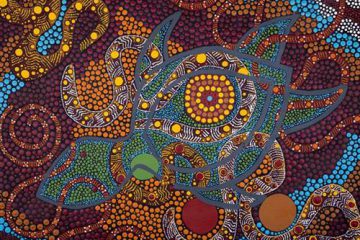
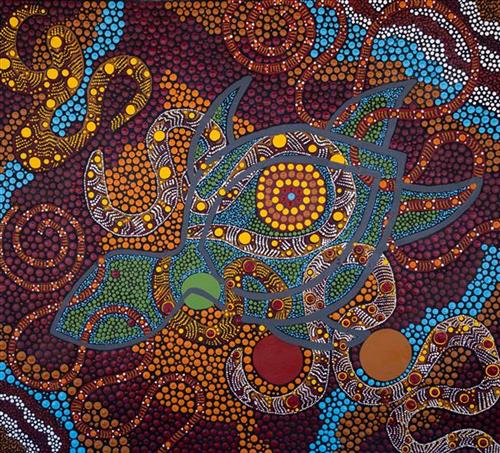
Turtles roam the sea as family every year even when the times to find land to hatch their young on the beach

Status: Stock
Hand painted earrings made with polymer and acrylic paint or posca pen. Note that earrings will vary in colour and design as this item is individually handmade.
“Wanti Yuu (Woman Yeah!) is a story of resilience and of women coming together. It is about the strength of the women in our community who put themselves last and take on a lot. She [Wanti Yuu] is someone who looks after her family, putting the grand kids and everyone around her first. The word Matriarch comes to mind. They are the matriarch of the family. The Boss Lady. Always helping everyone else out and leaving herself to the end. She paints, she teaches us her knowledge, like basket weaving and honey ant collecting. She is the top lore woman and her story of Pujiman (traditional, desert dwelling) is so important. She is a leader of the Martu women and a senior artist. That’s all I can say about these women. These women; you give her the bread if you know what I mean. It’s a true story. Anything in my pockets. Because when you look at her, her stance, her energy and her vibe, you can feel it. You don’t muck around with Wanti Yuu.”
-Silvia Wilson
Wanti Yuu celebrates women’s resilience, matriarchal relationships, and Sylvia’s place in this story.
As Sylvia explains, the work is both a depiction of, and attribute to, the women in her life. “I follow my great grandmother’s guidance and direction in life. These women in my life carry so much on their shoulders, as well as the responsibility and future of our culture.”

Status: Stock
Trinket jewellery hand made by Martumili Artists using beads, wood and found bush nuts.

Status: Stock
Trinket jewellery hand made by Martumili Artists using beads, wood and found bush nuts.

Status: Stock
Trinket jewellery hand made by Martumili Artists using beads, wood and found bush nuts.
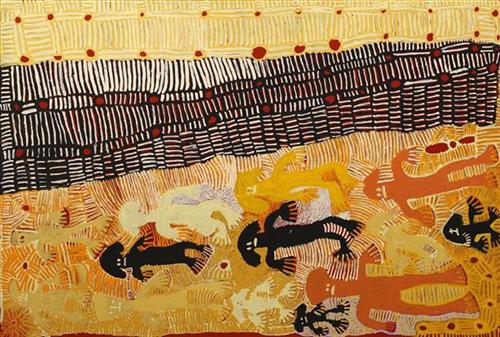
This work is about both a memory Doris has and a Tjukurrpa (dreaming) story, of a place called Nyunmanu. Doris lived here for many years.
The memory is ‘Anangu tjuta at Nyunmanu’ – lots people living in a cave. Watis (men), kungkas & pipirri (children). There is lots of minkulpa (bush tobacco) growing in this cave. Older kungkas are telling young kungkas to dance. Snakes and goannas were speared and eaten as a meal. Everyone is taking minkulpa and sleeping heavy.
Another memory Doris has of this place, is her and her husband walking a very long way to this place. They were looking for water but could not find any and her husband got sick in this cave. They didn’t have a fire, it was too dangerous. Doris says ‘this place can make you go mad’.
Nyunmanu is a Dingo Tjukurrpa site just to the south east of the remote Aboriginal community of Kintore in the Northern Territory. Most of the dingoes and their pups from this place rose up into the sky and became stars. However, the ancestral mother Dingo and her pup had gone out hunting and were too tired to rise up, so they turned into a large rock that marks the place of this sacred Dreaming.
It is said that if you sleep in this place you will dream of the ancestral dingo puppies. The story goes that if you remove one of the gleaming stones found at Nyunmanu, the puppies will haunt your dreams until you return it to the place where it belongs. The custodians of this Tjukurrpa are Nungarrayi, Tjungarrayi, Napaltjarri and Tjapaltjarri women and men.
The circles in this story often represent important waterholes. The roundels extending from the circles are the designs the women paint on their breasts during ceremony.
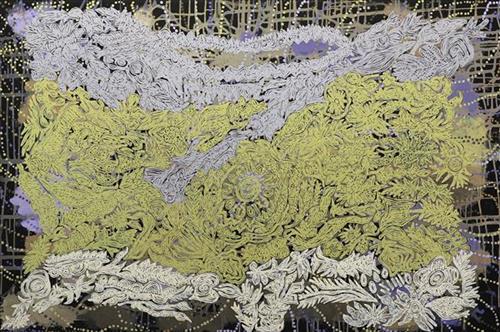
The painting depicts designs associated with Kapi Tjukurrpa (Water Dreaming) at Kalipinypa a site northwest of Sandy Blight Junction, Western Australia.The Tjukurrpa tells of an important rain making ceremony to invoke the elements. It is a powerful storm bringing on the lightning, thunderclouds and rain sending its deluge to rejuvenate the earth, filling rock holes, clay pans and creeks. It has the power to create new life and growth upon the land. The different elements of the image represent puuli (hills), tali (sandhills) and kapi (water). Plants and leaves spring up after the heavy rain, nourishing the land and the people. The concentric circles represent waterholes, while the arrow shapes represent the footprints of the white heron that frequents the site.
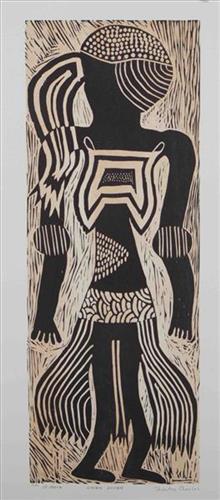
The Wandjina created the earth and all life upon it, then he created the first human beings: the Gyorn Gyorn people. He then told them to work the land and do well. The Gyorn Gyorns were confused and didn’t understand what the Wandjina wanted from them. The Wandjina was annoyed couldn’t control the Gyorn Gyorn so he travelled back to Wallungunda (Milky Way) to where Idjair was and asked if he could help with the creation. More Wandjinas came back and helped him in all areas of creation. The Gyorn Gyorns became hunters and gathers. They also show the traditional dancing amongst our tribes.
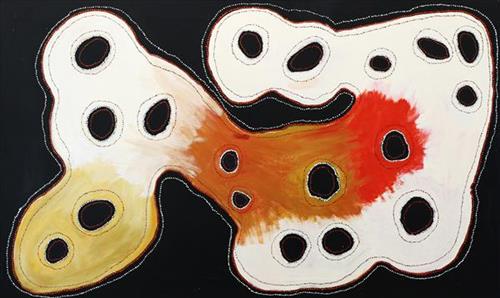
This painting represents the sacred site of Ilpilli, Napurrula’s country, which is located between Mt Liebig and Kintore.
Karen’s ancestors (The Napurrula women) were travelling across land searching for water and came upon this site. They discovered rockholes with water and a creek, which meant there was plenty of food around. This became a significant place and they remained there for a long time.
Eventually the missionaries came and took them to Haasts Bluff.