359709482372072
The ancient gift of hope.
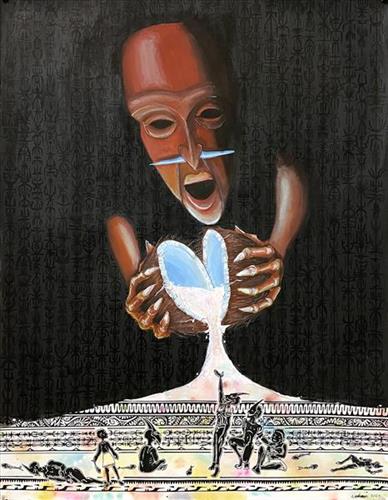
Once upon a time an ancient tribe upon an island filled with rich plants and fish, until they were struck with an unforgiving plague of misfortune which lead the tribe to starvation, a brave and malnourished man stood up on his toes, with every little strength he had, he called upon the gods, and they answered baring but a single coconut, the milk quenched the land and sea into a tropical island once more.
377810582372346
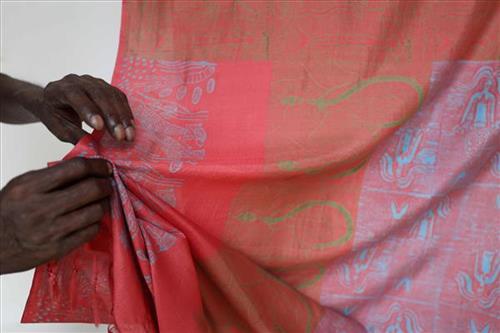
Yawkyawk Sari
Deborah Kamanj Wurrkidj b. 1971, Darwin, Australia YAWKYAWK (YOUNG WOMAN SPIRIT)
Janet Kalidjan Marawarr b. 1962, Oenpelli, Australia YAWKYAWK LA NGALNG (YOUNG WOMAN SPIRIT AND YABBY)
Owen Ngarridj Yalandja b. 1962, Oenpelli, Australia YAWKYAWK (YOUNG WOMAN SPIRIT)
Joy Bulandjan Garlbin b. 1959, Maningrida, Australia DJÓMI (MERMAID)
Elizabeth Gochan Wullunmingu b. 1972, Darwin, Australia JIN-MERDAWA (MERMAID)
Woodblock print on handwoven silk, extract print with organic dyes
Design brief by Janet Marawarr
Print composition by Anshu Arora and Prithi Pais
Printed by artisans at Tharangini Studio
Woodblock carving by Shri C.H. Sreeram and Shri S.K. Rajak
Fabric by Nandita Sulur
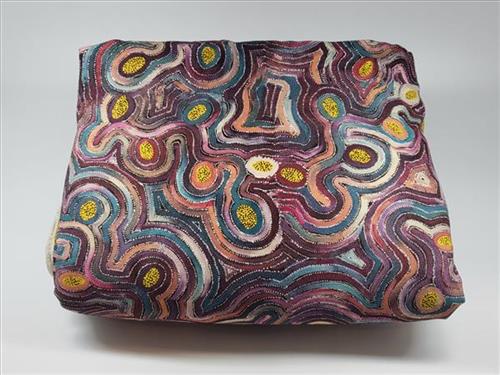
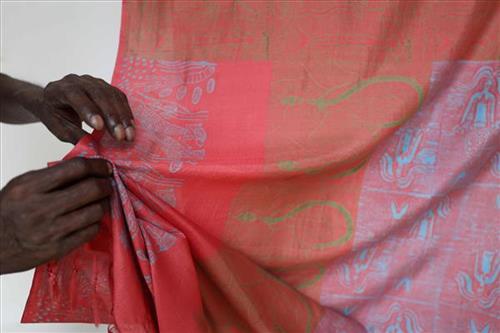
Yawkyawk is a word from the Aboriginal Kunwinjku and Kuninjku language, meaning young woman and young woman spirit being. Residing in fresh or saltwater, some Yawkyawk have long hair, associated with trailing blooms of algae. The female water spirit and fertility mermaid for the Kunibidji people is known as Djómi. Kuninjku artist Owen Ngarridj Yalandja is a senior member of the Darnkolo clan,custodians of an important Yawkyawk site near their outstation, Barrihdjowkkeng. The Yawkyawk djang (cultural histories) is central to the Darnkolo clan’s identity, for which they have spiritual and cultural responsibility. Yalandja was impressed by the carving technique on the woodblocks that returned with the team from India in 2023. He submitted a Yawkyawk design to Raylene Bonson for carving, and she prepared it for Tharangini Studio. Yalandja’s design is repeated throughout this sari. Yawkyawk swim underneath the rock. They always stay there. When the sun comes out they come out from underneath the river, make themselves warm. When they sit, they cry [sing] to themselves. Sometimes they go out to find the manme (food) and the mankung (sugarbag honey). – Janet Kalidjan Marawarr
377810582372345
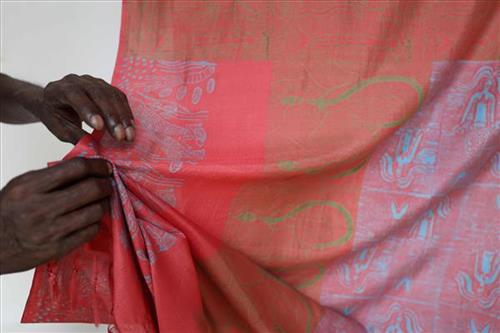
Yawkyawk Sari
Deborah Kamanj Wurrkidj b. 1971, Darwin, Australia YAWKYAWK (YOUNG WOMAN SPIRIT)
Janet Kalidjan Marawarr b. 1962, Oenpelli, Australia YAWKYAWK LA NGALNG (YOUNG WOMAN SPIRIT AND YABBY)
Owen Ngarridj Yalandja b. 1962, Oenpelli, Australia YAWKYAWK (YOUNG WOMAN SPIRIT)
Joy Bulandjan Garlbin b. 1959, Maningrida, Australia DJÓMI (MERMAID)
Elizabeth Gochan Wullunmingu b. 1972, Darwin, Australia JIN-MERDAWA (MERMAID)
Woodblock print on handwoven silk, extract print with organic dyes
Design brief by Janet Marawarr
Print composition by Anshu Arora and Prithi Pais
Printed by artisans at Tharangini Studio
Woodblock carving by Shri C.H. Sreeram and Shri S.K. Rajak
Fabric by Nandita Sulur
Yawkyawk is a word from the Aboriginal Kunwinjku and Kuninjku language, meaning young woman and young woman spirit being. Residing in fresh or saltwater, some Yawkyawk have long hair, associated with trailing blooms of algae. The female water spirit and fertility mermaid for the Kunibidji people is known as Djómi. Kuninjku artist Owen Ngarridj Yalandja is a senior member of the Darnkolo clan,custodians of an important Yawkyawk site near their outstation, Barrihdjowkkeng. The Yawkyawk djang (cultural histories) is central to the Darnkolo clan’s identity, for which they have spiritual and cultural responsibility. Yalandja was impressed by the carving technique on the woodblocks that returned with the team from India in 2023. He submitted a Yawkyawk design to Raylene Bonson for carving, and she prepared it for Tharangini Studio. Yalandja’s design is repeated throughout this sari. Yawkyawk swim underneath the rock. They always stay there. When the sun comes out they come out from underneath the river, make themselves warm. When they sit, they cry [sing] to themselves. Sometimes they go out to find the manme (food) and the mankung (sugarbag honey). – Janet Kalidjan Marawarr
377810582372344
Yawkyawk Sari
Deborah Kamanj Wurrkidj b. 1971, Darwin, Australia YAWKYAWK (YOUNG WOMAN SPIRIT)
Janet Kalidjan Marawarr b. 1962, Oenpelli, Australia YAWKYAWK LA NGALNG (YOUNG WOMAN SPIRIT AND YABBY)
Owen Ngarridj Yalandja b. 1962, Oenpelli, Australia YAWKYAWK (YOUNG WOMAN SPIRIT)
Joy Bulandjan Garlbin b. 1959, Maningrida, Australia DJÓMI (MERMAID)
Elizabeth Gochan Wullunmingu b. 1972, Darwin, Australia JIN-MERDAWA (MERMAID)
Woodblock print on handwoven silk, extract print with organic dyes
Design brief by Janet Marawarr
Print composition by Anshu Arora and Prithi Pais
Printed by artisans at Tharangini Studio
Woodblock carving by Shri C.H. Sreeram and Shri S.K. Rajak
Fabric by Nandita Sulur
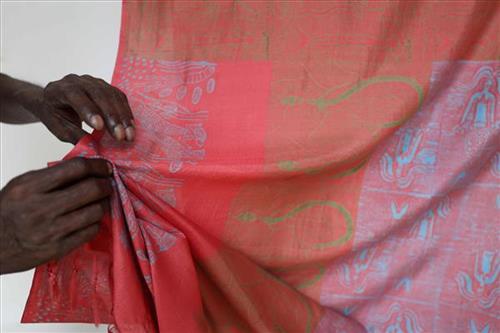
Yawkyawk is a word from the Aboriginal Kunwinjku and Kuninjku language, meaning young woman and young woman spirit being. Residing in fresh or saltwater, some Yawkyawk have long hair, associated with trailing blooms of algae. The female water spirit and fertility mermaid for the Kunibidji people is known as Djómi. Kuninjku artist Owen Ngarridj Yalandja is a senior member of the Darnkolo clan,custodians of an important Yawkyawk site near their outstation, Barrihdjowkkeng. The Yawkyawk djang (cultural histories) is central to the Darnkolo clan’s identity, for which they have spiritual and cultural responsibility. Yalandja was impressed by the carving technique on the woodblocks that returned with the team from India in 2023. He submitted a Yawkyawk design to Raylene Bonson for carving, and she prepared it for Tharangini Studio. Yalandja’s design is repeated throughout this sari. Yawkyawk swim underneath the rock. They always stay there. When the sun comes out they come out from underneath the river, make themselves warm. When they sit, they cry [sing] to themselves. Sometimes they go out to find the manme (food) and the mankung (sugarbag honey). – Janet Kalidjan Marawarr
377810582372342
Yawkyawk Sari
Deborah Kamanj Wurrkidj b. 1971, Darwin, Australia YAWKYAWK (YOUNG WOMAN SPIRIT)
Janet Kalidjan Marawarr b. 1962, Oenpelli, Australia YAWKYAWK LA NGALNG (YOUNG WOMAN SPIRIT AND YABBY)
Owen Ngarridj Yalandja b. 1962, Oenpelli, Australia YAWKYAWK (YOUNG WOMAN SPIRIT)
Joy Bulandjan Garlbin b. 1959, Maningrida, Australia DJÓMI (MERMAID)
Elizabeth Gochan Wullunmingu b. 1972, Darwin, Australia JIN-MERDAWA (MERMAID)
Woodblock print on handwoven silk, extract print with organic dyes
Design brief by Janet Marawarr
Print composition by Anshu Arora and Prithi Pais
Printed by artisans at Tharangini Studio
Woodblock carving by Shri C.H. Sreeram and Shri S.K. Rajak
Fabric by Nandita Sulur
Yawkyawk is a word from the Aboriginal Kunwinjku and Kuninjku language, meaning young woman and young woman spirit being. Residing in fresh or saltwater, some Yawkyawk have long hair, associated with trailing blooms of algae. The female water spirit and fertility mermaid for the Kunibidji people is known as Djómi. Kuninjku artist Owen Ngarridj Yalandja is a senior member of the Darnkolo clan,custodians of an important Yawkyawk site near their outstation, Barrihdjowkkeng. The Yawkyawk djang (cultural histories) is central to the Darnkolo clan’s identity, for which they have spiritual and cultural responsibility. Yalandja was impressed by the carving technique on the woodblocks that returned with the team from India in 2023. He submitted a Yawkyawk design to Raylene Bonson for carving, and she prepared it for Tharangini Studio. Yalandja’s design is repeated throughout this sari. Yawkyawk swim underneath the rock. They always stay there. When the sun comes out they come out from underneath the river, make themselves warm. When they sit, they cry [sing] to themselves. Sometimes they go out to find the manme (food) and the mankung (sugarbag honey). – Janet Kalidjan Marawarr
377810582372304
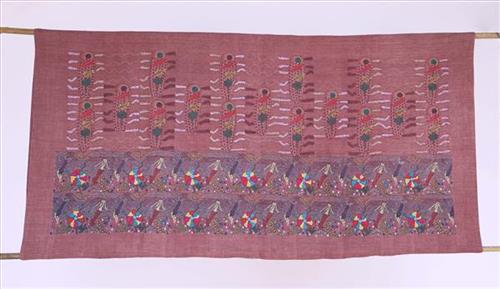
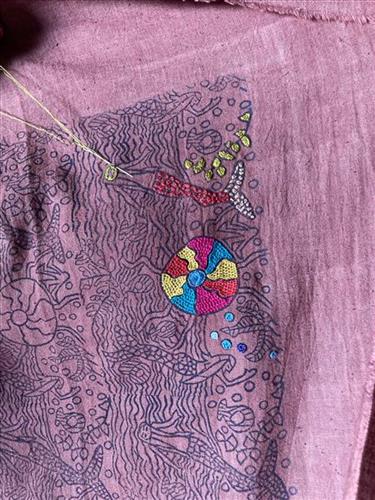
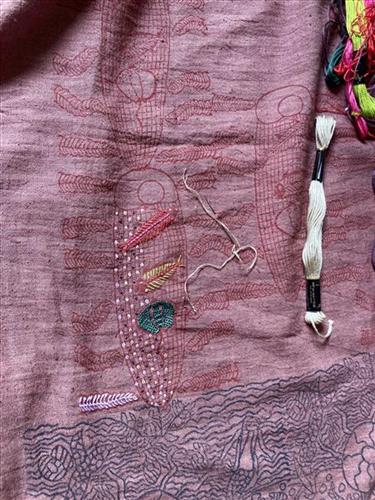
AN-GUJECHIYA (FISH TRAP) AND JIN-MERDAWA (MERMAID)
Elizabeth Gochan Wullunmingu b. 1972, Darwin, Australia
AN-GUJECHIYA (FISH TRAP)
JIN-MERDAWA (MERMAID)
Woodblock print and Lambadi embroidery on handwoven kala cotton
Pigment print with organic dyes
Design brief by Bábbarra Women’s Centre
Print composition by Anshu Arora and Prithi Pais
Printed by artisans at Tharangini Studio
Embroidery by M.Vasanthi & Sangeetha at Porgai Artisans Association
Woodblock carving by Shri C.H.Sreeram and Shri S.K. Rajak Fabric by Green Tailor Elizabeth Wullunmingu is an An-barra Burarra woman who grew up speaking Burarra language on her mother country at the entrance of the Blyth River in Arnhem Land, Australia. Her adopted mother, P. Galijan Dungudja, was a sewer in the Bábbarra Women’s Centre sewing room and a strong advocate for women in the community. Wullunmingu’s style is intricate, with delicate (shells) and dakarra (cockles) representative of the balaji (bush food) found on the beaches and saltwater estuaries east of Maningrida. The detailed hand embroidery is glorious, respectfully aligned to Wullunmingu’s own passion for sewing. Wullunmingu exclaims: I love to make Lino print fabric showing Jin-Merdawa (mermaid) . I like using bright colours. Jin-Merdawa live at Gupanga. Gupanga is located at the mouth of the Blyth River, Arnhem Land. It is a saltwater place. There must be more than one Jin-Merdawa living there? They eat fish, shellfish and seaweed. Sometimes they travel to the end of the river to find food in the ocean, but they don’t go far and always swim back to their home.
111982372426
Wak Wak
This painting depicts a sacred site at ‘Kurrurldul’, an outstation south of Maningrida.
The ‘rarrk’, or abstract crosshatching, on this work represents the design for the crow totem ancestor called ‘Djimarr’. Today this being exists in the form of a rock, which is permanently submerged at the bottom of Kurrurldul Creek. The ‘Djimarr’ rock in the stream at Kurrurldul is said to move around and call out in a soft hooting tone at night. Both the stone itself and the area around it are considered sacred.
The imagery represents the rock mentioned above at the bottom of Kurrurldul creek, which is the final transmutation of the dreaming ancestor ‘Djimarr’. Finally, the pattern used here is also the crow design used in the sacred ‘Mardayin’ ceremony, which is a large regional patri-moiety ceremony now rarely conducted in central and eastern Arnhem Land.
111982372425
Wak Wak
This painting depicts a sacred site at ‘Kurrurldul’, an outstation south of Maningrida.
The ‘rarrk’, or abstract crosshatching, on this work represents the design for the crow totem ancestor called ‘Djimarr’. Today this being exists in the form of a rock, which is permanently submerged at the bottom of Kurrurldul Creek. The ‘Djimarr’ rock in the stream at Kurrurldul is said to move around and call out in a soft hooting tone at night. Both the stone itself and the area around it are considered sacred.
The imagery represents the rock mentioned above at the bottom of Kurrurldul creek, which is the final transmutation of the dreaming ancestor ‘Djimarr’. Finally, the pattern used here is also the crow design used in the sacred ‘Mardayin’ ceremony, which is a large regional patri-moiety ceremony now rarely conducted in central and eastern Arnhem Land.
111982372424
Wak Wak
This painting depicts a sacred site at ‘Kurrurldul’, an outstation south of Maningrida.
The ‘rarrk’, or abstract crosshatching, on this work represents the design for the crow totem ancestor called ‘Djimarr’. Today this being exists in the form of a rock, which is permanently submerged at the bottom of Kurrurldul Creek. The ‘Djimarr’ rock in the stream at Kurrurldul is said to move around and call out in a soft hooting tone at night. Both the stone itself and the area around it are considered sacred.
The imagery represents the rock mentioned above at the bottom of Kurrurldul creek, which is the final transmutation of the dreaming ancestor ‘Djimarr’. Finally, the pattern used here is also the crow design used in the sacred ‘Mardayin’ ceremony, which is a large regional patri-moiety ceremony now rarely conducted in central and eastern Arnhem Land.