
114182407448
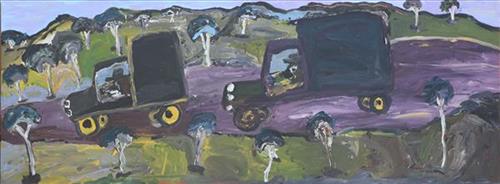
Wati Kutjarra – Janet Forbes
This is the story of two powerful magicians who came to the Ngaanyatjarra Lands from far away to the west;
‘These two men are always together, always camping together. They do all sorts of tricks when they travel across the lands as they stop from place to place. When they reached ‘Wirtapi Wara’ (Long Black or Blackstone Range) they argued about which way to go around. One went around the south side and the other the north side.
At a distance it seemed they didn’t recognise each other or perhaps they were just pretending not to recognise each other! It is also said that at Papulankutja they tricked each other by changing their appearance at the same time so they had no chance to recognise each other. The name Papulankutja comes from the Ngaanyatjarra word meaning, ‘to stare without recognising each other’.
‘They usually took the form of goanna but they could turn into other animals as well. Finally, when they got to Kaltukatjara (Docker River) they had become so arrogant that without realising they walked straight into some local men’s business even though they were warned by the local women. The goanna men led themselves blindly to their fate”.
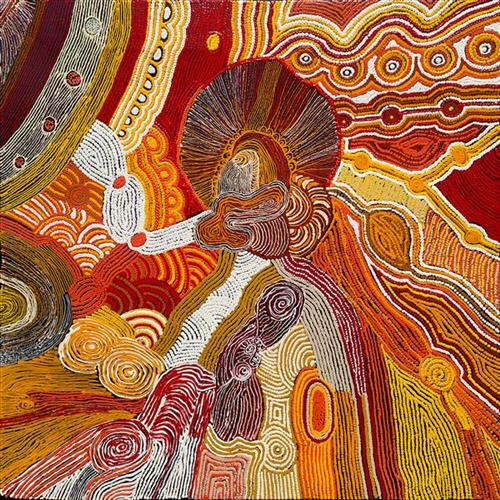
115682407411
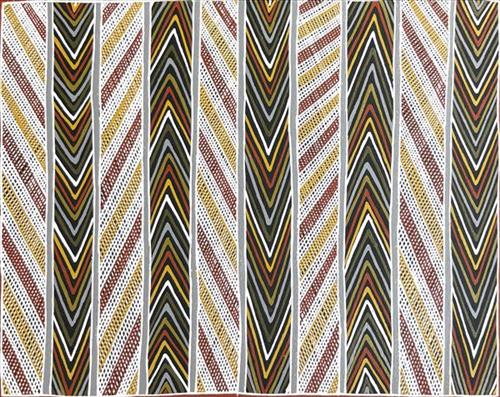
Lungurrma (North-east Wind)
Lungurrma (North-east Wind) heralds the new season when seas are calm and new growth starts. The months for this type of wind are October to December. There are big clouds without thunder or rain. The triangular patterning represents monsoon clouds ‘standing up’ on the northern horizon. The Lunggurrma design belongs to the Yirritja moiety clans linked to this design are known as the ‘line of clouds’ clans

114182407677
Minyma Kutjarra – (Two Sisters)
‘Minyma Kutjara’ (Two Ladies), is a popularly depicted story by women from the Ngaanyatjarra Lands. The painting has different chapters depending on where the artist is from and the inherited story of their ancestors. we see the ladies sitting together at their camp situated among the sand hills. They are surrounded by an abundance of desert flowers and fruits. The painting is a reflection on the lush nature of the land that was so many years ago. When there is rain coming to the lands it makes everyone so pleased as it indicates good foraging and hunting.

114182407676
Kungkarrangkalpa (Seven Sisters)
‘Kungkarrangkalpa’ (The Seven Sisters or Pleaides) is significant Tjukurrpa (dreamtime). Its origins you may be familiar with in astronomy and its connection to ‘Wati Nyiru’ (Magic Man or Orion). The roots of this dreaming stems across indigenous groups around the world. The Australian Aboriginal songline is one part to the whole dreaming which can be traced all around the world. The ladies of the Ngaanyatjarra Lands depict their significant chapter and understanding of the journey of the sisters. The different versions of this story depend on where you live and the significance’s of local Tjukurrpa places.
Nyiru fell in love with the sisters but he was of the wrong skin group to marry, but he still pursued them on their journey. The sisters travel across the land to escape Nyiru’s unwanted attentions, but he is persistent and always finds them. There are significant land forms which can be sited today that evidence this dreaming. As Nyiru is chasing the sisters he tries to catch them by using magic to turn into the most tempting kampurarrpa (bush tomato) and the most beautiful Yirli (wild fig tree), for them to eat and camp under. However, the sisters are knowledgeable of his magic and too clever for Nyiru who they outwit again and again. They go hungry and run through the night rather than be caught by him. As the journey continues, Nyiru gets so frustrated at the wit of the sisters that he uses his magic to make the oldest sister sick to try and get closer to her. The other sisters rescue the big sister and nurse her back to health. It is said he also captures the youngest sister, but with the help of the oldest sister, she escapes back to her sisters who are waiting for her. Eventually, the sisters fly into the sky to escape Nyiru, forming the constellation. Nyiru felt lonely, longing for the sisters who were so far away. Nyiru used his magic to go to the sky, forever in pursuit.

114182407675
‘Kungkarrangkalpa’ (The Seven Sisters / Pleiades) – Angela Lyons
‘Kungkarrangkalpa’ (The Seven Sisters / Pleiades) is an important Tjukurrpa (Dreaming) across the Ngaanyatjarra Lands. Many families hold knowledge for different parts of this story, and each community paints its own chapter according to Country and ancestral responsibility.
Angela’s paintings focus on the celestial aspect of the story — the moment the sisters move from the earth into the sky. The star cluster becomes the seven bright forms she paints: six surrounding one, often arranged like a shield pattern. This reflects the way the sisters move together, protect each other, and travel as a tight group while fleeing Wati Nyiru, who appears in the sky as Orion’s Belt.
Nyiru follows the sisters across Country, disguising himself with magic — turning into kampurarrpa (bush tomato), a yirli (wild fig), or even a tree — trying to tempt them. But the sisters see through his tricks, outwit him, and keep running. When the chase becomes too much, they rise into the sky, forming the Pleiades. Nyiru follows them, always behind, never close enough.
Angela expresses this story using bold, high-contrast colours and strong circular forms. Her shield-like shapes represent the sisters’ strength and unity, while the central star often marks the eldest sister — the one the others protect along the journey. Through her palette and composition, Angela brings the energy, movement, and brightness of the sky-world into her canvas.
This painting is a contemporary interpretation of a cultural story carried across generations, connecting sky, Country, and ancestral memory.

114182407674
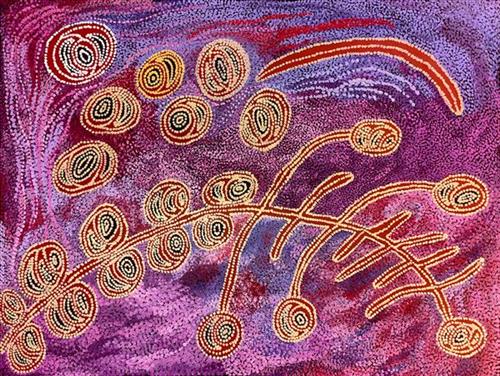
Kungkarrangkalpa (Seven Sisters) – Kuru Ala
Kuru Ala is a important women’s sites associated with the Kungkarrangkalpa (Seven Sisters) Tjukurrpa (Dreaming / story) across the Western and Central Deserts. Located south, west of Papulankutja (Blackstone), the site holds deep cultural, spiritual, and ceremonial significance for women in the Ngaanyatjarra Lands.
In the sky, Wati Nyiru is associated with Orion’s Belt, while the sisters become the star cluster known widely as the Pleiades. Many desert families still track these stars seasonally, tying sky and Country together in the story.
This place marks a key moment in the Seven Sisters story, where the sisters rested, gathered strength, and cared for one another while escaping the persistent pursuit of Wati Nyiru. The surrounding caves, rock formations, and ground features are recognised as physical evidence of the ancestral events that took place here during the Tjukurrpa.
Across many desert communities, the Seven Sisters Tjukurrpa follows the travels of the sisters as they move through Country, constantly evading Nyiru, who uses magic to disguise himself in many forms — bush foods, trees, and even animals — in an attempt to catch them. At Kuru Ala, the sisters stop to protect and heal the eldest sister before continuing their journey eastward.
Today, Kuru Ala remains an active cultural site, cared for and visited by women with ties to this Country. The story is still taught, sung, and remembered. The paintings created by artists of Papulankutja and Mantamaru reflect both the ancestral narrative and the living landscape, mapping the caves, water sources, and pathways the sisters travelled.

111582407672
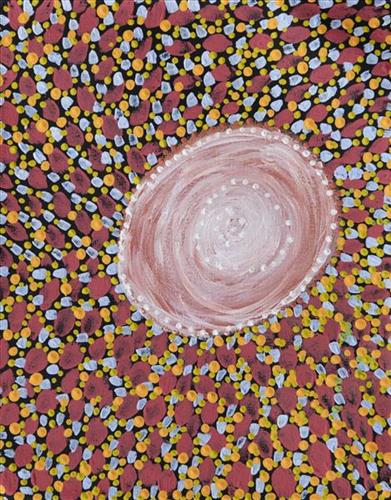
Puntawarri
“All around is sandhills and lakes on every side. You can see the grass, but the lakes are all dry. In the middle is Puntawarri waterhole. That’s the jila (snake) place, two jila. They nyupa (spouses), they darlings, man and woman. They sleeping near to Puntawarri. It’s a hole in the ground- that jila will come out of the ground and all the dust will go everywhere. All the dust going everywhere, the dust that flies up when the jila flies up out of its hole. The jila isn’t in that place anymore. It’s gone now but that jila used to stop there.”
– Helen Dale Samson
Puntawarri is an important cultural area located on the middle stretches of the Canning Stock Route and east of the Jigalong Mission (now Jigalong Aboriginal community). It is also the site of an abandoned community, a waterhole, creek and lake. Puntawarri’s close proximity to Jigalong Mission made it a popular site for Martu to visit during the ‘mission days’. Dale was born at Jigalong Mission, and continues to live in the community now located there today. Though she grew up in the dormitory at Jigalong, she spent her weekends and holidays in the bush, camping at sites such as Puntawarri with her extended family. Once married, she lived around Puntawarri, walking and hunting in the surrounding Country.
For many Martu, like Dale’s family, Jigalong Mission was the site where their pujiman (traditional, desert dwelling) lifestyle came to an end from the late 1940s as they transitioned to a life as stockmen and women working in cattle stations in the Pilbara region and beyond. In the wake of the extreme and prolonged drought of the 1960s, the last of the remaining pujimanpa (desert dwellers) were forced to move to missions like Jigalong, where a supply of food and water was assured. There, many Martu were reunited with family members that had already moved in from the desert.
The waterhole at Puntawarri is said to be populated by several kinds of ancestral jila, as referred to by Dale in her account. However the site is best known for its association with the Ngayurnangalku, fearsome ancestral cannibal beings. During the Jukurrpa (Dreaming) the Ngayurnangalku came together from all over the desert, first stopping near Puntawarri on their travels to Kumpupirntily (Kumpupintily, Lake Disappointment). At Kumpupirntily, they had a big meeting to debate whether or not they would continue to live as cannibals, and eventually came to the decision to stop eating people. That night, a female baby cannibal was born to the eastern Ngayurnangalku on the red sandhills at Puntawarri, where she continues to live today as the ‘big mummy’ Ngayurnangalku. Following protocol, the baby also had to be consulted by the group. She determined that the Ngayurnangalku should continue to eat people. Her decision divided the group, and from this point the group from the east continued to live as ‘bad’ cannibals at Kumpupirntily, while the group from the west became ‘good’, thereafter consuming only animals.

111582407671
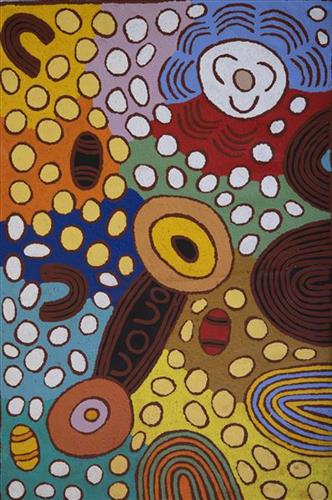
Untitled
Martumili Artists work with over three hundred artists from remote Martu Aboriginal communities, including Punmu, Parnngurr, Kunawarritji, Jigalong, Irrungadji (Nullagine), and Warralong, as well as from the Parnpajinya (Newman) gallery and studio spaces. Known for their diverse, energetic, and unmediated painting styles, their works reflect the dramatic geography and scale of their homelands. Each artist, however, brings a unique approach to their craft.
Younger Martu artists often start painting alongside their parents, grandparents, and extended family, which fosters an organic learning process. This not only involves mastering painting techniques but also understanding specific locations, family histories, traditional ways of life, bush tucker, and Jukurrpa (Dreaming). Over time, with encouragement from their peers, they develop their own distinct styles and explore unique painting techniques and subject matter. In this work the artist brings a contemporary, evolving perspective to their work.

111582407670
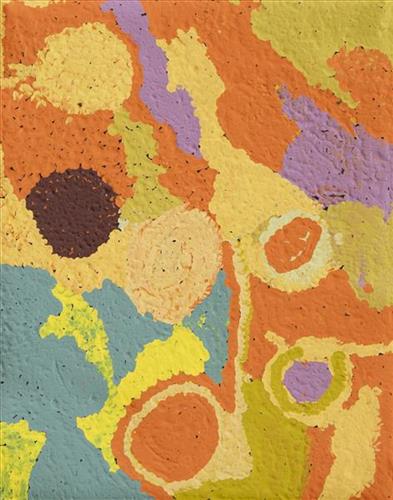
Wantili (Warntili, Canning Stock Route Well 25)
“Wantili (Warntili, Canning Stock Route Well 25) area, close to Parnngurr. My ngurra (home Country, camp), my jamu’s (grandfather’s) Country, my father’s daddy, Jakayu [Biljabu’s] daddy and my daddy’s Country. Jakayu been bury her father there. In pujiman (traditional, desert dwelling) days, my family and Jakayu’s family been walking round there together. Big sandhills here. Sandhill, sandhill, sandhill everywhere. Claypan there, in the middle. Good place for swimming and drinking, for hunting little kangaroo. When no water [we would] go to [the adjacent Canning Stock Route] well. When there [was] rain we stay there at Wantili. Everywhere, we been walking everywhere.
Near to Wantili, road [Canning Stock Route] going kayili (north). Long time [ago] only horses and cattle [travelled along that road], going Meekatharra and back in the cold time, gone right up to GJ (Georgia) Bore. Half way, when he see water at Wantili, that mob would camp one night, bullock eating all the grass and men’s drinking water. One Martu been working with that mob, droving bullock. Every time he been give us meat, all the pujimanpa (desert dwellers).”
– Ngamaru Bidu
Wantili is a large round jurnu (soak) and linyji (claypan) near Well 25 on the Canning Stock Route. The Wantili region is dominated by claypans surrounded by tuwa (sandhills), and Nyilangkurr, a prominent yapu (hill) is located close to the eastern edge of the claypan. Following rain the typically dry claypans are filled with water, with the overflow from nearby waterholes flowing to Wantili. At that time, Wantili becomes an important place for obtaining fresh water for drinking and bathing. Wantili is significant for the fact that at this site Kartujarra, Manyjilyjarra, Putijarra and Warnman people would all come together for ceremonies during the pujiman era. Many jiwa (stones used by women for grinding seeds) from these times, including those used by Ngamaru’s family, can still be found there today.
Wantili lies within Ngamaru’s ngurra (home Country, camp) through her grandfather and father. As described in her account, Wantili was one of the sites Ngamaru knew intimately and travelled extensively with her family and other family groups, such as the Biljabu family. During the pujiman period Martu would traverse very large distances annually, moving seasonally from water source to water source, and hunting and gathering bush tucker as they went. Knowledge of water sources was critical for survival, and today Martu Country is still defined in terms of the location and type of water.
As Ngamaru recounts, Wantili also held significance for her as a site of contact between her family and kartiya (white people); drovers with their cattle travelling along the Canning Stock Route. The establishment of the route by Alfred Canning and his team in 1910 resulted in first contact with Europeans for many Martu, including Ngamaru and her family. Increasingly, Martu followed the route to newly established ration depots, mission and pastoral stations. They were drawn to the route in search of food, by a sense of curiosity, or by loneliness. By the late 1950s and early 1960s, most of the desert family groups had left the desert. Eventually, these factors combined with an extreme and prolonged drought in the 1960s to prompt the few remaining pujimanpa to move in from the desert.
Culturally, Wantili is an incredibly important site in two central Jukurrpa (Dreaming) stories. The first relates to the world’s creation. In this narrative, the world was initially dark, and people were like rocks, with no arms or legs. Following the sun’s first rising, life-forms become increasingly complex while particular features in the land are created. Beyond these details much of the narrative is ngurlu (sacred, taboo), and only for Martu, but the site is open, and anyone can go there.
Wantili is also one of the many sites featured in the epic Minyipuru (Jakulyukulyu, Seven Sisters) Jukurrpa story. Minyipuru is a central Jukurrpa narrative for Martu, Ngaanyatjarra, Pitjantjatjara and Yankunytjatjara people that is associated with the seasonal Pleiades star constellation. Relayed in song, dance, stories and paintings, Minyipuru serves as a creation narrative, a source of information relating to the physical properties of the land, and an embodiment of Aboriginal cultural laws. The story follows the movement of a group of women travelling all the way across the desert, beginning at Roebourne on the coast of Western Australia, as they are pursued by Yurla, a lustful old man. As the women travelled, they stopped to rest at many sites to eat, dance, rest and sing, on the way leaving behind an assortment of articles that became formations in the land, such as groupings of rocks and trees, grinding stones and seeds. The sisters rested at Wantili before throwing seeds, then continued their journey far to the east and beyond Martu Country, stopping at various sites through central and South Australia.