377810582359797


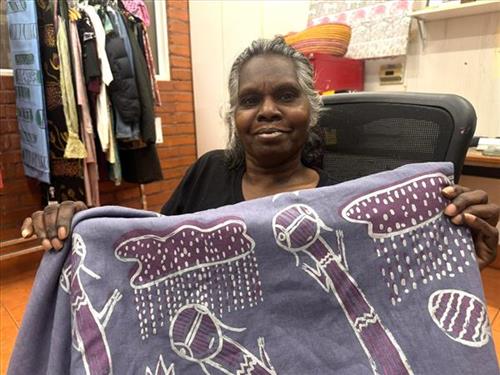
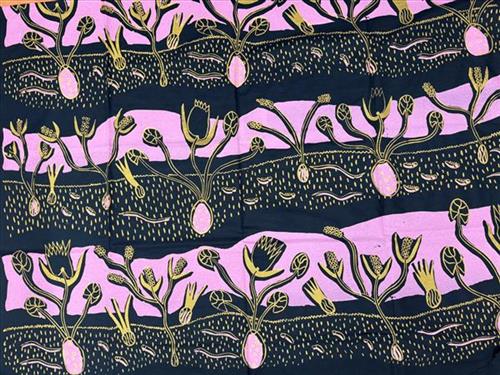
Kukurlk Kare (Going Underground)

Karrinung kukurlk kare, karrijare manme (we are going underground looking for food).

“This is my country. In this painting, I’m looking at her little bit different way. This is what we see when we’re kukurlk kare (going underground)

Man-kurndalh (Black plum) I call mother. It is my mother’s Djang/Dreaming. The bush onion (kulumuduk) is white, the same as onions you buy at the store. We don’t eat this one though, it’s poison.

Wayuk is the water lily, with the big root growing in the earth. This is when that water is drying up a bit. There are worms and beetles- this is what we see underground, when we are digging for manme.”

-Jennifer Wurrkidj

 

377810582359792


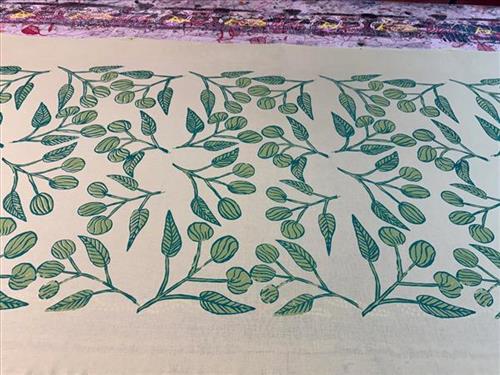
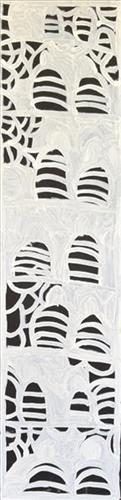
Man-djarduk (Red Bush Apples)

Deborah Wurrkidj is a Kuninjku artist from the Kurulk clan whose country lies around the outstation of Mumeka in central Arnhem Land.

In this design she has depicted man-djarduk (red bush apples) – a sweet, crisp bush food that is a favourite to collect.

Man-djarduk fruits in kurrung and kunumeleng seasons, the build-up and first rains seasons.

377810582359733


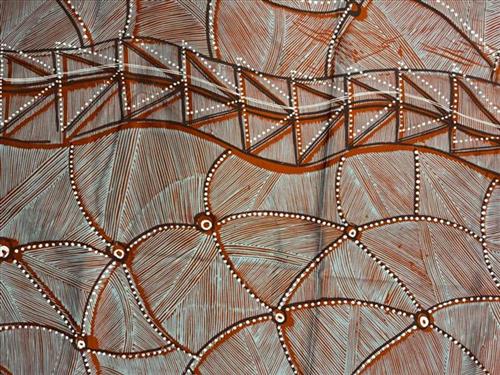
Kunkurra (Spiral Wind)

‘My designs, they are all alive living up in my head’- Janet Marawarr

Janet Marawarr has depicted kunkurra, the spiralling wind associated with several sites in the Kardbam clan. On one level, this design can be interpreted as a depiction of the kinds of mini-cyclones common during the wet season in Arnhem Land, where the artist lives. Kunkurra also relates specifically to a site called Bilwoyinj, near Mankorlod, on the artist’s clan estate.

At this site, two of the most important Kuninjku creation beings, a father and son known as na-korrkko, are believed to have hunted and eaten a goanna. They left some of the goanna fat behind at the site, which turned into the rock that still stands there today.

Bilwoyinj site is also a ceremonial ground for a ceremony called Yabbaduruwa, a major ceremony owned by the Yirridja patrimoiety. The Yabbaduruwa ceremony is primarily concerned with initiation, land ownership and promoting the cyclical regeneration of the human and natural worlds.

377810582359727


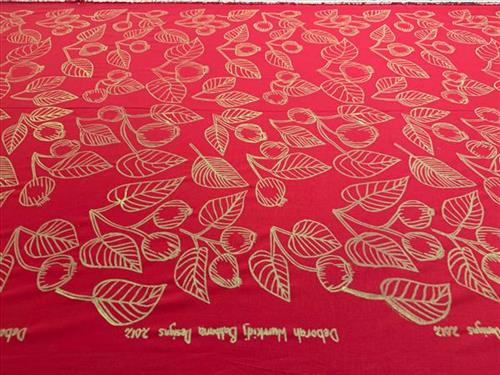
Man-djarduk (Red Bush Apples)

Deborah Wurrkidj is a Kuninjku artist from the Kurulk clan whose country lies around the outstation of Mumeka in central Arnhem Land.

In this design she has depicted man-djarduk (red bush apples) – a sweet, crisp bush food that is a favourite to collect.

Man-djarduk fruits in kurrung and kunumeleng seasons, the build-up and first rains seasons.

377810582359696


Yawkyawk la Kunronj (freshwater mermaid) 2005

This screen print was created by the young Jennifer Wurrkidj, one of the most prolific artists at Bábbarra Women’s Centre. This design was re exposed onto screen after Kamanj passed away. Her sister Deborah Wurrkidj talks about this design.


At that time the children were all going to homelands school. The design shows too many yawkyawk in the billabong at Barridjowkeng a very sacred Yirridjidja site for Kuninjku people.

The design shows  kundayarr (pandanus) and wayuk (waterlily) around the billabong.

Our grandfather on our mothers side used to live at this site and they used to drink the water from this billabong. There is now an Outstation located at this site. 

This scene shows wet season as we can see by the mandjewk – (heavy rainclouds). The yawkyawk love the sound of the rain. 

Yawkyawk are young girls but they are spirits from kunred (country) that have fish tails. 

220982359902


Maisie Petyarre Bundey – Anhelengkw (Emu) Dreaming

Anhelengkw (emu) dreaming is the breast body painting depicting the story of the mother emu who runs away and leaves the father emu to look after the eggs until they hatch, he then raises the chicks.

This story is passed down through Maisie’s family and celebrated in dance.

221282359885


Kungkarangkalpa / Seven Sisters

Kungkarangkalpa means the Seven Sisters. This is an extensive creation story that relates to the Pleiades constellation in the southern hemisphere. The story traverses Australia taking on different forms, however local women are privy to the part of the story which takes place in the country near Ernabella. For this part of the story, the man called Nyiru is chasing the sisters as he wants to sleep with the oldest sister. All the younger sisters are deeply afraid of him. As Nyiru is chasing the sisters, he tries to catch them by using magic to turn himself into the most tempting bush tomatoes for the sisters to eat and the most beautiful ili (fig) tree for the sisters to camp under. However, the sisters are aware of his magic and go hungry and run through the night rather than be caught by Nyiru. Eventually, to escape Nyiru, the sisters fly into the sky where they turn into stars and form the constellation.

221282359884


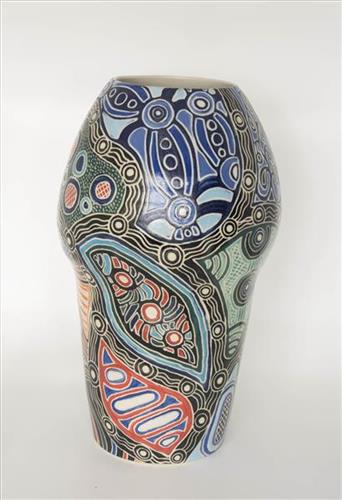
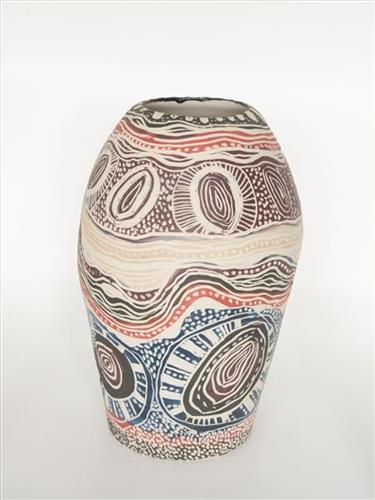
Kampurarpa Tjukurpa – Elizabeth’s Story

Kampurarpa are bush tomatoes. Elizabeth’s work comments on the environmental change that has occurred on her country due to the introduction of non-native fauna such as cattle, and flora, notably weeds like buffel grass. Buffel grass is so widespread and destructive that it is commonly known in and around Pukatja as tjanpi mamu or devil grass.

From the very start of Elizabeth’s artistic practice she has drawn her kampurarpa tjukurpa (bush tomato story) in clay. In the old times kampurarpa were one of the main foods for Anangu.

I’ve seen the land change. We used to have a lot of flowers. We used to go out to the bush to collect bush tucker, like kampurarpa (bush tomatoes). And now there’s a lot of buffel grass everywhere. The land is changed by the buffel grass. Now there’s no more flowers – no purple flowers, yellow flowers, white or pink flowers. I’ve seen it. When all the cattle and the sheep and the goats came, the kangaroos left and went a long way away. They saw the strange animals and they left. That’s a true story.

Today, sometimes we still go out and collect kampurarpa but not like we did before. Our country has been changed by cattle and weeds like buffel grass, so we can’t find all the old foods like we once did. I’ll keep telling the kampurarpa story in my work, that keeps the stories, songs and dances about these important foods alive and strong.