377810582339802


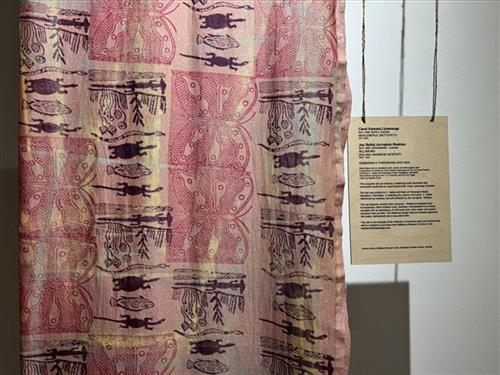
MERLEMERLE (BUTTERFLY) and BILLABONG BOLUNG (RAINBOW SERPENT)

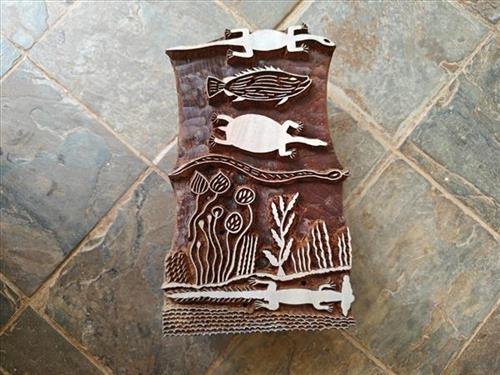
Wood Block print on handwoven silk, extract print with organic dyes Composition as briefed by Carol Kamanj Liyawanga and Jay Jurrupula Rostron Printed by C. Satish and Tharangini Studio, Bangalore, Karnataka Wood Block carving by Shri C.H. Sreeram and Shri S.K. Rajak Fabric by Nandita Sulur.

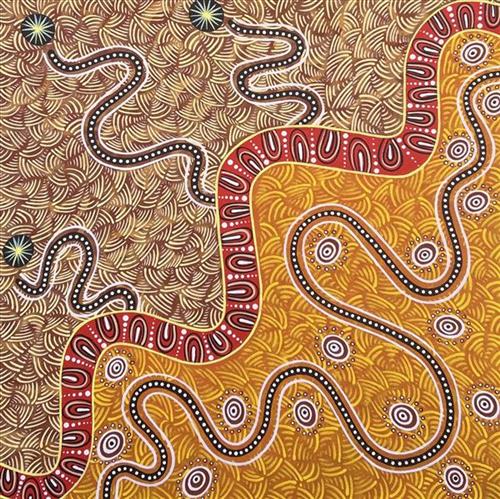
This exquisite silk sari features a billabong motif intermixed with merlemerle (butterfly) by senior Kune artist, Carol Liyawanga Campion. The sari was printed by C. Satish and team at Tharangini Studio, Bangalore, Karnataka.

In selecting the colours and layout, C. Satish referenced an existing Lino print artwork by Jay Jurrupula – Rostron. The sari features animals from Jurrupula – Rostron’s homeland near Korlobidadah, West Arnhem Land, Australia.

Korlobidadah is an inland paradise with an abundance of wild bush food, clean water and sacred ancestral rock art sites. The billabong design features kalawan (goanna), vile snake, barramundi and a long neck turtle.

111582339736


Nganjirr

“Grandfather’s Country, not far from Well 33, called Nganjirr. Not far, [you] can go up by car. Go camping there. When it rains, fills up, then is dry.

Two Countries – Nganjirr and Kun Kun (Kuny-Kuny), Marlene’s Country. [You] can just go out for the day- lovely and quiet. Go hunting and get some jinyjwirrily (wild gooseberry, or desert raisins)”

– Kara Patch

Nganjirr and Kun Kun are both significant parts of Kara’s ‘ngurra’ (home Country, camp). Nganjirr, a grouping of three rockholes just south of Kil-kil (Canning Stock Route Well 36), is an importaint place for the Patch family through two brothers, Nganjirrmarta and Wirrulypa. A large marntila/tarntulu (Acacia pruinocarpa) sitting on rocky outcrop close to Nganjirr is used to locate the rockholes.

Kun Kun (Kuny-kuny) is a soak accessing a large body of underground water, located southeast of Kunawarritji (Canning Stock Route Well 33). The site is sacred for its association with the marlu (kangaroo) Jukurrpa (Dreaming), and was an important ceremonial site during the pujiman (traditional, desert dwelling) period. Soaks, or soakwaters, derive their name from the manner in which their waters generally seep into the sand from below stores, sometimes as part of an ephemeral river or creek. Soaks were an especially important source of water during the pujiman era, being the most dependable water source in times of drought. Water was obtained from soaks by scooping away the sand with a piti (timber bowls used for carrying food and water) until clear water gathered at the base of the hole, sometimes at a depth of several metres.

In the Pujiman time, Martu would traverse very large distances annually in small family groups, moving seasonally from water source to water source, and hunting and gathering bush tucker as they went. Knowledge of water sources was critical for survival, and today Martu Country is still defined in terms of the location and type of water. Each of the hundreds of claypans, rockholes, waterholes, soaks and springs found in the Martu desert homelands is known by name, location, quality and seasonal availability through real life experience and the recounting of Jukurrpa narratives.

111582339730


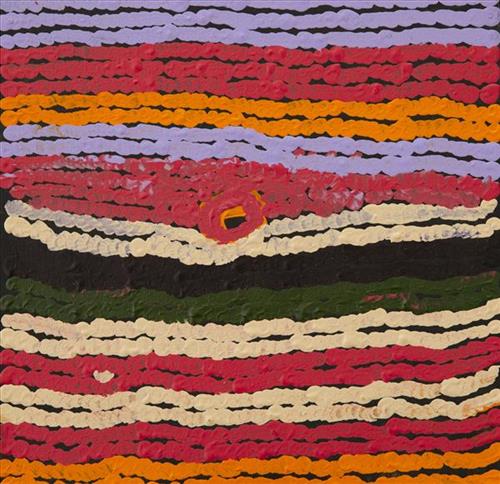
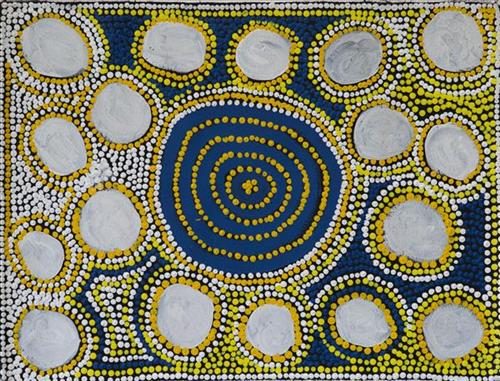
Untitled

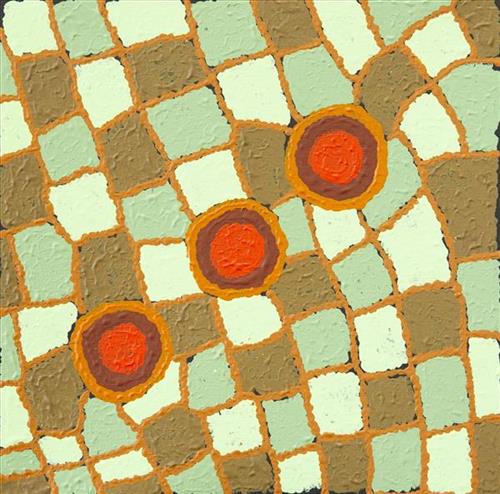
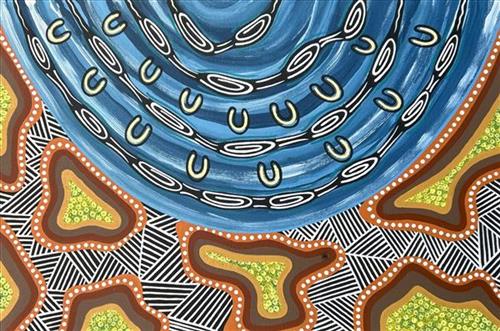
This is Mayiwalku’s Country- her ‘ngurra’ (home Country, camp). People identify with their ngurra in terms of specific rights and responsibilities, and the possession of intimate knowledge of the physical and cultural properties of one’s Country. Painting ngurra, and in so doing sharing the Jukurrpa (Dreaming) stories and physical characteristics of that place, has today become an important means of cultural maintenance. 

Mayiwalku’s ngurra encompasses the Country that she and her family walked in the pujiman (traditional, desert-dwelling) era. Mayiwalku was born at Yirnangarri. She grew up, walked and hunted primarily around the Country extending across the Punmu, Kunawarritji (Canning Stock Route Well 33) and Karlamilyi (Rudall River) regions. Following the death of both their parents, Mayiwalku and her sisters travelled alone between Punmu and Kunawarritji, occasionally meeting with other family groups. They continued to live nomadically before eventually deciding to move to Jigalong Mission along with many other relatives following an extreme and prolonged drought in the 1960s. 

Portrayed in this work are features of Mayiwalku’s ngurra, such as the dominant permanent red tali (sandhills), warta (trees, vegetation), and the individually named water sources she and her family camped at. These include Januwa, Jilankujarra, Karlajarntu, Kartungu, Kularti, Kumpupajanu, Kunalimpi, Kunarra, Marnakarti, Pangkapirni, Wilunganinya, Wurur-wururna, Yilyara, and Yirrajarra Rock holes, waterholes, soaks and springs were all extremely important sites for Martu people during the pujiman period, and are generally depicted with circular forms. 

The encyclopaedic knowledge of the location, quality and seasonal availability of the hundreds of water bodies found in one’s Country sustained Martu as they travelled across their Country, hunting and gathering, visiting family, and fulfilling ceremonial obligations. They would traverse very large distances annually, visiting specific areas in the dry and wet season depending on the availability of water and the corresponding cycles of plant and animal life on which hunting and gathering bush tucker was reliant. As they travelled and hunted they would also burn areas of Country, generating a greater diversity of plant and animal life.
115682339801


Woven Mat

Traditionally, Nganiyal (conical mats) were used as an insect screen when erected, and as a sitting mat when folded. They are used in Ceremony as well as a functional item. 

Nowadays, artists weave many different shapes including flat, round and oblong. 

115682339711


Woven Mat

Traditionally, Nganiyal (conical mats) were used as an insect screen when erected, and as a sitting mat when folded. They are used in Ceremony as well as a functional item. 

Nowadays, artists weave many different shapes including flat, round and oblong. 

115682339653


Woven Mat

Traditionally, Nganiyal (conical mats) were used as an insect screen when erected, and as a sitting mat when folded. They are used in Ceremony as well as a functional item. 

Nowadays, artists weave many different shapes including flat, round and oblong. 

111582339774


West Coast Eagles

This painting portrays one of the annual football carnivals in Martu Community. Each of the remote communities has a football team, and every year a different community is chosen as host to the carnival. The carnivals are important social events, and present a chance to catch up with friends and family members. Everyone travels long distances to support the players and celebrate together. 

Life in community is unique; the distance between communities and major centres means few outside visitors pass through, travel between communities and towns is via long 4WD journeys or on the mail plane, fresh fruits and vegetables are relatively scarce, and up until recently telephone communication was limited to a few fixed landlines and community phone booths. Whilst these communities are continually being modernised, Country remains central to community life, both physically and culturally.