111582423833


Kulyakartu – Tali

“The sand dunes play important roles in our Martu culture, especially in most parts of the desert regions. Tali (sandhills) are sometimes boundaries, travel pathways, and act as wind breaks in windy seasons for Martu. I have been guided by my elders, Muuki, Nola, and Wokka Taylor in what to paint and what not to paint. And as young adults we paint seasons, some rockholes and sand dunes, some animals too. This painting are the Tali, at Kulyakartu.” 

– Nuriah Jadai


The traditional lands of the Martu people encompass the Great Sandy Desert and Rudall River regions of Western Australia, an enormous tract dominated by distinctive red tali, or tuwa (sandhills). These sandhills present an unforgiving landscape; sparse vegetation covers a seemingly never ending expanse of dunes, and yet these lands and the location of resources within them was known intimately by its pujiman (traditional, desert dwelling) inhabitants. At this time, Martu traversed very large distances annually in small family groups, moving from water source to water source through the harsh desert landscape with incredible stamina and resourcefulness. Travel was often undertaken at night, and when travelling during the day, Martu wore yakipiri (woven bark sandals) to protect their feet from the hot desert sand.

The Martu term for family, walytja, encapsulates a broader idea of relatedness that permeates every aspect of life. The Martu four-section kinship system determines a person as belonging to either the Purungu, Milangka, Panaka or Karrimarra skin group, and was created by the Jukurrpa (Dreaming) ancestors.

The significance of walytja is revealed in Martu art not only in its depiction of ngurra as delineated by ancestral inheritance, but also through the act of painting itself. Martumili artists begin to paint with their parents, grandparents and extended family, fostering an organic process of learning about painting techniques, along with knowledge of specific locations and their related Jukurrpa narratives. In this way, the passing down of cultural knowledge through art ensures the continuity of Martu heritage.

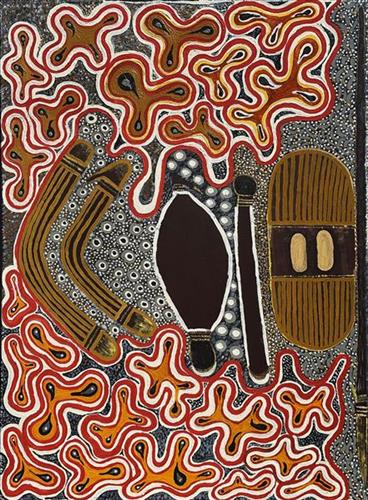
114182424223


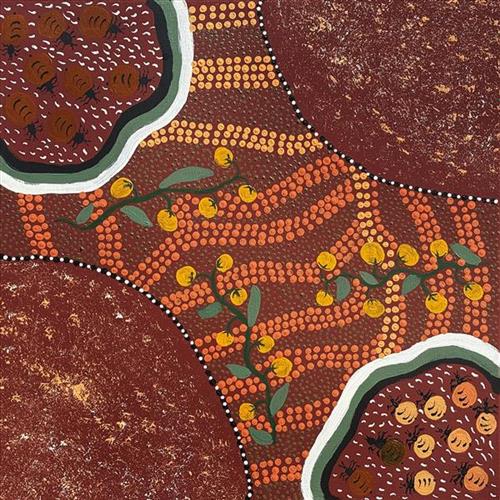
Kampurarrpa Piti

Kampurarrpa Piti is the name of a rock hole where water can be found. Kampurarrpa means bush tomato or raisin while piti is the word for hole. The rock hole was given this name because it is where Kampurarrpa grows.

Traditionally the people would go there for the Kampurarrpa and water. They used to tap on the many round rocks to scare off the birds that were eating the Kampurarrpa.


Dimensions: 61 x 61cm

114182424222


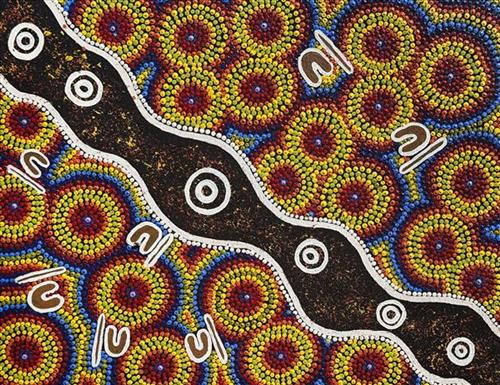
Kungkarrangkalpa (Seven Sisters) – Kuru Ala

Kuru Ala is a important women’s sites associated with the Kungkarrangkalpa (Seven Sisters) Tjukurrpa (Dreaming / story) across the Western and Central Deserts. Located south, west of Papulankutja (Blackstone), the site holds deep cultural, spiritual, and ceremonial significance for women in the Ngaanyatjarra Lands.

In the sky, Wati Nyiru is associated with Orion’s Belt, while the sisters become the star cluster known widely as the Pleiades. Many desert families still track these stars seasonally, tying sky and Country together in the story.

This place marks a key moment in the Seven Sisters story, where the sisters rested, gathered strength, and cared for one another while escaping the persistent pursuit of Wati Nyiru. The surrounding caves, rock formations, and ground features are recognised as physical evidence of the ancestral events that took place here during the Tjukurrpa.

Across many desert communities, the Seven Sisters Tjukurrpa follows the travels of the sisters as they move through Country, constantly evading Nyiru, who uses magic to disguise himself in many forms — bush foods, trees, and even animals — in an attempt to catch them. At Kuru Ala, the sisters stop to protect and heal the eldest sister before continuing their journey eastward.

Today, Kuru Ala remains an active cultural site, cared for and visited by women with ties to this Country. The story is still taught, sung, and remembered. The paintings created by artists of Papulankutja and Mantamaru reflect both the ancestral narrative and the living landscape, mapping the caves, water sources, and pathways the sisters travelled.


Dimensions: 30 x 40cm

116482424182


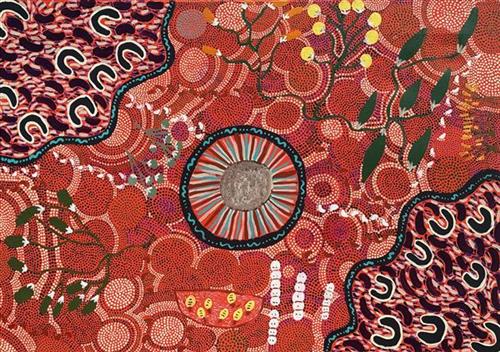
Midnight Sky

This painting reminds me of when we go camping out bush we always camp out in the flat where we can see the stars shining.


Dimensions: 60 x 91.5 cm

114182424149


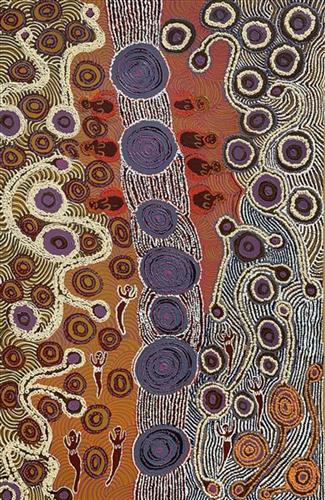
Kungkarrangkalpa (Seven Sisters)

‘Kungkarrangkalpa’ (The Seven Sisters or Pleaides) is significant Tjukurrpa (dreamtime). Its origins you may be familiar with in astronomy and its connection to ‘Wati Nyiru’ (Magic Man or Orion).  The roots of this dreaming stems across indigenous groups around the world. The Australian Aboriginal songline is one part to the whole dreaming which can be traced all around the world. The ladies of the Ngaanyatjarra Lands depict their significant chapter and understanding of the journey of the sisters. The different versions of this story depend on where you live and the significance’s of local Tjukurrpa places.

Nyiru fell in love with the sisters but he was of the wrong skin group to marry, but he still pursued them on their journey. The sisters travel across the land to escape Nyiru’s unwanted attentions, but he is persistent and always finds them. There are significant land forms which can be sited today that evidence this dreaming. As Nyiru is chasing the sisters he tries to catch them by using magic to turn into the most tempting kampurarrpa (bush tomato) and the most beautiful Yirli (wild fig tree), for them to eat and camp under. However, the sisters are knowledgeable of his magic and too clever for Nyiru who they outwit again and again. They go hungry and run through the night rather than be caught by him. As the journey continues, Nyiru gets so frustrated at the wit of the sisters that he uses his magic to make the oldest sister sick to try and get closer to her. The other sisters rescue the big sister and nurse her back to health. It is said he also captures the youngest sister, but with the help of the oldest sister, she escapes back to her sisters who are waiting for her. Eventually, the sisters fly into the sky to escape Nyiru, forming the constellation. Nyiru felt lonely, longing for the sisters who were so far away. Nyiru used his magic to go to the sky, forever in pursuit.


Dimensions: 61 x 101cm

114182424147


Kungkarrangkalpa (Seven Sisters) – Kuru Ala

Kuru Ala is a important women’s sites associated with the Kungkarrangkalpa (Seven Sisters) Tjukurrpa (Dreaming / story) across the Western and Central Deserts. Located south, west of Papulankutja (Blackstone), the site holds deep cultural, spiritual, and ceremonial significance for women in the Ngaanyatjarra Lands.

In the sky, Wati Nyiru is associated with Orion’s Belt, while the sisters become the star cluster known widely as the Pleiades. Many desert families still track these stars seasonally, tying sky and Country together in the story.

This place marks a key moment in the Seven Sisters story, where the sisters rested, gathered strength, and cared for one another while escaping the persistent pursuit of Wati Nyiru. The surrounding caves, rock formations, and ground features are recognised as physical evidence of the ancestral events that took place here during the Tjukurrpa.

Across many desert communities, the Seven Sisters Tjukurrpa follows the travels of the sisters as they move through Country, constantly evading Nyiru, who uses magic to disguise himself in many forms — bush foods, trees, and even animals — in an attempt to catch them. At Kuru Ala, the sisters stop to protect and heal the eldest sister before continuing their journey eastward.

Today, Kuru Ala remains an active cultural site, cared for and visited by women with ties to this Country. The story is still taught, sung, and remembered. The paintings created by artists of Papulankutja and Mantamaru reflect both the ancestral narrative and the living landscape, mapping the caves, water sources, and pathways the sisters travelled.


Dimensions: 76 x 122cm

114182424267


Heather Watson – Kumanara Bore

Kumanara Bore is in the Ngaanyatjarra Lands of Western Australia. Napalar (the long tailed lizard) lives close to Kumanara Bore at Mamutjara rock hole. This is a good hunting ground and tjukapa (story) for Napalar.

Heather Watson was born in the bush at a rock hole called Aliwanyawanyu in the Pitantjatjara Lands of South Australia while her parents were travelling for work and the Mission. Aliwanyawanu is the place of the Ngintaka Tjukurpa(Perentie Lizard). Being born there Watson has a special responsibility to looking after the Ngintaka story and has markings on her body that signify the Ngintaka.

Heather lives in Irrunytju (Wingellina) Community, Ngaanyatjarra lands of Western Australia. She belongs to the Pitjantjatjara language and cultural group .


Dimensions: 92 x 122cm

114182424266


Wati Kutjarra – Janet Forbes

This is the story of two powerful magicians who came to the Ngaanyatjarra Lands from far away to the west;

‘These two men are always together, always camping together. They do all sorts of tricks when they travel across the lands as they stop from place to place. When they reached ‘Wirtapi Wara’ (Long Black or Blackstone Range) they argued about which way to go around. One went around the south side and the other the north side.

At a distance it seemed they didn’t recognise each other or perhaps they were just pretending not to recognise each other! It is also said that at Papulankutja they tricked each other by changing their appearance at the same time so they had no chance to recognise each other. The name Papulankutja comes from the Ngaanyatjarra word meaning, ‘to stare without recognising each other’.

‘They usually took the form of goanna but they could turn into other animals as well. Finally, when they got to Kaltukatjara (Docker River) they had become so arrogant that without realising they walked straight into some local men’s business even though they were warned by the local women. The goanna men led themselves blindly to their fate”.


Dimensions: 20 x 30cm

114182424254


Wati Kutjarra – Janet Forbes

This is the story of two powerful magicians who came to the Ngaanyatjarra Lands from far away to the west;

‘These two men are always together, always camping together. They do all sorts of tricks when they travel across the lands as they stop from place to place. When they reached ‘Wirtapi Wara’ (Long Black or Blackstone Range) they argued about which way to go around. One went around the south side and the other the north side.

At a distance it seemed they didn’t recognise each other or perhaps they were just pretending not to recognise each other! It is also said that at Papulankutja they tricked each other by changing their appearance at the same time so they had no chance to recognise each other. The name Papulankutja comes from the Ngaanyatjarra word meaning, ‘to stare without recognising each other’.

‘They usually took the form of goanna but they could turn into other animals as well. Finally, when they got to Kaltukatjara (Docker River) they had become so arrogant that without realising they walked straight into some local men’s business even though they were warned by the local women. The goanna men led themselves blindly to their fate”.


Dimensions: 40 x 40cm