377815582333040
Untitled
377815582333039
Untitled
377815582333038
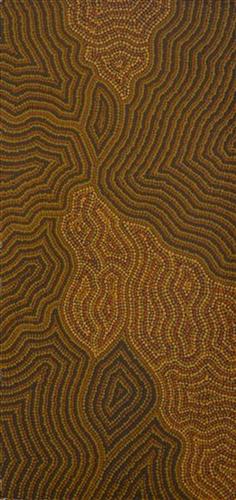
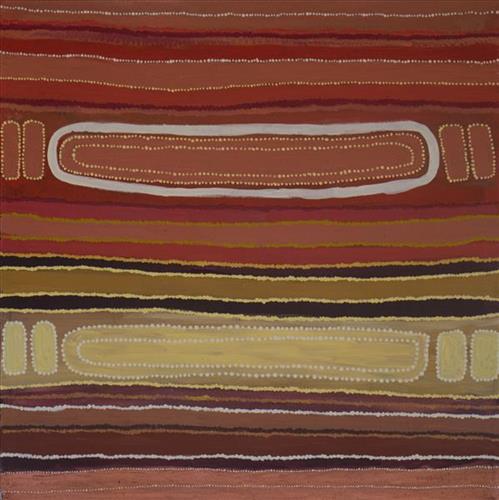
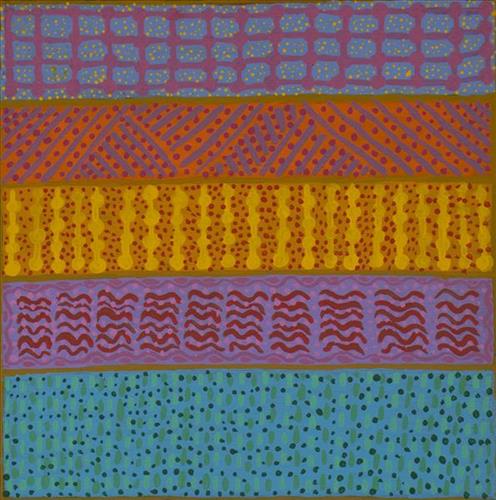
Clay pans and Spinifex
This paining is about the claypans and spinifex in the dry season time, when spinifex, the native plants and the country gets dry. When the rain comes it makes the country green again. Some animals love dry season for hunting. Some times we go hunting for animals for our families
With the Paru (spinifex) we pull out the whole plant, roots and all and then we twist it around to make a flat basket (Jitatu) like a donut ring. Then this sits on the head and you can carry water for example. The water is in a Kapara like a shallow bowl which you make from the hard wood of a tree like Parntal (Owenia Reticulata)
377815582333037
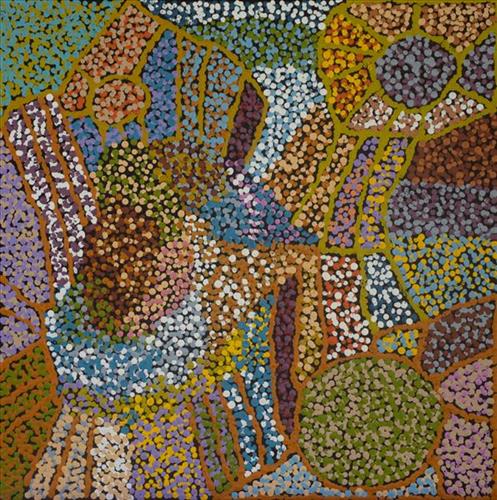
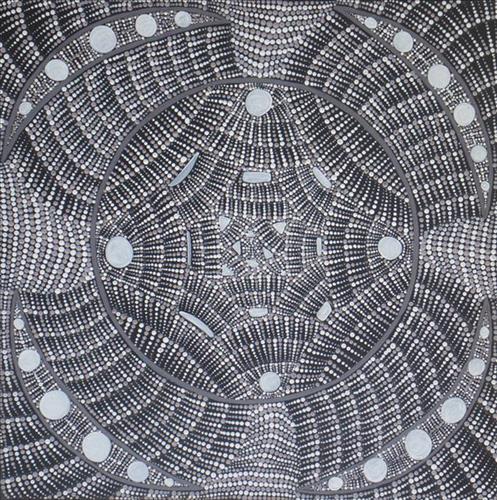
Kulyakartu
This painting depicts Kulyakartu, the artists grandfathers country where family used to live, north – east of Martu country. It shows the Tali or tuwa (sand hills) and the small creeks (karru) and the desert plants.
377815582333036
Untitled
377815582333035
Untitled
377815582333032
Untitled
111982333028
Lorrkon (Hollow Log)
The Lorrkon or bone pole coffin ceremony was the final ceremony in a sequence of mortuary rituals celebrated by the people of Arnhem Land. This ceremony involves the placing of the deceased’s bones into a hollow log which was decorated with painted clan designs and ceremonially placed into the ground where it remained until it slowly decayed over many years.
The log is made from a termite hollowed Stringybark tree (Eucalyptus tetradonta) and is decorated with totemic emblems. The western Arnhem Land version of the Lorrkon ceremony involves the singing of sacred songs to the accompaniment of karlikarli, a pair of sacred boomerangs used as rhythm instruments. During the final evening of the ceremony, dancers decorate themselves with kapok down, or today, cotton wool and conduct much of the final segments of the ceremony in the secrecy of a restricted mens’ camp. The complete ceremony may stretch over a period of two weeks, but on the last night the bones of the deceased, which have been kept in a bark container or today wrapped in cloth and kept in a suitcase are taken out, are painted with red ochre and placed inside the hollow log. This ceremony may take place many years after the person has died.
At first light on the final morning of the Lorrkon ceremony, the men appear, coming out of their secret bush camp carrying the pole towards the women’s camp. The two groups call to each other using distinct ceremonial calls. The women have prepared a hole for the pole to be placed into and when it is stood upright, women in particular kinship relationships to the deceased dance around the pole in a jumping/shuffling motion. The Lorrkon is then often covered with a tarpaulin and left to slowly decay.
111982333027
Nawarlah – Brown River Stingray
We hunt the Nawarlah (Brown River Stingray) during the wet season. There is a plant with a yellow flower that tells us that it is the right time. We know it will be fat.
It is well known that Aboriginal art often depicts images of sacred totems or dreamings of Aboriginal culture. However, the world of the non-sacred also provides a rich source of subject matter for Aboriginal art. Much of the rock art of western Arnhem Land for example features secular topics such as common food animals and plants, depicted because of their economic importance but also merely because of their existence in the environment.