111582329965


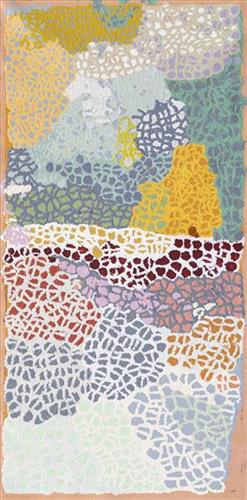
Laripuka

Laripuka is a waterhole kayili (north) of the Percival Lakes region of Western Australia’s Great Sandy desert. This is Yikartu’s ngurra (home Country, camp); she was born here. Yikartu recalls travelling here with her family and Grandmother in the pujiman (traditional, desert dwelling) days.

The Western Desert term ‘ngurra’ is hugely versatile in application. Broadly denoting birthplace and belonging, ngurra can refer to a body of water, a camp site, a large area of Country, or even a modern house. People identify with their ngurra in terms of specific rights and responsibilities, and the possession of intimate knowledge of the physical and cultural properties of one’s Country. This knowledge is traditionally passed intergenerationally through family connections. Painting ngurra, and in so doing sharing the Jukurrpa (Dreaming) stories and physical characteristics of that place, has today become an important means of cultural maintenance. Physical maintenance of one’s ngurra, like cultural maintenance, ensures a site’s wellbeing, and is a responsibility of the people belonging to that area.
111582329964


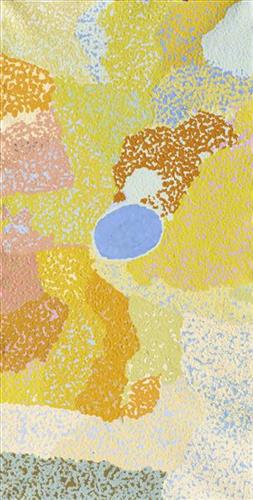
Jupurrl

“This one a yinta (permanent springs) in my ngurra (home Country, camp), Jupurrl. It’s kakarra (east) of Kulyakartu and kayili (north) side of Wirnpa. I was a married woman when I was walking around this place, pujiman (traditional, desert dwelling) time. I married a good man. There’s lots of kapi (water) there. Lots of yukari (green grass, vegetation). Plenty of bushtucker, pussycat and goanna. There’s no kapi when you first get there, but you dig him up and then there’s lots of kapi. We’ve got to take all the kids to that ngurra. Show them my daddy’s ngurra. There’s another waterhole, not far from there called Jakapinka. A jila (snake) made that kapi. It’s my brother’s Country.”

– Yikartu Bumba


During the pujiman (traditional, desert dwelling) days, Yikartu and her family travelled extensively through this Country. At this time Martu would traverse very large distances annually in small family groups, moving seasonally from water source to water source, and hunting and gathering bush tucker as they went. Knowledge of water sources was critical for survival, and today Martu Country is still defined in terms of the location and type of water. Each of the hundreds of claypans, rockholes, waterholes, soaks and springs found in the Martu desert homelands is known by name, location, quality and seasonal availability through real life experience and the recounting of Jukurrpa (Dreaming) narratives. 

225182329941


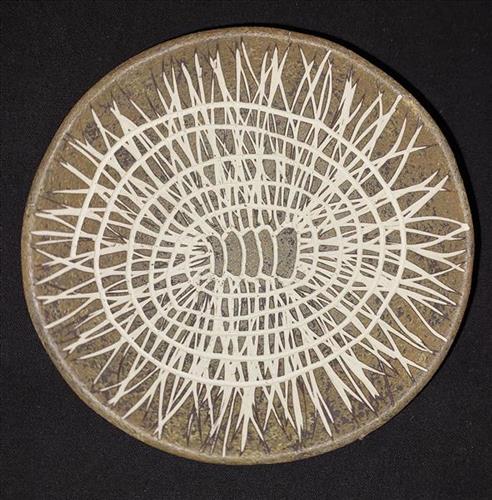
Kakan (Black Palm) Basket Weaving

This design shows how the bottom part of a black palm basket is woven. My grandmothers and aunties used to make them. They cut off the young palm leaves in the centre, stripped and scrapped them. Then they would put the strips in freshwater to make them soft and keep them straight for weaving.

225182329940


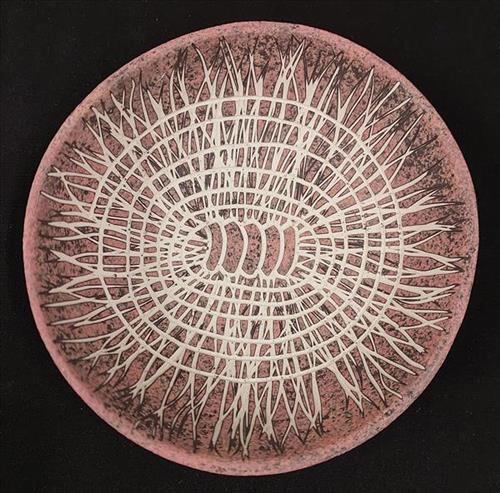
Kakan (Black Palm) Basket Weaving

This design shows how the bottom part of a black palm basket is woven. My grandmothers and aunties used to make them. They cut off the young palm leaves in the centre, stripped and scrapped them. Then they would put the strips in freshwater to make them soft and keep them straight for weaving.

225182329939


Mossman River Design

The Mossman River is very important to me and my family. Laurence, my partner and the father of our 5 children, is one of the Traditional Owners of this area. We both grew up along the river and Laurence’s grandparents used to live in a hut next to the river. In the hot season, we used to camp there with our families. Laurence would teach me and later our children how to dive for turtle and fish. We would cross the river to hunt and collect bush food. Back at the camp, we would make fire, cook our damper and fish in an earth oven and share with our families.

225182329938


Mossman River Design

The Mossman River is very important to me and my family. Laurence, my partner and the father of our 5 children, is one of the Traditional Owners of this area. We both grew up along the river and Laurence’s grandparents used to live in a hut next to the river. In the hot season, we used to camp there with our families. Laurence would teach me and later our children how to dive for turtle and fish. We would cross the river to hunt and collect bush food. Back at the camp, we would make fire, cook our damper and fish in an earth oven and share with our families.

225182329937


Mossman River Design

The Mossman River is very important to me and my family. Laurence, my partner and the father of our 5 children, is one of the Traditional Owners of this area. We both grew up along the river and Laurence’s grandparents used to live in a hut next to the river. In the hot season, we used to camp there with our families. Laurence would teach me and later our children how to dive for turtle and fish. We would cross the river to hunt and collect bush food. Back at the camp, we would make fire, cook our damper and fish in an earth oven and share with our families.

225182329936


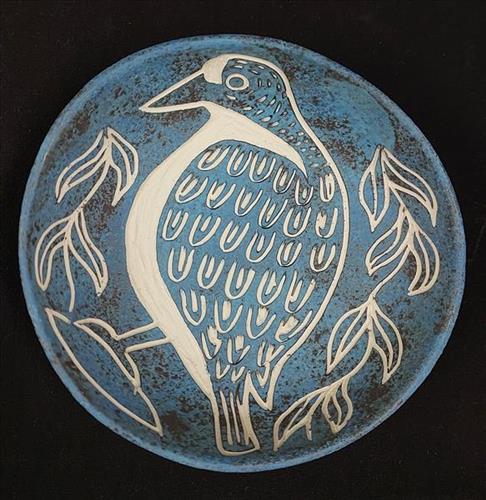
Yindili (Kingfisher)

The Kingfisher, known as Yindili in Kuku Yalanji language, is according to our culture one of the significant messenger birds.  The Kingfisher will let us know when to expect a visit from families living in another community, And when we see a Kingfisher close by, we know that something good will soon happen in our personal life.