111582330115


Frogs Egss

Martumili Artists work with over three hundred artists from remote Martu Aboriginal communities, including Punmu, Parnngurr, Kunawarritji, Jigalong, Irrungadji (Nullagine), and Warralong, as well as from the Parnpajinya (Newman) gallery and studio spaces. Known for their diverse, energetic, and unmediated painting styles, their works reflect the dramatic geography and scale of their homelands. Each artist, however, brings a unique approach to their craft.

Younger Martu artists often start painting alongside their parents, grandparents, and extended family, which fosters an organic learning process. This not only involves mastering painting techniques but also understanding specific locations, family histories, traditional ways of life, bush tucker, and Jukurrpa (Dreaming). Over time, with encouragement from their peers, they develop their own distinct styles and explore unique painting techniques and subject matter. In this work the artist brings a contemporary, evolving perspective to their work.

111582330114


Pujiman (Traditional, Desert Dwelling)

“This painting is of pujiman (traditional, desert dwelling) [people]. It’s around Parnngurr area. The men are getting ready to go hunting. There’s dingoes; Pujiman would get ’em as a little baby and raise ’em up to keep as hunting dogs. [There’s] Kids staying home, and women too. Shade is made from spinifex. Not much of a shelter but to keep the heat away.”

– Noreena Kadibil


Depicted in this work is a scene of everyday pujiman (traditional, desert dwelling) life at Parnngurr rockhole as communicated to Noreena by her parents and grandparents. Parnngurr rockhole is located just south of Parnngurr Aboriginal community. At the junction of three linguistic groups; Manyjilyjarra, Kartujarra, and Warnman, it was a critical and permanent source of water during the pujiman era that supported many ritual large gatherings. During this nomadic period families stopped and camped here depending on the seasonal availability of water and the corresponding cycles of plant and animal life on which hunting and gathering bush tucker was reliant. At Parnngurr and other similarly important camp sites families would meet for a time before moving to their next destination. Parnngurr and its surrounds are physically dominated by distinctively red tali (sandhills), covered sparingly with spinifex and low lying shrub.

Parnngurr is also important site chronicled in the epic Jukurrpa (Dreaming) story of the Minyipuru (Jakulyukulyu, Seven Sisters). The sisters stopped to rest on Parnngurr Hill before continuing on their long journey east. Minyipuru is a central Jukurrpa narrative for Martu, Ngaanyatjarra, Pitjantjatjara and Yankunytjatjara people that is associated with the seasonal Pleiades star constellation.

It is of great significance to the creative output of Martumili Artists that some of the last of the remaining pujimanpa (traditional, desert dwellers) comprise a high portion of the core elders that paint with the group. Through these elders critical traditional cultural and social knowledge has been, and continues to be, passed on to younger Martu artists; knowledge from the pujiman (traditional, desert dwelling) era. At this time Martu traversed very large distances annually in small family groups, moving seasonally from water source to water source, and hunting and gathering bush tucker as they went. 

Whilst desert life has moved away from mobile hunter-gatherer subsistence throughout the course of the twentieth century, all Martumili Artists, young and old, have regular experience of the practices that most closely approximate the pujiman lifestyle. Living between Newman and the remote Martu communities of Punmu, Parnngurr, Kunawarritji, Jigalong, Irrungadji (Nullagine) and Warralong, knowledge of Jukurrpa (Dreaming) narratives, kapi (water) location and quality, and the medicinal properties of native plants, as well as the continued practices of hunting, gathering, and waru (fire) burning are all transferred to younger generations as integral components of everyday life. 

In addition to strong cultural and social maintenance through life in Aboriginal communities, cultural knowledge is transferred through visual arts as practiced by Martumili Artists. Younger Martu artists typically begin painting with their parents, grandparents and extended family, thus fostering an organic process of learning, not only about painting techniques, but also specific locations, family histories, traditional ways of life, bush tucker and Jukurrpa.

111582330113


Wuukurta (Honey Ants)

Wuukurta (honey ants) are found in a variety of arid or semiarid environments, with nests of up to two metres deep and more than two metres across. Wuukurta are a highly sought after bush tucker, known otherwise as ‘bush lollies’ due to their sweet, honey like taste. They are eaten whilst still alive by holding the head and legs between two fingers and biting off the thorax. Martu dig for wuukurta nests through the seasons, but they are known to be especially abundant following the rains.

During the pujiman (traditional, desert dwelling) period, Martu would traverse very large distances annually in small family groups, moving seasonally from water source to water source, and hunting and gathering bush tucker as they went. Whilst desert life has moved away from mobile hunter-gatherer subsistence throughout the course of the twentieth century, bush tucker continues to be a significant component of the modern Martu diet. Hunting and gathering bush tucker remains equally valuable as an important cultural practice that is passed on intergenerationally. Though hunting and gathering implements have been modernised, methods of harvesting, tracking and the use of fire burning to drive animals from their retreats are still commonly practiced today.

111582330112


Wild Flowers

This work depicts the remarkably diverse flora found through Martu Country. These plants are not only vital as significant food sources, but also celebrated for their aesthetic splendour. In the context of the often harsh and arid environments in which desert flowers bloom, their vibrancy, delicacy, and variation become even more spectacular. 

111582330111


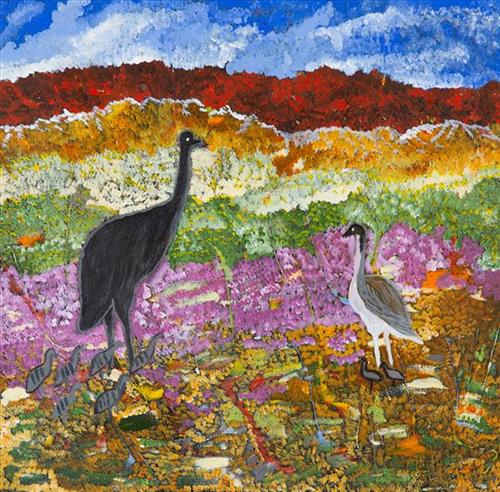
Karlaya (Emu) and Kipara (Bush turkey) Jukurrpa (Dreaming)

“This is the story of the Karlaya (Emu) and Gibbra (bush turkey). They could both fly until the gibbra tucked its wings telling the emu it couldnt fly and that they should cut their wings too, the emu was tricked by the gibbra and cut its wings. The emu felt very sorry for itself. The emu then hid all but two of its chicks telling the gibbra its hard to feed any more, the gibbra was tricked and killed all but two of its chicks, the emu then called back the rest of their chicks. That was the pay back.” -Noreena Kadibil The term Jukurrpa is often translated in English as the ‘dreaming’, or ‘dreamtime’. It refers generally to the period in which the world was created by ancestral beings, who assumed both human and nonhuman forms. These beings shaped what had been a formless landscape; creating waters, plants, animals, and people. At the same time they provided cultural protocols for the people they created, as well as rules for interacting with the natural environment. At their journey’s end, the ancestral beings transformed themselves into important waters, hills, rocks, and even constellations. Kipara (Australian Bustard, bush turkey) are ground-dwelling, large, speckled grey-brown birds found in the plains of the Western Desert and across northern Australia. Kipara fly long distances in the search of food, and were once widespread among the plains of Australia. However, following colonisation they have become increasingly rare. Kipara often travel in groups, and walk slowly, picking at food such as jinyjiwirrily (wild gooseberry, desert raisin), and are usually found at twilight and after dark. Kipara are known by Martu to be attracted to burn areas in the nyurnma (freshly burnt) and waru-waru (green shoots and young plants are sprouting from burnt areas) stages. Traditionally, kipara were stalked and then wounded whilst taking off using a karli (boomerang). Today, kipara are generally hunted with rifles from vehicles, enabling a close range approach. Also depicted in this work are karlaya (emus); large, flightless birds endemic to Australia, and found across the whole country. Emus have been hunted by Martu people as a source of bush tucker from the pujiman (traditional, desert dwelling) era through to today. Typically, emus were tracked using their distinctive jina (tracks, footprints). Acute skill in track observation and identification traditionally possessed by Aboriginal people developed directly in relation to their past hunter-gatherer existence, when survival depended in large part on the successful tracking of hunted animals. In the absence of an actual animal sighting, tracks act as an identifier that an animal was present, which were then followed to the animal’s location. Once caught, the emu and its eggs were consumed, fat was harvested for several medicinal applications, bones were shaped into tools, feathers were used for adornment, and tendons substituted for string. During the pujiman period, Martu would traverse very large distances annually in small family groups, moving seasonally from water source to water source, and hunting and gathering bush tucker as they went. Whilst desert life has moved away from mobile hunter-gatherer subsistence throughout the course of the twentieth century, bush tucker continues to be a significant component of the modern Martu diet. Hunting and gathering bush tucker remains equally valuable as an important cultural practice that is passed on intergenerationally. Though hunting and gathering implements have been modernised, methods of harvesting, tracking and the use of fire burning to drive animals from their retreats are still commonly practiced today.

220182330026


Yalpirakinu

Yalpirakinu is Adrian’s mother’s country. Adrian’s mother is the late Eunice Napangardi, a well known painter herself. His artworks consistently refer to the desert mountains, ridges and trees which are part of Yalpirakinu. Using a restricted colour palette, Adrian’s  brushwork is loaded with energy, drama and memories. He is a deliberate and thoughtful painter; reworking, pushing and pulling the image to completion.

220182330025


Family in Yalpirakinu

Yalpirakinu is Adrian’s mother’s country. Adrian’s mother is the late Eunice Napangardi, a well known painter herself. His artworks consistently refer to the desert mountains, ridges and trees which are part of Yalpirakinu. Using a restricted colour palette, Adrian’s brushwork is loaded with energy, drama and memories. In this painting Adrian has drawn from his memory to portray his family in Yalpirakinu.

220182330022


Family in Yalpirakinu

Yalpirakinu is Adrian’s mother’s country. Adrian’s mother is the late Eunice Napangardi, a well known painter herself. His artworks consistently refer to the desert mountains, ridges and trees which are part of Yalpirakinu. Using a restricted colour palette, Adrian’s brushwork is loaded with energy, drama and memories. In this painting Adrian has drawn from his memory to portray his family in Yalpirakinu.