11153038090


Jartijiti Kapi

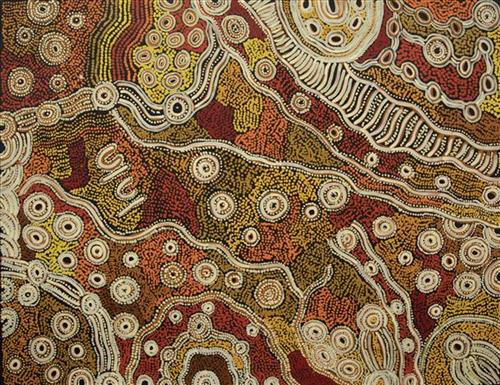
‘Jartijiti’ is how Martu people pronounce ‘33’, the colloquial name for the Kunawarritji community where Bugai lives and paints. Kunawarritji is an important site in the Great Sandy Desert where multiple stories and histories intersect. Originally an important spring kapi (water), at the turn of the 20th century Kunawarritji became a well (Well 33) along the Canning Stock Route. Each year throughout the 1930-50s, the well became a site of contact between the drovers, their cattle, and desert families such as Bugai’s. Long before colonial history entered this country, other stories dominated this site. In the Jukurrpa (Dreaming), the Minyi Puru (Seven Sisters) stopped here and shaped a number of landforms before continuing on their epic journey east across the desert. Today, Kunawarritji is a site of return, a place where people have come back to continue making their life in the desert. Bugai continues to live at and look after ‘Jartijiti’ today, painting it and the many other life-giving waterholes of her country further south along the Stock Route.

220982050893


View Of Country

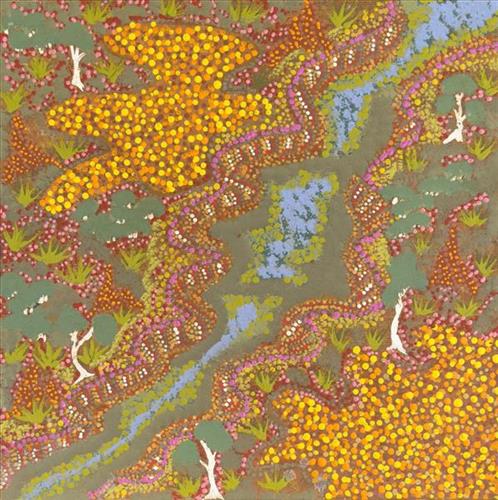
This shows the layered landscape of Alyawarr, Central Australia. Knowing your country is an important part of living in a remote community like Ampilatwatja.

Knowing when and where to go hunting and gathering, knowing where there is ‘soakage’ (where you can dig for water), travelling with family for ceremonies, and maintaining a connection with the land.

“This is my country, my view of country.”

The community of Ampilatwatja made a conscious decision not to paint altyerr (dreaming stories). The artists paint their country where those stories sit.


115682361756


Warrnyu Dhawu (Flying Fox Story)

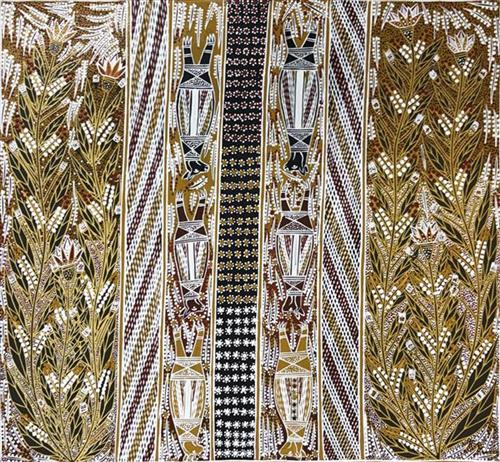
Back in the Creation time, Warrnyu (Flying Foxes) once lived, like men, in the cave at the place called Kurrki Warrnyu Yirri Djaringal (they also lived in caves called Wadatilmurr & Gurngurmirrngu). Warrnyu lived in these caves for many years and then one day Djanyarr (The Dog), an ancestral being in the form of a man, came along. He was looking around for a place to live. Djanyarr heard the sound of a Flying Fox screaming. He went down to the cliff and pushed the rock and the water came out at the Ganalbingu place called Gurrkawakarrmurr. He then went into the cave and into the sacred hole, frightening all the Flying Fox away. When he went into the hole he left his dilly bag in the tree and went out on the other side of the sacred cave and leaving his spear and woomera. He sat there for a long time. The Dog made three streams and the water went inside the cave. Two of these streams are good drinking water. In the middle it is a sacred water. No-one drinks from the middle of the stream. Children, men, women, young boys or girls are not allowed to drink from the middle of the stream. If they drink the water from the middle of the stream they will go grey too early.

At Kurrki Warrnyu Yirri Ngilaya Djaringal, the Flying Fox made himself into a young man… that’s what Aboriginal people do today. They have ceremonies and dances to make the young boys into men. The songs are called Yirrarwu, Gulumu, Rruburra and Burryun. Dhapi (initiation ceremony) happen today because the Warrnyu (Flying Fox) people performed them a long time ago before the Yolngu people. It was the Warrnyu people who first performed circumcision of the young boys to make them into men. It all happened at Kurrki Warrnyu Yirri Ngilaya Djaringal, this is how this place got its name.

Leaving behind the cave at Kurrki Warrnyu Yirri Djaringal, the Dog travelled west across the Arafura Swamp and came to Djalkulmurr (Mount Delight). From there he travelled north and came to Dunganda (a hill situated a few kilometres east of Ramingining). There he met a female Dog, then they both headed north and came to a place called Garanydjirrmurr where they spoke the Mildjingi language. From Garanydjirrmurr they changed their direction and went west through Guliny’barra, Burgumara and onto the plains. When they reached the plains they smelled something cooking, way up in the north – at Wessel Islands. The aroma they smelt was so enticing that they decided to go there. Lungurrma (the north-east wind) was carrying the smell. One Dog headed north again, but the other Dog decided not to go with him and went back the opposite way. The first Dog that went to Malwanatharra (Sandy Point) went into the sea following its nose to wherever the smell was coming from. It is believed that this Dog still lives in the sea…

377810582363422


Man-ngarre (Native Grasses)

Designed 2007

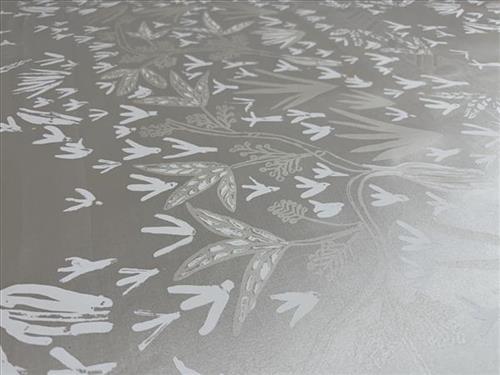
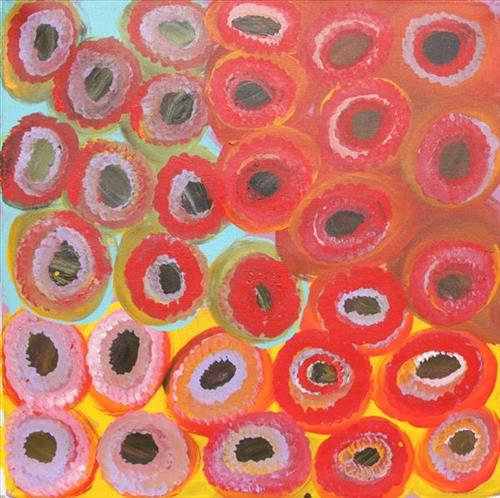
Elizabeth had a distinctive artistic style, depicting the natural world with loose, organic strokes. Her style was evident in her key designs Kun-ngol (clouds), showing the cloud formations over her floodplain country after the wet season, and the fine detail of Kun-kirh (mud ripples) depicting cracked mud in the sun during dry season. Elizabeth was close family with Janet Marawarr, Lucy Yarawanga and Raylene Bonson, leading artists at Bábbarra.

This design celebrates the grasses of Arnhem land, the spear grass, Sorghum intransthat grows in the wet season and dies off or is burnt during the dry season.

221282363457


Tjanmata – Bush Onion

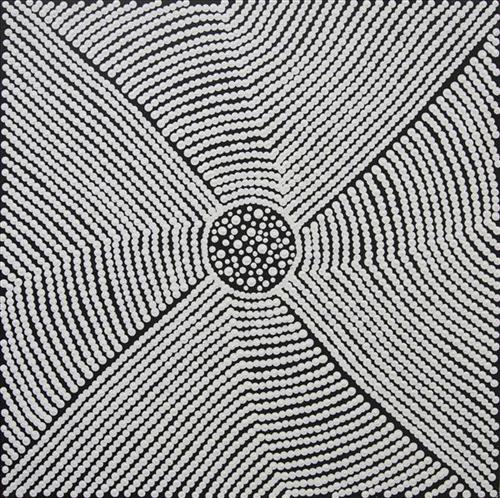
Tanmata or bush onions are found near creek beds on the Aṉangu Pitjantjatjara Yankunytjatjara (APY) Lands in the remote northwest of SA. Aṉangu bake the small bulbs in hot ashes and then remove the outer papery covering (nyiri) before eating them.

Until comparatively recently, bush foods were the primary source of sustenance for Aṉangu Pitjantjatjara. Many bush foods are still gathered regularly, almost exclusively by women, and they therefore feature strongly in women’s mark making. Women learn the art of gathering each of the foods from a young age and much inma (ceremony) relates to these practices and the maintenance of supply.

221282363456


Tjanmata – Bush Onion

Tanmata or bush onions are found near creek beds on the Aṉangu Pitjantjatjara Yankunytjatjara (APY) Lands in the remote northwest of SA. Aṉangu bake the small bulbs in hot ashes and then remove the outer papery covering (nyiri) before eating them.

Until comparatively recently, bush foods were the primary source of sustenance for Aṉangu Pitjantjatjara. Many bush foods are still gathered regularly, almost exclusively by women, and they therefore feature strongly in women’s mark making. Women learn the art of gathering each of the foods from a young age and much inma (ceremony) relates to these practices and the maintenance of supply.

221282363454


Tjitji Tjuta Walytjata

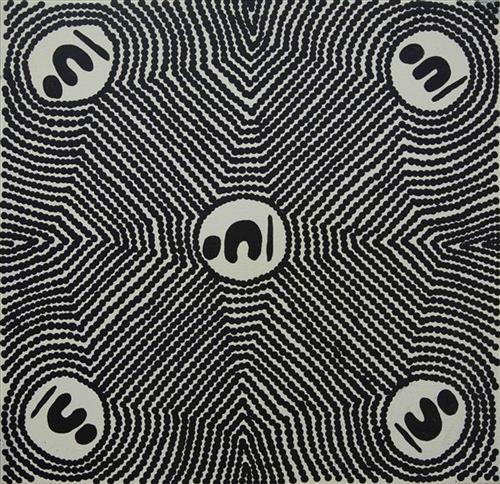
This Tjukurpa is from a place called Walytjata near Pipalyatjara. It’s a true story. You can see all the kids sitting there in the cave. The mother left and told the kids to stay there, but she never came back. It’s a sad story. The older brother, he was looking after everyone. He would go out hunting for malu (kangaroo), kalaya (emu) and bring back the kuka (meat) for all the kids.

221282363451


Kungkarangkalpa / Seven Sisters

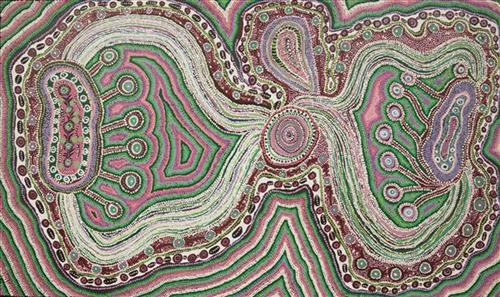
Kungkarangkalpa means the Seven Sisters. This is an extensive creation story that relates to the Pleiades constellation in the southern hemisphere. The story traverses Australia taking on different forms, however local women are privy to the part of the story which takes place in the country near Ernabella. For this part of the story, the man called Nyiru is chasing the sisters as he wants to sleep with the oldest sister. All the younger sisters are deeply afraid of him. As Nyiru is chasing the sisters, he tries to catch them by using magic to turn himself into the most tempting bush tomatoes for the sisters to eat and the most beautiful ili (fig) tree for the sisters to camp under. However, the sisters are aware of his magic and go hungry and run through the night rather than be caught by Nyiru. Eventually, to escape Nyiru, the sisters fly into the sky where they turn into stars and form the constellation.

221282363449


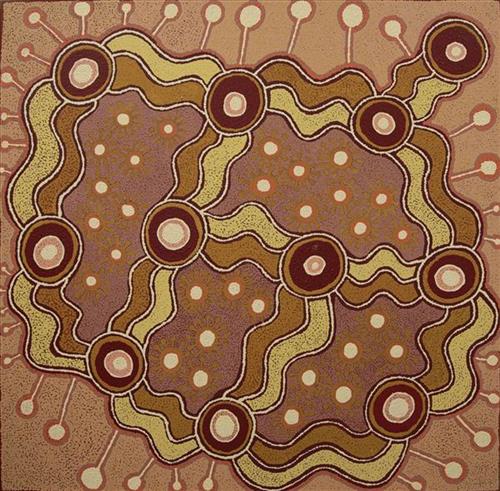
Tjukula/Waterholes

For the Pitjantjatjara people living in the desert, knowledge of their water sources was critical to their survival. This resulted in an intimate understanding of the landscape which continues today. Water is an essential element in the desert. These rock holes were particularly important during the dry season when most of the water holes and creeks dried up.  Deep familiarity with the topography of their country and the way rain would interact with the land ensured constant sources of water could be found. Knowledge of rock hole sites is passed on from generation to generation and revered by all Anangu (people).

Tjukula means rock-holes, which are found with surprising frequency in the Musgrave Ranges and country around Ernabella.  Between visits, Anangu would use a construction of rocks and spinifex to guard these important water sources from spoilage by feral and stock animals such as cattle, camels, horses and donkeys.

221282363446


Minyma Kutjara

There is a story of deep significance to women which contains metaphorical references to female cycles. It tells of two women travelling north. The pair meet with a group of women, including Kutungu, who are caring for a man who then passes away. They then travel to the area known as Mantaruta, near Uluru, where they chase a curious wanampi (serpent) deep into the ground while trying to catch him. They burn their body hair to attract him and hit him on the head and run away. From afar they throw a manguri/traditional head-ring for carrying which also hits him. He then comes and hits the women who travel on bleeding and hurt.