221382361261


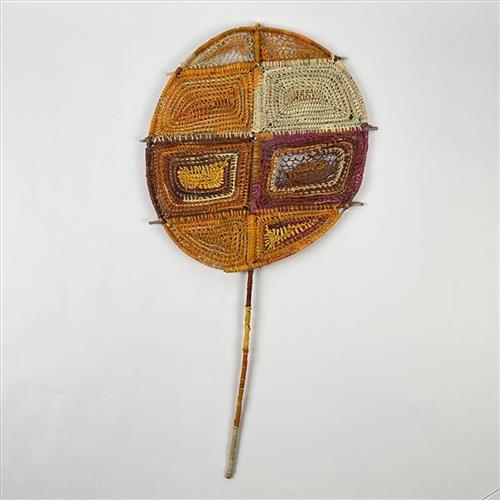
Woven Pandanus Stingray

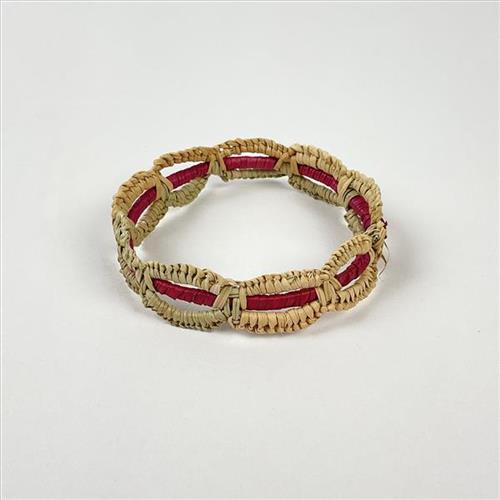
Fibre Art is an ancient Aboriginal women’s craft that is still made today using the same techniques as their ancestors. Making fibre art is labour intensive and much care and fine needlework is required to ensure the finished object is both functional and beautiful. Fibre art from Ghunmarn Culture Centre includes dilly bags, floor mats, bush fans, woven creatures found in the landscape, plants such as yams (bush potato), baskets, place mats, and spirit figures such as mermaids and Mukuys. Natural pandanus fibre (Mukarra), is used to make much of the fibre art produced by the artists of Djilpin Arts. Women collect the pandanus by pulling from the top of the pandanus tree, then stripping and drying the leaves before they are dyed with natural bush colour collected from the Beswick surrounds.

221382361251


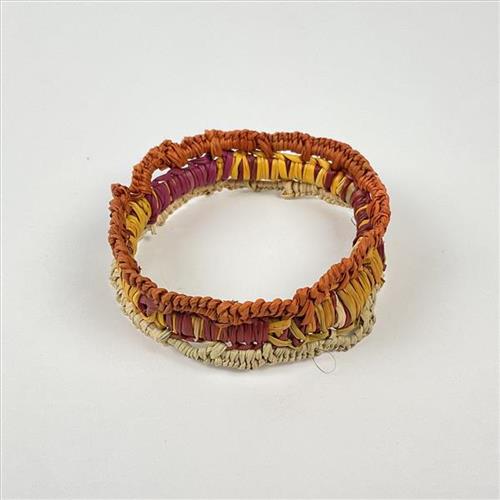
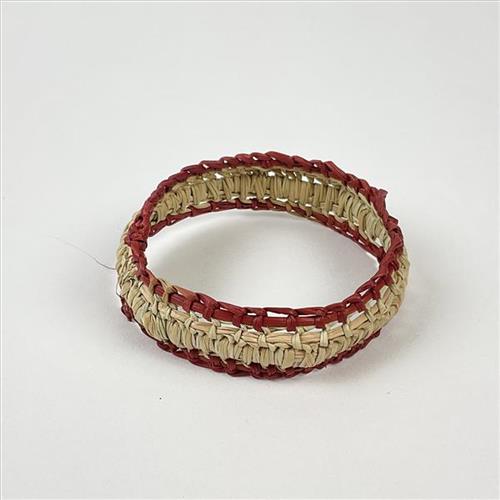
Bracelet

Djilpin Arts is a not for profit Aboriginal Corporation that promotes the maintenance, development and transmission of traditional cultural knowledge systems.

Djilpin Arts specialises in art, live cultural performance, digital media, and produced the popular performance event – the Walking With Spirits Festival as well as Concerts on Country.

Djilpin Arts operates the Ghunmarn Culture Centre – home of the Blanasi Collection and offers fine arts & crafts for sale. Djilpin Arts operates an outlet in Katherine – Shed 5, where all works are sourced from Ghunmarn Culture Centre. Ghunmarn Culture Centre is in the Wugularr (Beswick) community of South East Arnhem Land.

All artworks are made by local artists living in the community. Artwork reflects the traditional songs and stories that have been passed down through the generations with a contemporary edge.  Fibre art is a special feature of Djilpin Arts as is its Gapu Series of fine art prints.

221382361250


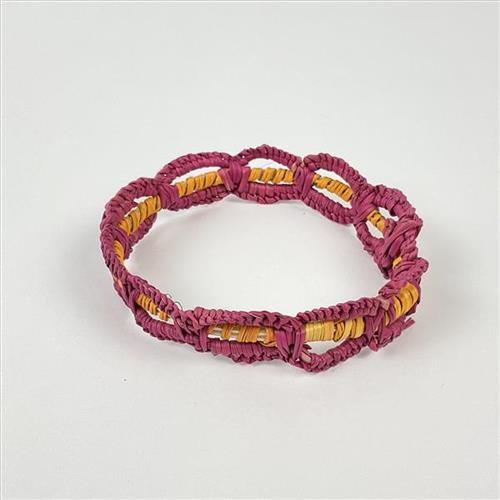
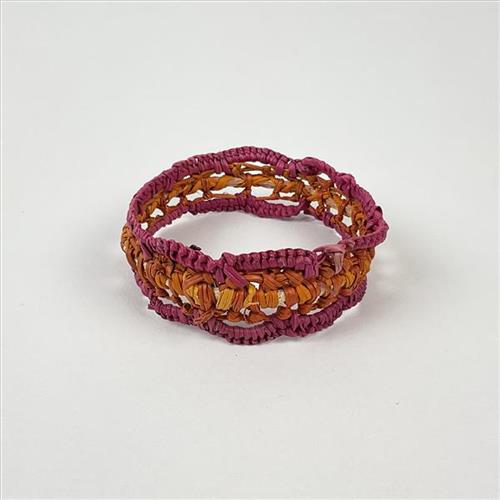
Bracelet

Djilpin Arts is a not for profit Aboriginal Corporation that promotes the maintenance, development and transmission of traditional cultural knowledge systems.

Djilpin Arts specialises in art, live cultural performance, digital media, and produced the popular performance event – the Walking With Spirits Festival as well as Concerts on Country.

Djilpin Arts operates the Ghunmarn Culture Centre – home of the Blanasi Collection and offers fine arts & crafts for sale. Djilpin Arts operates an outlet in Katherine – Shed 5, where all works are sourced from Ghunmarn Culture Centre. Ghunmarn Culture Centre is in the Wugularr (Beswick) community of South East Arnhem Land.

All artworks are made by local artists living in the community. Artwork reflects the traditional songs and stories that have been passed down through the generations with a contemporary edge.  Fibre art is a special feature of Djilpin Arts as is its Gapu Series of fine art prints.

221382361249


Bracelet

Djilpin Arts is a not for profit Aboriginal Corporation that promotes the maintenance, development and transmission of traditional cultural knowledge systems.

Djilpin Arts specialises in art, live cultural performance, digital media, and produced the popular performance event – the Walking With Spirits Festival as well as Concerts on Country.

Djilpin Arts operates the Ghunmarn Culture Centre – home of the Blanasi Collection and offers fine arts & crafts for sale. Djilpin Arts operates an outlet in Katherine – Shed 5, where all works are sourced from Ghunmarn Culture Centre. Ghunmarn Culture Centre is in the Wugularr (Beswick) community of South East Arnhem Land.

All artworks are made by local artists living in the community. Artwork reflects the traditional songs and stories that have been passed down through the generations with a contemporary edge.  Fibre art is a special feature of Djilpin Arts as is its Gapu Series of fine art prints.

221382361248


Bracelet

Djilpin Arts is a not for profit Aboriginal Corporation that promotes the maintenance, development and transmission of traditional cultural knowledge systems.

Djilpin Arts specialises in art, live cultural performance, digital media, and produced the popular performance event – the Walking With Spirits Festival as well as Concerts on Country.

Djilpin Arts operates the Ghunmarn Culture Centre – home of the Blanasi Collection and offers fine arts & crafts for sale. Djilpin Arts operates an outlet in Katherine – Shed 5, where all works are sourced from Ghunmarn Culture Centre. Ghunmarn Culture Centre is in the Wugularr (Beswick) community of South East Arnhem Land.

All artworks are made by local artists living in the community. Artwork reflects the traditional songs and stories that have been passed down through the generations with a contemporary edge.  Fibre art is a special feature of Djilpin Arts as is its Gapu Series of fine art prints.

221382361247


Bracelet

Djilpin Arts is a not for profit Aboriginal Corporation that promotes the maintenance, development and transmission of traditional cultural knowledge systems.

Djilpin Arts specialises in art, live cultural performance, digital media, and produced the popular performance event – the Walking With Spirits Festival as well as Concerts on Country.

Djilpin Arts operates the Ghunmarn Culture Centre – home of the Blanasi Collection and offers fine arts & crafts for sale. Djilpin Arts operates an outlet in Katherine – Shed 5, where all works are sourced from Ghunmarn Culture Centre. Ghunmarn Culture Centre is in the Wugularr (Beswick) community of South East Arnhem Land.

All artworks are made by local artists living in the community. Artwork reflects the traditional songs and stories that have been passed down through the generations with a contemporary edge.  Fibre art is a special feature of Djilpin Arts as is its Gapu Series of fine art prints.

115682361180


Woven Mat

Yolŋu weavers of Arnhem Land create utilitarian, ceremonial, and decorative pieces using naturally sourced materials. This mat is made from young Pandanus spiralis leaves, harvested with a wooden hook, stripped of prickles, and dried to create strong, resilient fibres. These fibres are then twisted, coiled, or woven using traditional techniques to produce both functional and decorative mats.

Bula’bula weavers exclusively use natural dyes, derived from locally sourced roots, leaves and grasses. These pigments are extracted and infused into pandanus fibres by boiling over an open fire, producing the rich, vibrant colours characteristic of contemporary Yolŋu weavings.

Traditionally, Nganiyal (conical mats) functioned as insect screens when erected and as seating mats when folded, playing an important role in both daily life and ceremonial practices. Today, Yolŋu artists create a variety of shapes, including flat, round, and oblong mats. These non-traditional styles and the use of bright colours became more common after Missionaries began commissioning pieces in this style.

111582361530


Parnngurr School

“In 1984 my nyupa (partner) Mr Williams and I moved our family from Jigalong to Parnngurr community. Our five children were all young back then. People wanted to mine at Parnngurr. There was lots of drilling going on.

There wasn’t much out there when Parnngurr community formed, just a bow shelter, a windmill and a 44 gallon drum.

We worked hard for there to be a good school in community. If there was going to be teachers at the school they needed somewhere to live. The first teacher to work at Parnngurr school lived in a caravan. I worked alongside her at the school.

The school is different now. It’s grown a lot. There are more buildings, and a new basketball court was recently built. A lot of people have worked hard to make the school a good place.

This painting shows the Parnngurr School and two of my granddaughters, Yvette and Jessica. My granddaughters attended Parnngurr School when they were kids, they’re teenagers now.”

 – Noreena Kadibil


Noreena Kadibil is a Martu artist currently living in Parnngurr community. Noreena is known for her historical paintings, sharing significant family histories through her work. Noreena regularly paints the Parnngurr School. Community schools are vital components of remote communities, enabling young families to continue living in community, providing employment and an opportunity for two-way learning.

Noreena has close ties to Parnngurr School. She was employed as a Martu teacher when the school was first formed, and many of her children and grandchildren have either attended or been employed by the school. Depicting her grandchildren alongside Parnngurr School illustrates the continuing importance of the school within Noreena’s family and the wider community.


111582361525


Mulyamiji

“Mangkarr (greater bilby), nurta (desert bandicoot), winyminji (quoll): those three animals, we protect them now. The old people use to eat the animals and we’re working with the KJ [Kanyirninpa Jukurrpa] ranger mob to protect them. Mangkarr is taller than nurta. This one [nurta] is stumpy like a guinea pig. Winyminji is the same size as a cat. It’s like a cat.” 

– Carol Williams


Mankarr (greater bilby) is an omnivorous desert-dwelling mammal found in a range of arid habitats across northwestern and central Australia, including rocky soils, shrublands, woodlands and spinifex regions. Its fur is usually grey or white, and it has a long, sharp nose and long pinkish ears. At the time of European colonisation of Australia, there were two species. The lesser bilby became extinct in the 1950s, and while the greater bilby has survived, it remains  a threatened species.

Nurta (desert bandicoot) was a bandicoot found in the central and western desserts up until 2016. It is now considered to be extinct. Small in size, the nurta had a long and narrow head which aided its investigation of the sand while digging. The nurta featured orange-brown fur on its back, with a white underbelly and one or two dark bands on the hindquarters. The decline and extinction of the desert bandicoot is attributed to a range of factors including predation by cats and foxes, and habitat destruction due to the combined impact of introduced exotic herbivores and to the cessation through large areas of culturally historical fire burning land management practices. 

Winyminji (quolls) are carnivorous marsupials also native to Australia. They are primarily nocturnal and spend most of the day in a den. They have brown or black fur and pink noses. Largely solitary, they come together for social interactions such as mating, which occurs during the winter season. The quolls’ diet includes smaller mammals, small birds, lizards, and insects.

Since European colonisation of Australia, all species depicted in this work have experienced a significant decline in number. One species, the eastern quoll, became extinct in the 1960s. As described by Carol, the preservation and conservation of the mangkarr and winyminji are managed as part of the Kanyirninpa Jukurrpa ranger program.
116482361466


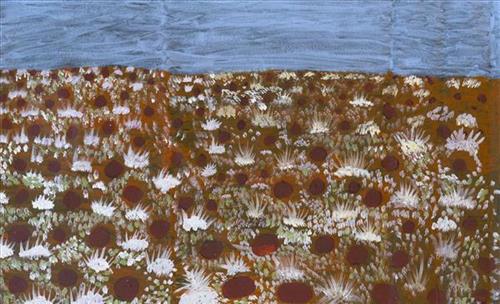
Wild bush onion and flowers

These are the wild bush onions and beautiful flowers that grow after the rains through our beautiful Pilbara Ngurra (Country).