111582438724


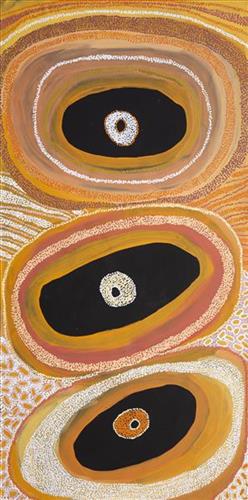
Mungili Rock Holes

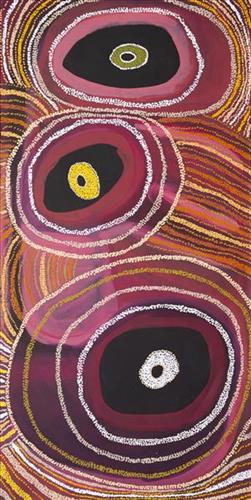
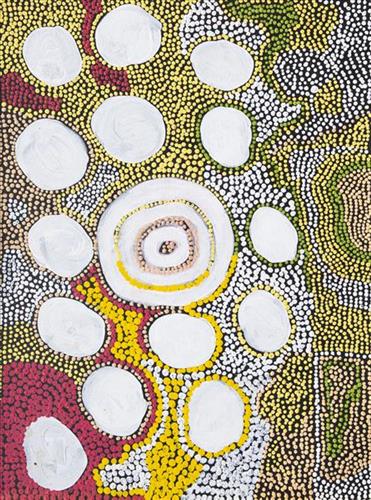
“Mungili rock hole. Big rock hole, big Country. I never see that place. My mother born [there], her and her grandmother walk through there, they tell me story [for that place]. Mother born there in the Country Mungili, walking through the bush. There is a camping spot, camping in bush – bush, bush, bush. [Points at painting] This is the lake Country and goes through there.”

– Matthew Mintern Smith

In this work Matthew depicts a claypan located in Mungili, the small outstation community situated just off the Eagle Highway in Western Australia. Mungili lies approximately 430 kilometres northeast of Wiluna and 250 kilometres north of Warburton. Mungili is ngurra (home (home Country, camp) for Matthew through his mother and grandmother. He typically depicts the site with a central large circular form that represents the main claypan, surrounded by smaller circular forms symbolising satellite water bodies.

The Western Desert term ‘ngurra’ is hugely versatile in application. Broadly denoting birthplace and belonging, ngurra can refer to a body of water, a camp site, a large area of Country, or even a modern house. People identify with their ngurra in terms of specific rights and responsibilities, and the possession of intimate knowledge of the physical and cultural properties of one’s Country. This knowledge is traditionally passed intergenerationally through family connections. Country for Martu is full of memory; not just the memory of their own movement through it, but also of their family. As summarised by Ngalangka Nola Taylor, “painting the ngurra, they do it to remember their connections.” 

Painting ngurra, and in so doing sharing the Jukurrpa (Dreaming) stories and physical characteristics of that place, has today become an important means of cultural maintenance. Physical maintenance of one’s ngurra, like cultural maintenance, ensures a site’s wellbeing, and is a responsibility of the people belonging to that area.  

111582438723


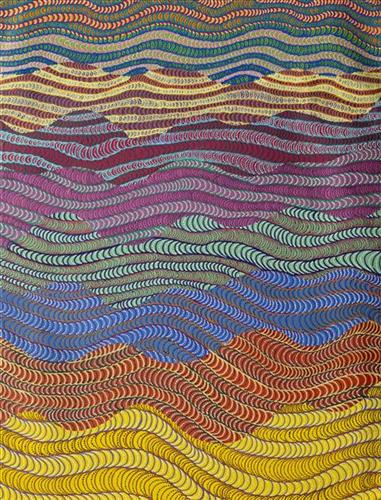
Tuwa (Sandhills)

‘’Went with Martumili. Old Jigalong. Judith’s nanna Country, where Judith nanna was born. Went from old Jigalong to Jigalong to right through Parnngurr, Camped the night and then Judith’s pop went to pick him up. His name is Mr Rowlands and I call him brother. He showing me where my nanna’s Country started from Parnngurr towards Lake Disappointment. We camped the night. Judith’s nanna was getting cheeky bossing him (Mr Rowland) around; “we not married anymore that’s why I left him.” Between Lake Disappointment and Durba Springs (Pinpi) there were these beautiful rolling sand hills, we winding through them over top, we stopped half way and I looked out to the sunset saw all the glistening spinifex. The orange from the sunset lit the sand dunes up. When I do the Tuwa paintings I think of that day.’’

– Kathleen Sorensen

The traditional lands of the Martu people encompass the Great Sandy Desert and Rudall River regions of Western Australia, an enormous tract dominated by distinctive red tali, or tuwa (sandhills). These sandhills present an unforgiving landscape; sparse vegetation covers a seemingly never ending expanse of dunes, and yet these lands and the location of resources within them was known intimately by its pujiman (traditional, desert dwelling) inhabitants. At this time, Martu traversed very large distances annually in small family groups, moving from water source to water source through the harsh desert landscape with incredible stamina and resourcefulness. Travel was often undertaken at night, and when travelling during the day, Martu wore yakipiri (woven bark sandals) to protect their feet from the hot desert sand.

111582438722


Kaalpa (Kalypa, Canning Stock Route Well 23)

“Kaalpa (Kalypa, Canning Stock Route Well 23) is my grandfather’s Country. There’s a waterhole there, Kaalpa waterhole. It’s my two pops’ Country. They been walking around, hunting around Kaalpa. You can see a yapu (rock), warla (lake), claypans, karru (creek) and tuwa (sandhills) there. It’s on the [Canning] Stock Route, it’s Well 23. One walypala One walypala (whitefella) well, and a real kalyu (water) there, jurnu. The Seven Sisters landed there, Jukurrpa (Dreaming). That man Yurla yapu (hill, stone, rock) there.” [Yurla, who chased the Seven Sisters during the Jukurrpa remains at Kaalpa in the form of a rock]) 

In pujiman (traditional, desert dwelling) days, pujimanpa (desert born people) walking around all this Country. My pops told me about that place, a big flat area, parlkarra (flat country) good for hunting parnajarrpa (goanna), lunki (witchetty grub), lungkurta (blue tongue lizard), wamurla (bush tomato), jinyjiwirrilyi (wild gooseberry). Kaalpa is a busy place for emus getting a drink. 

The old people were telling me “Kaalpa’s your grandfather’s Country, you gotta paint it.” I went [to Kaalpa] for the first time [in 2018] on a Martumili KJ [Kanyirninpa Jukurrpa] trip. We went out there when we were looking for the [Greater] Bilby. They took me and [my sister] Tamisha, they showed us our grandfather’s Country, Well 23. I went out there, had a good look, walked around, and went back to Wantili (Warntili, Canning Stock Route Well 25), Parnngurr, and I started painting it. Now it’s my mind, now I know what Kaalpa looks like. When I went there, I was pukurlpa (happy). It made you open up your spirit, it feels like home.”

 – Corban Clause Williams

Kaalpa is a permanent water source located northeast of Kumpupirntily (Kumpupintily, Lake Disappointment). This site is a place of great cultural significance, and is also known for good hunting. Adjacent to the waterhole is a hill of the same name. The landscape around Kaalpa is parlkarra (flat country), bordered by tali (sandhills) stretching as far as Windy Corner, northeast and towards the border of Western Australia and the Northern Territory. The large and dangerous Jukurrpa (Dreamtime) mosquito and fly beings partially created the landforms in this area and continue to live underground here.

Kaalpa also features in the Minyipuru (Jakulyukulyu, Seven Sisters) Jukurrpa, a central creation narrative for Martu, Ngaanyatjarra, Pitjantjatjara and Yankunytjatjara people that is associated with the seasonal Pleiades star constellation. At Kaalpa the Minyipuru met a group of men; it was the first time either group had seen members of the opposite sex. The men tried to grab the women, but the Minyipuru chased them, hitting them with their digging sticks and leaving them lying there as they continued travelling east.

Relayed in song, dance, stories and paintings, Minyipuru serves as a creation narrative, a source of information relating to the physical properties of the land, and an embodiment of Aboriginal cultural laws. Beginning in Roebourne on the west coast of Western Australia, the story morphs in its movement eastward across the land, following the women as they walk, dance, and even fly from waterhole to waterhole. As they travel the women camp, sing, wash, dance and gather food, leaving markers in the landscape and creating landforms that remain to this day, such as groupings of rocks and trees, grinding stones and seeds. During the entirety of their journey the women are pursued by a lustful old man, Yurla, although interactions with other animals, groups of men, and spirit beings are also chronicled in the narrative.

The intersection of the Canning Stock Route with Kaalpa also made this a site of early contact with Europeans for many Martu then living a pujiman life in the desert. Following the route’s construction, Martu encountered Europeans and other Martu working as cattle drovers as they would travel up and down the Stock Route from water source to water source. Increasingly, pujimanpa followed the route to newly established ration depots, mission and pastoral stations. They were drawn to the route in search of food, by a sense of curiosity, or by loneliness. By the late 1950s and early 1960s, most of the desert family groups had left the desert. Eventually, these factors combined with an extreme and prolonged drought in the 1960s to prompt the few remaining pujimanpa to move in from the desert.
111582438721


Kaalpa (Kalypa, Canning Stock Route Well 23)

“Kaalpa (Kalypa, Canning Stock Route Well 23) is my grandfather’s Country. There’s a waterhole there, Kaalpa waterhole. It’s my two pops’ Country. They been walking around, hunting around Kaalpa. You can see a yapu (rock), warla (lake), claypans, karru (creek) and tuwa (sandhills) there. It’s on the [Canning] Stock Route, it’s Well 23. One walypala One walypala (whitefella) well, and a real kalyu (water) there, jurnu. The Seven Sisters landed there, Jukurrpa (Dreaming). That man Yurla yapu (hill, stone, rock) there.” [Yurla, who chased the Seven Sisters during the Jukurrpa remains at Kaalpa in the form of a rock]) 

In pujiman (traditional, desert dwelling) days, pujimanpa (desert born people) walking around all this Country. My pops told me about that place, a big flat area, parlkarra (flat country) good for hunting parnajarrpa (goanna), lunki (witchetty grub), lungkurta (blue tongue lizard), wamurla (bush tomato), jinyjiwirrilyi (wild gooseberry). Kaalpa is a busy place for emus getting a drink. 

The old people were telling me “Kaalpa’s your grandfather’s Country, you gotta paint it.” I went [to Kaalpa] for the first time [in 2018] on a Martumili KJ [Kanyirninpa Jukurrpa] trip. We went out there when we were looking for the [Greater] Bilby. They took me and [my sister] Tamisha, they showed us our grandfather’s Country, Well 23. I went out there, had a good look, walked around, and went back to Wantili (Warntili, Canning Stock Route Well 25), Parnngurr, and I started painting it. Now it’s my mind, now I know what Kaalpa looks like. When I went there, I was pukurlpa (happy). It made you open up your spirit, it feels like home.”

 – Corban Clause Williams

Kaalpa is a permanent water source located northeast of Kumpupirntily (Kumpupintily, Lake Disappointment). This site is a place of great cultural significance, and is also known for good hunting. Adjacent to the waterhole is a hill of the same name. The landscape around Kaalpa is parlkarra (flat country), bordered by tali (sandhills) stretching as far as Windy Corner, northeast and towards the border of Western Australia and the Northern Territory. The large and dangerous Jukurrpa (Dreamtime) mosquito and fly beings partially created the landforms in this area and continue to live underground here.

Kaalpa also features in the Minyipuru (Jakulyukulyu, Seven Sisters) Jukurrpa, a central creation narrative for Martu, Ngaanyatjarra, Pitjantjatjara and Yankunytjatjara people that is associated with the seasonal Pleiades star constellation. At Kaalpa the Minyipuru met a group of men; it was the first time either group had seen members of the opposite sex. The men tried to grab the women, but the Minyipuru chased them, hitting them with their digging sticks and leaving them lying there as they continued travelling east.

Relayed in song, dance, stories and paintings, Minyipuru serves as a creation narrative, a source of information relating to the physical properties of the land, and an embodiment of Aboriginal cultural laws. Beginning in Roebourne on the west coast of Western Australia, the story morphs in its movement eastward across the land, following the women as they walk, dance, and even fly from waterhole to waterhole. As they travel the women camp, sing, wash, dance and gather food, leaving markers in the landscape and creating landforms that remain to this day, such as groupings of rocks and trees, grinding stones and seeds. During the entirety of their journey the women are pursued by a lustful old man, Yurla, although interactions with other animals, groups of men, and spirit beings are also chronicled in the narrative.

The intersection of the Canning Stock Route with Kaalpa also made this a site of early contact with Europeans for many Martu then living a pujiman life in the desert. Following the route’s construction, Martu encountered Europeans and other Martu working as cattle drovers as they would travel up and down the Stock Route from water source to water source. Increasingly, pujimanpa followed the route to newly established ration depots, mission and pastoral stations. They were drawn to the route in search of food, by a sense of curiosity, or by loneliness. By the late 1950s and early 1960s, most of the desert family groups had left the desert. Eventually, these factors combined with an extreme and prolonged drought in the 1960s to prompt the few remaining pujimanpa to move in from the desert.
221382396538


Bush Yam in Basket

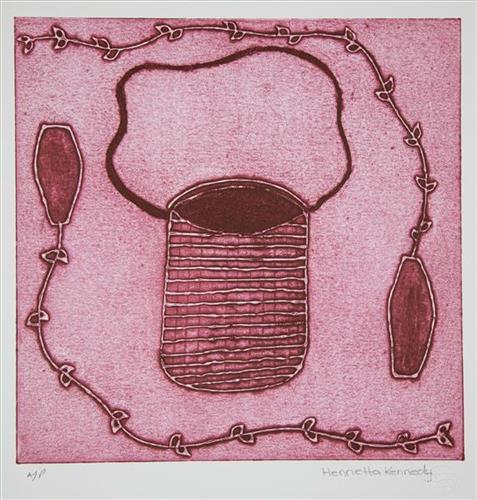
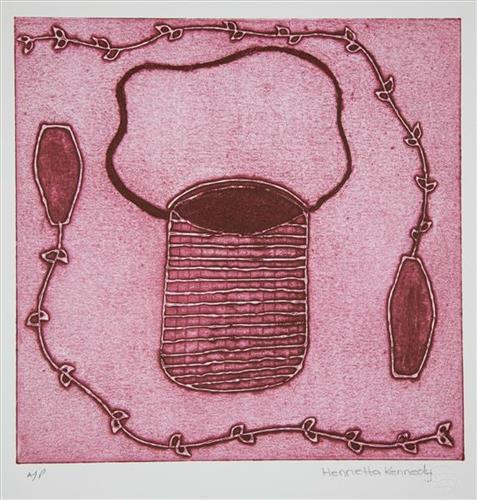
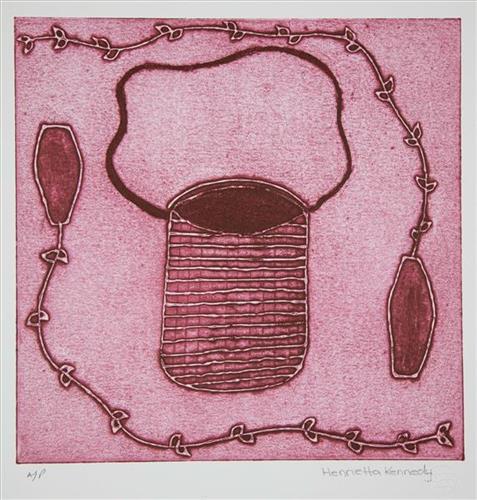
The 2025 Gapu series is the 12th workshop series in Djilpin’s long collaboration with Basil Hall Editions. Djilpin Artists worked, for the first time, with Printmaker Antonia Aitken. Collograph plates were developed by 15 artists over a week in April at Djilpin Arts Centre in Wugularr (Beswick). For Series XII, artists have depicted traditional string and dilly bags, bathi, exploring the place of these artefacts in culture, ceremony and mythology.

Evangeline Wilson’s print for Gapu XII was selected for Walyalup Fremantle Arts Centre Print Award (August) with the complete Series launching at Honey Bones Galley, Melbourne (October 2025).


Dimensions: 29.5×29.5cm, 46.5×38.5 (paper)

221382396536


Bush Yam in Basket

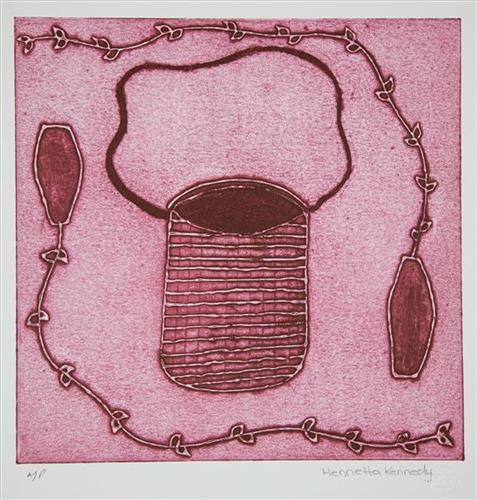
The 2025 Gapu series is the 12th workshop series in Djilpin’s long collaboration with Basil Hall Editions. Djilpin Artists worked, for the first time, with Printmaker Antonia Aitken. Collograph plates were developed by 15 artists over a week in April at Djilpin Arts Centre in Wugularr (Beswick). For Series XII, artists have depicted traditional string and dilly bags, bathi, exploring the place of these artefacts in culture, ceremony and mythology.

Evangeline Wilson’s print for Gapu XII was selected for Walyalup Fremantle Arts Centre Print Award (August) with the complete Series launching at Honey Bones Galley, Melbourne (October 2025).


Dimensions: 29.5×29.5cm, 46.5×38.5 (paper)

221382396535


Bush Yam in Basket

The 2025 Gapu series is the 12th workshop series in Djilpin’s long collaboration with Basil Hall Editions. Djilpin Artists worked, for the first time, with Printmaker Antonia Aitken. Collograph plates were developed by 15 artists over a week in April at Djilpin Arts Centre in Wugularr (Beswick). For Series XII, artists have depicted traditional string and dilly bags, bathi, exploring the place of these artefacts in culture, ceremony and mythology.

Evangeline Wilson’s print for Gapu XII was selected for Walyalup Fremantle Arts Centre Print Award (August) with the complete Series launching at Honey Bones Galley, Melbourne (October 2025).


Dimensions: 29.5×29.5cm, 46.5×38.5 (paper)

221382396533


Bush Yam in Basket

The 2025 Gapu series is the 12th workshop series in Djilpin’s long collaboration with Basil Hall Editions. Djilpin Artists worked, for the first time, with Printmaker Antonia Aitken. Collograph plates were developed by 15 artists over a week in April at Djilpin Arts Centre in Wugularr (Beswick). For Series XII, artists have depicted traditional string and dilly bags, bathi, exploring the place of these artefacts in culture, ceremony and mythology.

Evangeline Wilson’s print for Gapu XII was selected for Walyalup Fremantle Arts Centre Print Award (August) with the complete Series launching at Honey Bones Galley, Melbourne (October 2025).


Dimensions: 29.5×29.5cm, 46.5×38.5 (paper)

116482438511


Garduwarra, Gambara (Wildflowers against Waterholes)

When we go back out to Country after a Big rain we see all of our beautiful Wildflowers that have sprang out against our Waterholes.