359709482359396


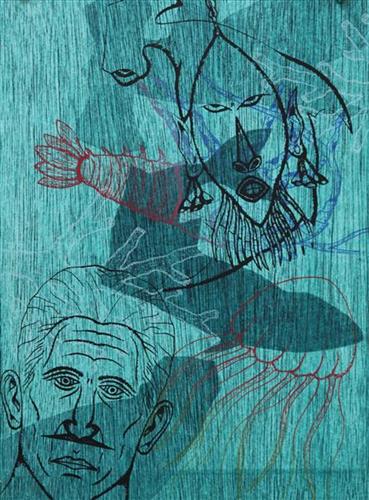
Malu Thumayawaik

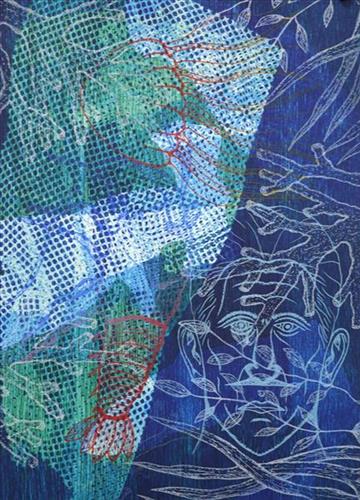
The mask in the artwork represents the profound concerns of my ancestors regarding the exploitation of our marine environment, driven by climate change and pollution. For centuries since creation, Indigenous peoples have possessed a rich tradition of sustainable marine conservation, emphasising responsible harvesting to ensure that resources endure for generations. Coral reefs, mangroves, and seagrasses are not merely ecosystems but essential components of biodiversity, food security, and cultural identity. Protecting these invaluable ecosystems is not just an environmental obligation but a cultural imperative. We must unite globally to protect our oceans, ensuring their health and abundance for future generations.


Art Centre notes:

This artwork is a unique state, monotype screen print on BFK Rives paper (100% cotton rag paper with strong archival properties. 

Paper size: 39 x 28cm

Printed at Canberra, Feb 2025

Print Assistant: Basil Hall.
359709482359395


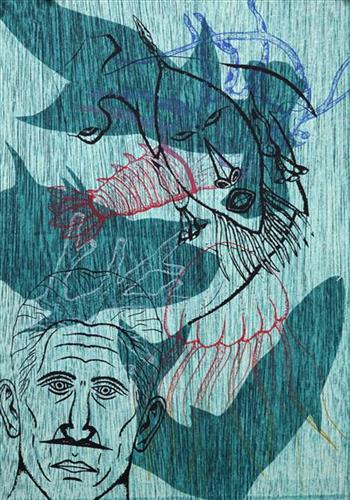
Malu Thumayawaik

The mask in the artwork represents the profound concerns of my ancestors regarding the exploitation of our marine environment, driven by climate change and pollution. For centuries since creation, Indigenous peoples have possessed a rich tradition of sustainable marine conservation, emphasising responsible harvesting to ensure that resources endure for generations. Coral reefs, mangroves, and seagrasses are not merely ecosystems but essential components of biodiversity, food security, and cultural identity. Protecting these invaluable ecosystems is not just an environmental obligation but a cultural imperative. We must unite globally to protect our oceans, ensuring their health and abundance for future generations.


Art Centre notes:

This artwork is a unique state, monotype screen print on BFK Rives paper (100% cotton rag paper with strong archival properties. 

Paper size: 39 x 28cm

Printed at Canberra, Feb 2025

Print Assistant: Basil Hall.
359709482359393


Malu Thumayawaik

The mask in the artwork represents the profound concerns of my ancestors regarding the exploitation of our marine environment, driven by climate change and pollution. For centuries since creation, Indigenous peoples have possessed a rich tradition of sustainable marine conservation, emphasising responsible harvesting to ensure that resources endure for generations. Coral reefs, mangroves, and seagrasses are not merely ecosystems but essential components of biodiversity, food security, and cultural identity. Protecting these invaluable ecosystems is not just an environmental obligation but a cultural imperative. We must unite globally to protect our oceans, ensuring their health and abundance for future generations.


Art Centre notes:

This artwork is a unique state, monotype screen print on BFK Rives paper (100% cotton rag paper with strong archival properties. 

Paper size: 39 x 28cm

Printed at Canberra, Feb 2025

Print Assistant: Basil Hall.
359709482359392


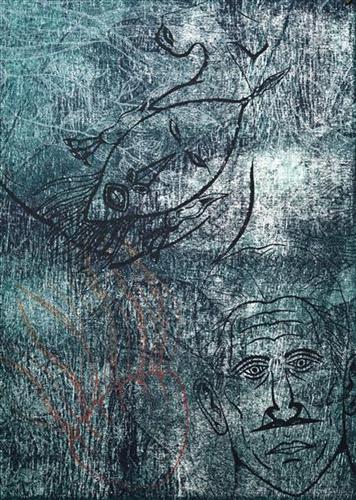
Malu Thumayawaik

The mask in the artwork represents the profound concerns of my ancestors regarding the exploitation of our marine environment, driven by climate change and pollution. For centuries since creation, Indigenous peoples have possessed a rich tradition of sustainable marine conservation, emphasising responsible harvesting to ensure that resources endure for generations. Coral reefs, mangroves, and seagrasses are not merely ecosystems but essential components of biodiversity, food security, and cultural identity. Protecting these invaluable ecosystems is not just an environmental obligation but a cultural imperative. We must unite globally to protect our oceans, ensuring their health and abundance for future generations.


Art Centre notes:

This artwork is a unique state, monotype screen print on BFK Rives paper (100% cotton rag paper with strong archival properties. 

Paper size: 39 x 28cm

Printed at Canberra, Feb 2025

Print Assistant: Basil Hall.
115682359517


Malka (Ceremonial Head Wear)

Malka are ceremonial head adornments made from balgurr (Kurrajong). The bark is stripped from the tree, smashed with a rock to soften then boiled, sometimes with natural bush dyes. The balgurr is then rolled in the a rope then used to create ceremonial wear. 

The essence of Yolngu ceremonies lies in the reenactment of the ancestral beings’ actions that shaped the land and established the laws that govern it. These ceremonies are conveyed through an intricate blend of songs, dances, paintings, objects, and carefully choreographed sequences of action.

For Yolngu, these elements are more than mere expressions; they embody the very essence of the ancestral beings. They serve as a vital link to the ancestral world, bridging the past with the present. Each clan holds a unique collection of songs, paintings, and sacred objects known collectively as the clan’s “madayin” or sacred Law, which is intimately tied to the deeds and legacies of the ancestral beings who forged the clan’s land.

The sacred Law of each clan is not isolated but interconnected with the Laws of other clans within the same moiety. This interconnection stems from the ancestral beings’ journeys, which often traversed the lands of multiple clans, creating a shared foundation of Law and tradition.

220982359474


Maisie Petyarre Bundey – Bush Tucker

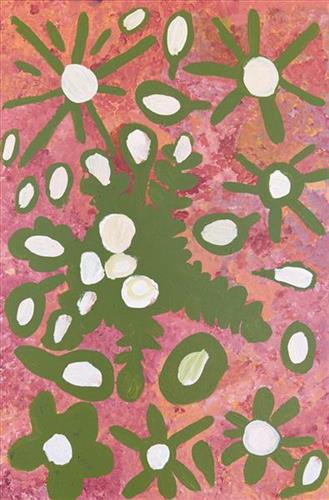
Maisie paints the bush tucker found in her country, the area that surrounds Boundary Bore in the Utopia homelands. She paints bush plums, bush bananas, bush potatoes and bush medicine plants. The main motif which recurs often in Maisie artworks is a full coolamon.
 
When she paints she always speaks of gathering and hunting on her country – long way from here, long time ago, filling up coolamons with bush potato, bush banana, goanna and porcupine. Maisie always says her family are happy ones and healthy ones.
 

115682359452


Woven Mat

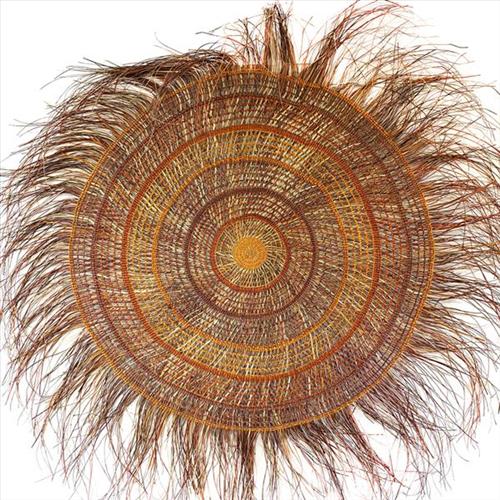
Traditionally, Nganiyal (conical mats) were used as an insect screen when erected, and as a sitting mat when folded. They are used in Ceremony as well as a functional item. 

Nowadays, artists weave many different shapes including flat, round and oblong. 

111982359553


Nguykal (Golden Trevally)

This is a depiction of Nguykal, the Golden Trevally [Gnathanodon speciosus]. In the early times of creation, Nguykal, the Trevally ancestor, travelled as two fish from the east along the coast. As he travelled along the coast he named clans or bapurru. These clans include Gamarl, Mardarrpa, Ritjarrngu, Gumatj, Dhalwangu, Wan.gurri and Warramiri. When Nguykal reached Gu-mugumuk on the east coast of Cape Stewart he leaped from the sea and landed inland at Gamurra Gu-yurra on Warrawarra clan lands. This created the sacred dreaming called Baltha, which is represented in design as a forked shape, reminiscent of the tail of a fish. Baltha stands as a tree at Gamurra Gu-yurra, and the forked shape that the main branches make with the trunk betray its sacred associations.
The Trevally ancestor then returned to the sea and kept travelling around Yinangarnduwa (Cape Stewart). Upon reaching Burnbuwa, a site midway between Yinangarnduwa and Yilan outstation, he became frightened by the appearance of lunggurrma, the clouds and rain associated with the northwest monsoon, which originated from beneath the sea. At this point the two fish separated. One of the Nguykal ancestors went inside at Burnbuwa and remains there as a dreaming, while the other returned back to the east and kept travelling until he reached the Yirrkala area. There he named a site Burnbuwa, which marks the link between these places.
Trevally spend much time swimming in and around the rocky reefs that lie close to shore along the north-central Arnhem Land coast. The formation swimming of the trevally has a religious dimension, and when the Gamarl and their close clansmen dance the Trevally ancestor, they also dance in formation like a school of fish and at one stage two groups of men will dance towards each other.
In painted depictions, cross-hatched stripes of infill surrounding Nguykal may represent rrawa or country at Burnbuwa and other places along the north-eastern Arnhem Land coast where Nguykal swam. Different clan groups each hold tenure over separate sections of country, but together they form a ‘company’ of related clans. These clans form a network linked by a system of reciprocal kinship and ceremonial ties. The Golden Trevally Ancestor is the explanation for the links between the different clan groups, and today the celebration of Nguykal’s creation journey in song, dance and design by the members of these groups continues to strengthen the kinship and ceremonial links between the members of these clans. 

111982359552


Wak Wak

This painting depicts a sacred site at ‘Kurrurldul’, an outstation south of Maningrida.

The ‘rarrk’, or abstract crosshatching, on this work represents the design for the crow totem ancestor called ‘Djimarr’. Today this being exists in the form of a rock, which is permanently submerged at the bottom of Kurrurldul Creek. The ‘Djimarr’ rock in the stream at Kurrurldul is said to move around and call out in a soft hooting tone at night. Both the stone itself and the area around it are considered sacred.

The imagery represents the rock mentioned above at the bottom of Kurrurldul creek, which is the final transmutation of the dreaming ancestor ‘Djimarr’. Finally, the pattern used here is also the crow design used in the sacred ‘Mardayin’ ceremony, which is a large regional patri-moiety ceremony now rarely conducted in central and eastern Arnhem Land.

111982359551


Kunkurra (The Spiralling Wind)

‘Kunkurra’, the spiralling wind is associated with several sites in the Kardbam clan estate. On one level, this painting can be interpreted as a depiction of the kinds of mini-cyclones common during the wet season in Arnhem Land, where the artist lives. In this painting, Kunkurra also relates specifically to a site called Bilwoyinj, near Mankorlod.

At this site, two of the most important Kuninjku creation beings, a father and son known as na-korrkko, are believed to have hunted and eaten a goanna. They left some of the goanna fat behind at the site, which turned into the rock that still stands there today. The word Bilwoyinj, which is the name of this site, also refers to the fat of the goanna. Bilwoyinj site is also a ceremonial ground for a ceremony called Yabbaduruwa, a major ceremony owned by the Yirridja patrimoiety. The Yabbaduruwa ceremony is primarily concerned with initiation, land ownership and promoting the cyclical regeneration of the human and natural worlds.