111582359504


Kiwirrkurra

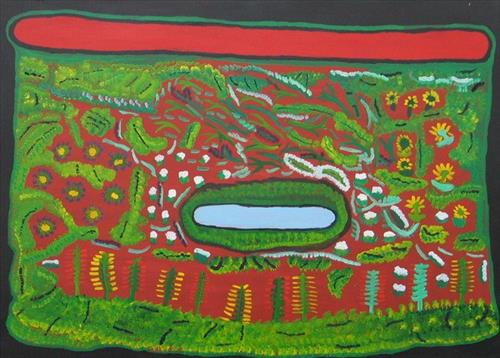
Kiwirrkurra is a rockhole located in the tali (sandhill) Country of the Gibson Desert, to the south west of Lake McKay. An Aboriginal community by the same name is now located nearby, to the west of the water source. 

Kiwirrkurra lies just east of Marapinti rockhole, an important site in the Minyipuru (Jakulyukulyu, Seven Sisters) Jukurrpa (Dreaming) narrative. At Marapinti the travelling women danced and pierced their noses, a practice also known as marapinti. Today the Minyipuru can be seen at Marapinti as a group of rocks, sitting up like women.

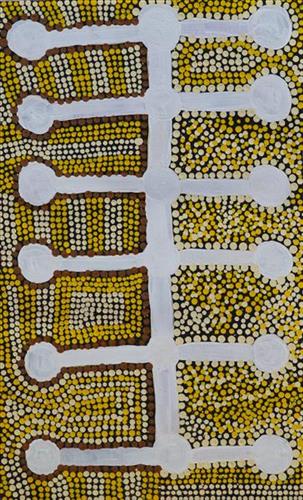
Minyipuru is a central Jukurrpa narrative for Martu, Ngaanyatjarra, Pitjantjatjara and Yankunytjatjara people that is associated with the seasonal Pleiades star constellation. Relayed in song, dance, stories and paintings, Minyipuru serves as a creation narrative, a source of information relating to the physical properties of the land, and an embodiment of Aboriginal cultural laws. Beginning in Roebourne on the west coast of Western Australia, the story morphs in its movement eastward across the land, following the women as they walk, dance, and even fly from waterhole to waterhole. As they travel the women camp, sing, wash, dance and gather food, leaving markers in the landscape and creating landforms that remain to this day, such as groupings of rocks and trees, grinding stones and seeds. During the entirety of their journey the women are pursued by a lustful old man, Yurla, although interactions with other animals, groups of men, and spirit beings are also chronicled in the narrative.

111582359503


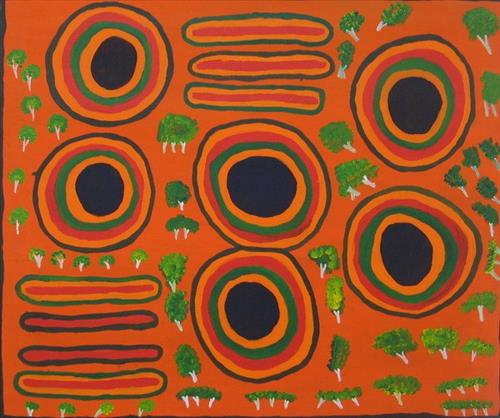
Tuwa

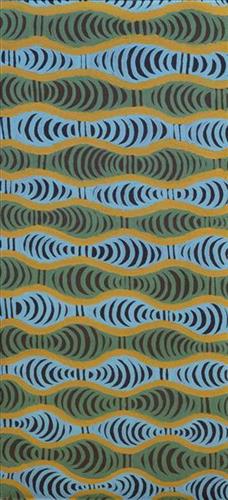
‘’Went with Martumili. Old Jigalong. Judith’s nanna Country, where Judith nanna was born. Went from old Jigalong to Jigalong to right through Parnngurr, Camped the night and then Judith’s pop went to pick him up. His name is Mr Rowlands and I call him brother. He showing me where my nanna’s Country started from Parnngurr towards Lake Disappointment. We camped the night. Judith’s nanna was getting cheeky bossing him (Mr Rowland) around; “we not married anymore that’s why I left him.” Between Lake Disappointment and Durba Springs (Pinpi) there were these beautiful rolling sand hills, we winding through them over top, we stopped half way and I looked out to the sunset saw all the glistening spinifex. The orange from the sunset lit the sand dunes up. When I do the Tuwa paintings I think of that day.’’

– Kathleen Sorensen

The traditional lands of the Martu people encompass the Great Sandy Desert and Rudall River regions of Western Australia, an enormous tract dominated by distinctive red tali, or tuwa (sandhills). These sandhills present an unforgiving landscape; sparse vegetation covers a seemingly never ending expanse of dunes, and yet these lands and the location of resources within them was known intimately by its pujiman (traditional, desert dwelling) inhabitants. At this time, Martu traversed very large distances annually in small family groups, moving from water source to water source through the harsh desert landscape with incredible stamina and resourcefulness. Travel was often undertaken at night, and when travelling during the day, Martu wore yakipiri (woven bark sandals) to protect their feet from the hot desert sand.

220182359413


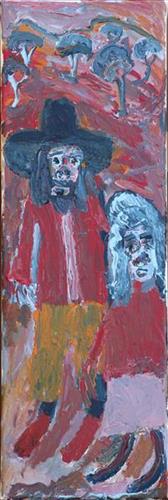
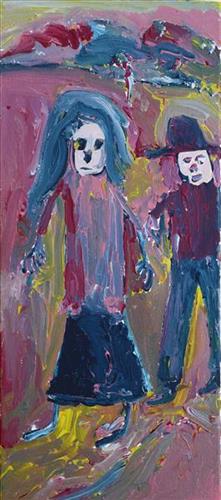
Family in Yalpirakinu

Yalpirakinu is Adrian’s mother’s country. Adrian’s mother is the late Eunice Napangardi, a well known painter herself. His artworks consistently refer to the desert mountains, ridges and trees which are part of Yalpirakinu. Using a restricted colour palette, Adrian’s brushwork is loaded with energy, drama and memories. In this painting Adrian has drawn from his memory to portray his family in Yalpirakinu.

220182359381


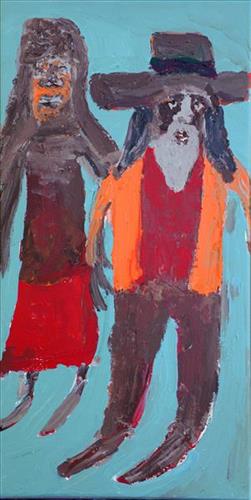
Yalpirakinu

Yalpirakinu is Adrian’s mother’s country. Adrian’s mother is the late Eunice Napangardi, a well known painter herself. His artworks consistently refer to the desert mountains, ridges and trees which are part of Yalpirakinu. Using a restricted colour palette, Adrian’s  brushwork is loaded with energy, drama and memories. He is a deliberate and thoughtful painter; reworking, pushing and pulling the image to completion.

114082359021


Coiled Pandanus Basket

This basket is made from natural, local materials sourced from the Gunbalanya area. Weavers gather fresh young leaves from the pandanus palm using a hooked stick, then strip and dry them. The pandanus is then boiled up on the campfire with local plant dyes.

Today’s coiled fibre works are the result of rich cultural exchange and artistic innovation. The coiling technique was traditionally used by southern Aboriginal people of the Murray River, and was introduced to Goulburn Island by missionary Greta Matthews in the 1920s. From here it spread amongst Aboriginal people throughout Arnhem Land. These works are living embodiments of Australia’s history. Kunwinjku women have been developing the artform for almost 100 years, experimenting with new forms and adapting it to local materials.

The old plant dyes used in Europe like indigo, saffron, woad and logwood fell out of use with the Industrial Revolution. But here, a natural “paintbox” thrives.

The most common dyes include:
Yellow-orange: Mandjurndum (the bright orange roots of the Pognolobus reticulatus bush)
Brown: Wirdilwirdil (the red bulb of Haemadorum breviculae grass)
Green: The growing shoot of the pandanus itself (Pandanus spiralis), boiled with the ashes of pandanus leaves.
Purple-pink – Windilk (the seeds of the Haemodorum coccineum plant, related to Kangaroo Paw)
Grey-Black – Manbedde (the leaves of the quinine bush, Petalostigma pubescens)

Source: Louise Hamby (ed.) “Twined Together”.

11452957161


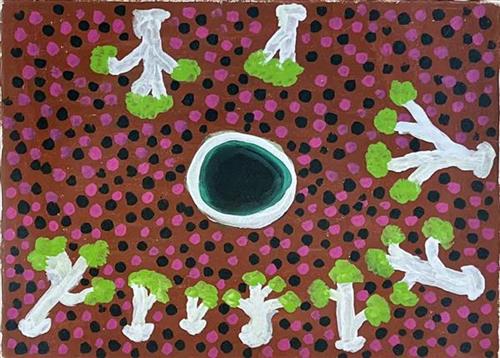
Pinti

Pinti is a jila (living waterhole).There are white flowers that grow all around this waterhole after the fire comes through.We collect Karlaka (wild honey) from the Kuparnu (grevillea) tree.There is a big jilji (sandhill) here too.

11452956013


Grass

This is grass country. There is a pirnti (claypan) here, it is the wet time and it is full of milky white water. There are all grasses growing around the pirnti.