Status: Stock
22124006737
Status: Stock
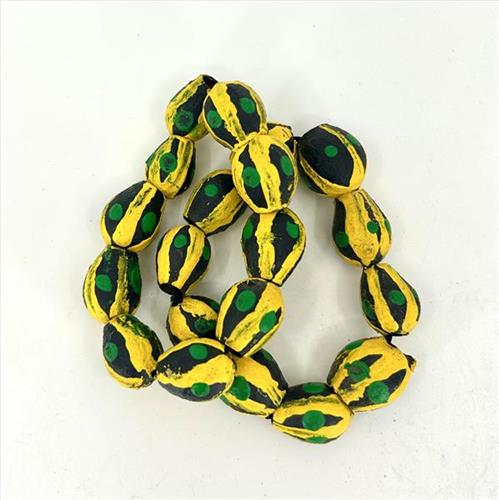
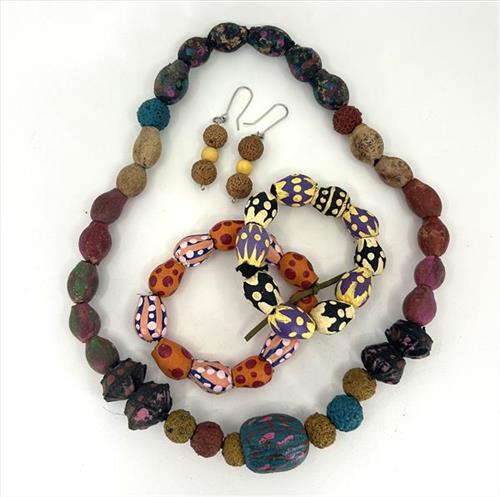
Handpainted Gumnut and seeds assorted jewellery

11194005104
Status: Stock
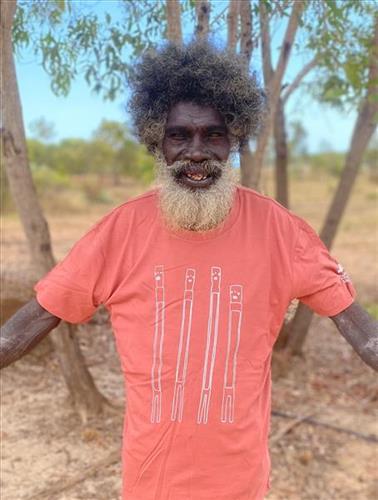
Seymour Tee (Coral)
The mimih spirit exists in a realm that runs parallel to and mirrors many facets of human life, also demonstrating the deep sense of time and place understood by Aboriginal and Torres Strait Islander people. Such spirits feature importantly in relation to Aboriginal spirituality, cosmology, social and moral tales as well as ritual. As is true with the multiple mediums employed by artists of West Arnhem Land, the development of artistic style and form is in line with an awareness by the artist that the work produced is predominantly made for a broader audience. Whether show in a national or international context these works communicate and exist in a particular space that is cross-cultural and simultaneously so particular to the Arnhem region.
The mimih sits within a complex and important pedagogical and religious body of knowledge which links Kuninjku people to their distinctive escarpment homelands. Young Kuninjku artists, or apprentices, employ the mimih as an important exercise for the practice of the rarrk technique, as it could be achieved on a smaller surface area before, being attempted in larger scale, on pieces of bark. The mimih serves a purpose for those young artists first learning to carve in a social space of sharing and innovating. The initial mimih manifestation was a large form that almost mirrored the anatomy of a human and at this stage the sculptures have been likened to morkuy carvings visible in eastern Arnhem Land. Contemporaneously, mimih are depicted in a refined, slender, even emaciated form with a broad range of facial expressions giving both individual character to, and denoting the potential volatility and humour that mimih spirits are notable for in their interaction with bininj (humans). The sculptures are frequently carved from the thin trunks of softwoods such as kapok (bombax ceiba or cottonwood) kurrajong, beach hibiscus or leichardt and are painted with earth pigments for their colouring and design.
A leading figure engaging the spirit in visual storytelling was Crusoe Kuningbal, a Kuninjku man, who while traveling was familiarised with carving styles from the east of Arnhem at the mission in Milingimbi pre-dating World War II. This showing a notable connection and interaction of different language groups across such space. As well as travel and the development of art forms being informed by cross cultural dialogues within northern Aboriginal language groups. The mimih became a valued inclusion in performance and public ceremony by Kuninjku people like Kuningbal. At times these ceremonies were performed for extended language groups in the local region.
Now a familiar and broadly depicted figure of iconography, it is important to acknowledge the development of this quite recent sculptural tradition. The depiction of this particular spirit being, once used as an addition to the sharing of song cycles and ceremony, has since been elevated to a prominent form and subject of contemporary sculpture. Variation in the creation of mimih acts as an indication of the individualism of each artist and their stylistic markers. Additionally significant to note is that in the space of the past thirty years the mimih has begun being produced by multiple language groups residing in the Maningrida area including the traditional owners of Maningrida, the Ndjébbana, speaking Kunibidji as well as Gurrgoni people who have strong ties to Kuninjku.
________
*Maningrida Arts & Culture acknowledge the work of many academic and non-academic voices when writing on this topic, it is important to note Luke Taylor, who’s broad research has informed this text.
116481608759
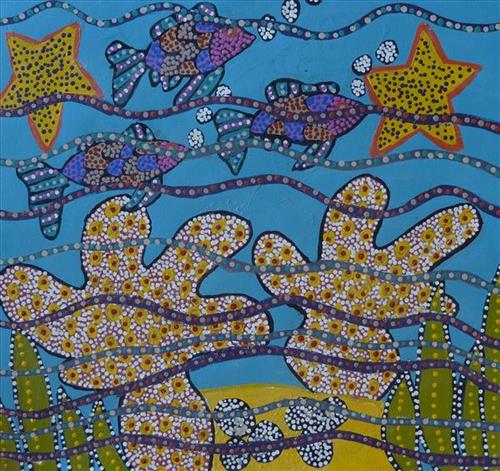
Barramundi
The Barramundi is fished for at the mouth of Gurr ( Harding River)
116481909741
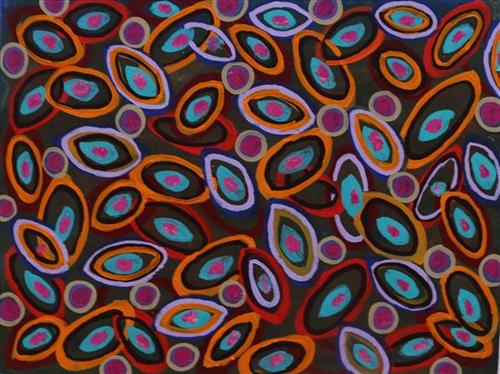
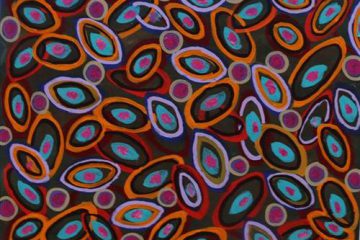
Fallen Seeds
We have many fallen seeds from our plants that give new growth to our wild flowers.
116481950049
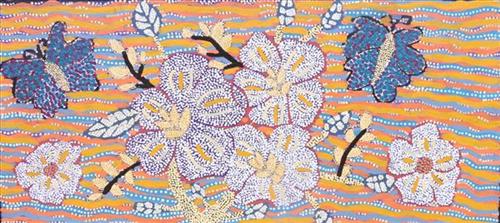
Butterfly
When I go bush with my family i like to look at the butterfly’s flying around.
220982337886
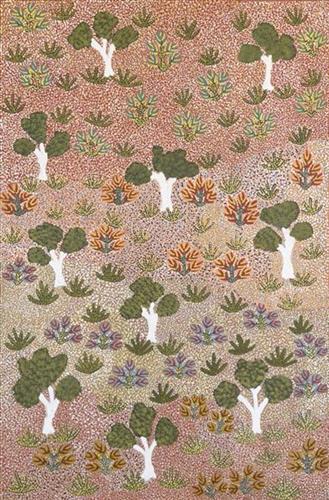
Edie Kemarre Holmes – Antarrengeny
The community of Ampilatwatja made a conscious decision not to paint ‘altyerr’ dreaming stories. The artists paint their country where those stories sit. Antarrengeny is Edie’s country and also her Father’s.
In this painting Edie depicts Antarrengeny, “when there has been no rain and the land shimmers like jewels. It is the open flat country, after a bushfire, when only the young grasses and the trees are growing and where there is good hunting.”
Edie has a strong connection to Antarrengeny. She gave birth to two of her daughters ‘out bush’ on this land. It is her country and she loves it dearly.
220982341032
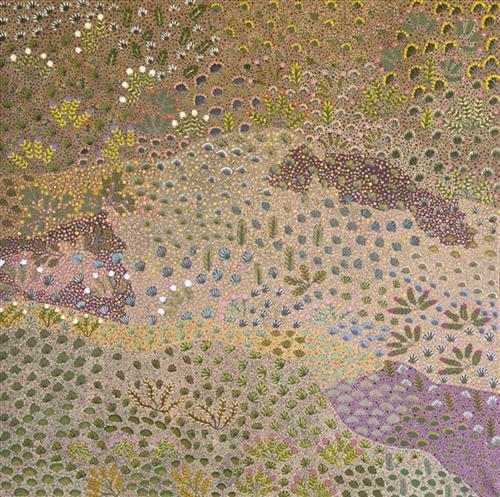
Kindy Kemarre Ross – My Country is Irrultja
The community of Ampilatwatja made a conscious decision not to paint ‘altyerr’ dreaming stories. The artists paint their country where those stories belong.
“My country is called Irrultja, it’s past the hill and the dried-up creek from here, it’s a nice place, my dad’s country too, and my Mum’s country is here in Ampilatwatja. When I go to see my country, we always go to gather bush medicine, we always climb up the hill that’s in the south, we always go there. We like to look out over the land and there are lots of flowers and bush medicine up there. I love my countryside; I see the nice flowers and gather bush medicine for me and my family. I like to paint a mix of wildflowers and bush medicines in all my paintings because it reminds me of my favourite part of my country and when it rains the flowers come out. Yeah, my countryside.”
220982347158
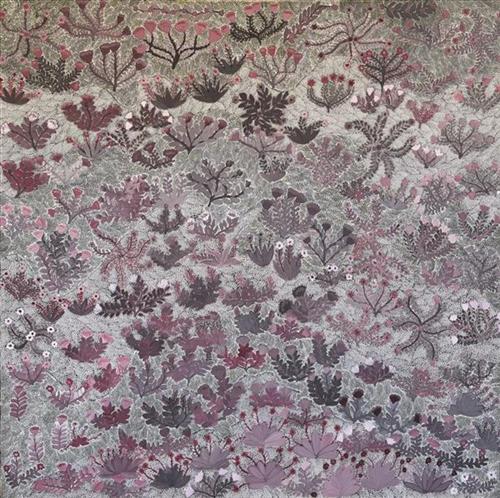
Kathleen Nanima Rambler – Awerle Anatye (yam plant)
When I go visit my family we drive along Bluebush Road, the road is south of Ali Curung towards the Stuart Highway. The road is sandy.
Bluebush Road has a dam, after Cyclone Tracey hit it was so large that it looked like the sea. This is where I see the big cream coloured bush tomatos, pink desert roses and goannas running across the road. All along the road is a sea of desert roses. The secret yams grow under the ground, you follow the cracks in the dirt and this is where you find the ripe yams. The secrets of the earth we call them.
The community of Ampilatwatja made a conscious decision not to paint ‘altyerr’ dreaming stories. The artists paint their country where those stories sit.
114182348670
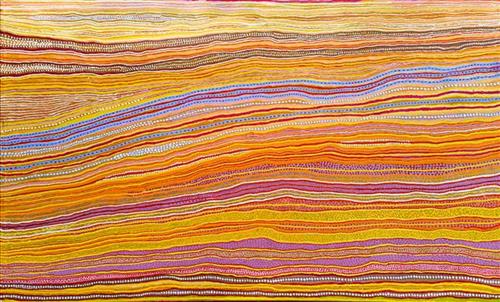
Kungkarrangkalpa (Seven Sisters)
Kungkarrangkalpa (The Seven Sisters or Pleiades) is an important Tjukurrpa (Dreaming) story, known across many cultures and reflected in the stars. The Australian Aboriginal songline is one chapter of this vast, interconnected narrative, with each region holding its own understanding of the journey.
In the Ngaanyatjarra lands, the story tells of Wati Nyiru (the Magic Man), who fell in love with the sisters. But he was of the wrong skin group to marry them, and so the sisters fled across the country to escape his relentless pursuit. He used magic to try and deceive them, disguising himself as a kampurarrpa (bush tomato) or a Yirli (wild fig tree) to lure them in. But the sisters were wise to his tricks, outsmarting him again and again, choosing hunger over capture.
Frustrated, Nyiru made the eldest sister sick, hoping to slow them down, but the other sisters cared for her and helped her recover. He even managed to capture the youngest sister for a time, but with the help of her older siblings, she escaped. As he chased them across the land, Nyiru transformed into a Quandong tree, a Yirli tree, and even a carpet snake, spying on the sisters as they rested and dug for food. Eventually, the sisters took to the sky, becoming the constellation known as the Pleiades, with Nyiru following as Orion—forever chasing but never reaching them.
Angilyiya Mitchell is a custodian of the Seven Sisters Dreaming at Kuru Ala—a sacred women’s place in her mother’s country, south of Papulankutja (Blackstone). This painting depicts that site.
The sweeping lines in the artwork evoke the rolling sandhills of this country, mapping the journey of the sisters as they travelled across the land. The site remains deeply significant today, a place where the echoes of this ancient story still resonate.