377810582350587


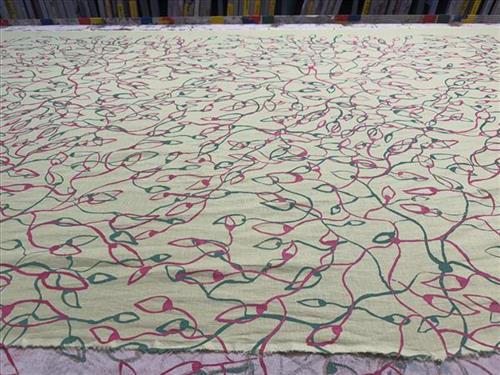
Bah-je (hunting bag) 2007

Linda Gurawana is a Djinang speaker with a long history of working at Babbarra Women’s Centre.

In Linda’s language, bah-je describes a woven hunting bag or dilly bag.

This three-colour design was created in 2007 and continues to be printed by the centre staff in Maningrida. 

The silk is a washed crepe de chine, with a beautiful hand feel and drape. 

377810582350764


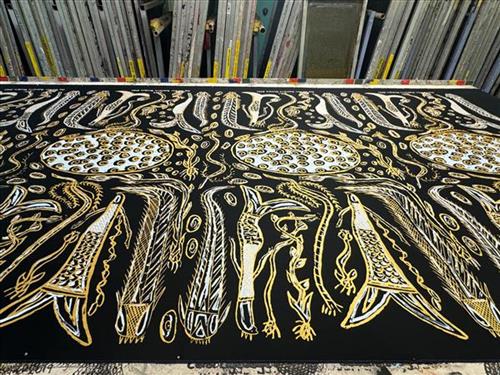
Djomi Egg

This design depicts the story of Blulandjan Joy’s ancestral dreaming, the Djomi freshwater spirit mermaid. In this design, the Djomi egg is also depicted in the centre. 

‘The Djomi figure is a mermaid like spirit with fish tail that lives in the freshwater stream that flows out to the sea cliff near Maningrida. Djomi is a known to be a very powerful fertility symbol.

‘There is a swamp by the ocean, near my home, where all the Djomi live and come to lay their eggs, they lay them here to grow more and more Djomi. When the wet season comes, the cyclones, storms, and big rain, brings enough water for the Djomi to swim out and into the water ways surrounding Maningrida. Anyone wanting to have a baby can go to that place and Djomi will give them a baby. This is a real story; we have lots of Djomi babies here in Maningrida.When the big rains of wet season are too strong, Djomi swim up into the pipes to hide and keep safe. Sometimes they will keep swimming further up the pipes and into pipes of people’s homes, they can travel everywhere. The Djomi carries human babies with them and will sometimes put babies into the water that people in Maningrida drink, that’s why we see many young women expecting babies.’

377810582350763


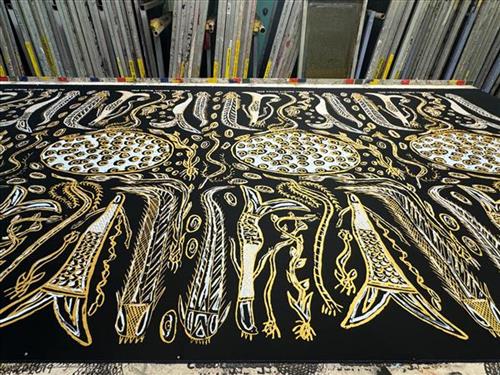
Djomi Egg

This design depicts the story of Blulandjan Joy’s ancestral dreaming, the Djomi freshwater spirit mermaid. In this design, the Djomi egg is also depicted in the centre. 

‘The Djomi figure is a mermaid like spirit with fish tail that lives in the freshwater stream that flows out to the sea cliff near Maningrida. Djomi is a known to be a very powerful fertility symbol.

‘There is a swamp by the ocean, near my home, where all the Djomi live and come to lay their eggs, they lay them here to grow more and more Djomi. When the wet season comes, the cyclones, storms, and big rain, brings enough water for the Djomi to swim out and into the water ways surrounding Maningrida. Anyone wanting to have a baby can go to that place and Djomi will give them a baby. This is a real story; we have lots of Djomi babies here in Maningrida.When the big rains of wet season are too strong, Djomi swim up into the pipes to hide and keep safe. Sometimes they will keep swimming further up the pipes and into pipes of people’s homes, they can travel everywhere. The Djomi carries human babies with them and will sometimes put babies into the water that people in Maningrida drink, that’s why we see many young women expecting babies.’

377810582350762


Mankotbe (Bush Onion)

Mankotbe (bush onion) grows under the ground, we follow the vine to dig it up. It is brown on the outside and white inside and we cook it on the fire, just like a potato. All the old people used to eat Mankotbe on my homeland. My grandmother showed me how to find that plant and the first time I ate so much my mouth got sore! You can’t be too greedy.

This design brings back good memories for me. I used to eat Mankotbe when I was young and living at my homeland Buluhkaduru. In those old times, my house was made of paper bark and sticks. If we wanted to come into town we had to walk, and it’s a long walk, so we would fill our dilly bags with sugar bag honey, Mankotbe and long yams to eat on the way. They were good times for me.

You can find Mankotbe any time of the year- the plant has big black leaves. When you find one onion, you know there is big mob around- they are always connected by a big long vine underground

377810582350756


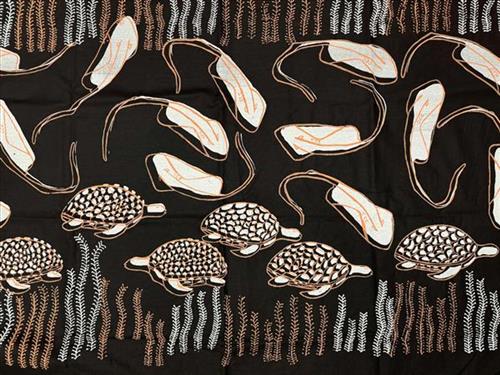
Mabbúlarr (Calm Still Water)

Mabbúlarr is the Ndjébbana word describing calm and stillness – both regarding people and the ocean.

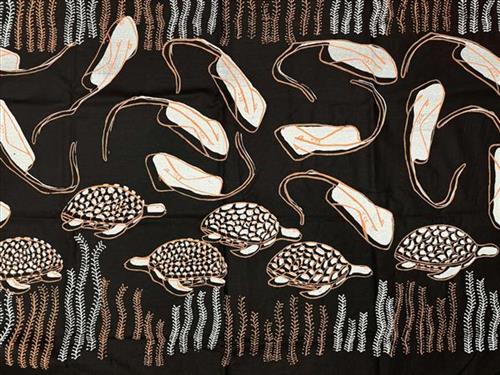
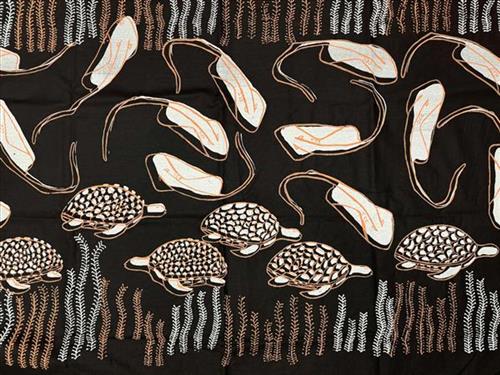
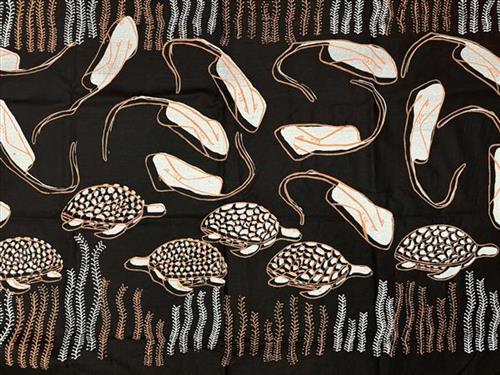
This design tells the story of underwater life in the shallows. The turtle we call marláddja (green turtle, Chelonia mydas) and the stingray we call marnandjúbba (Cowtail Stingray, Pastinachus sephen).

‘When strong wind blows the sea is rough, when there’s no wind the sea is calm. We call that mábbularr. You can see through the water and look at the turtle and stingray eating karlómerr (sea grass) and dancing underwater to find their mate. When we go on the boat hunting, we go at times of mábbularr.

In the old days men used to hunt with a canoe and with traditional made harpoon.  Guided by our ancestors’ spirits they would paddle all day to find sea turtle and dugongs in the right places. The men had to be smart for the tide and know the weather to balance their canoes. They would go at times of mábbularr (calm), early morning in daytime or at night-time when there is no moon and the water glows. We call the night-time glimmer of phosphorescence mílarrng-milarrng. Today people still go hunting, it brings a lot of families together and they share eating down the beach.

We have songline for sea turtle, also men paint turtle on their back and dance turtle in the Míddjarn the same way turtle dance underwater. It is very important we look after our country and songline passed on from many generations’. Josephine James 2021

377810582350750


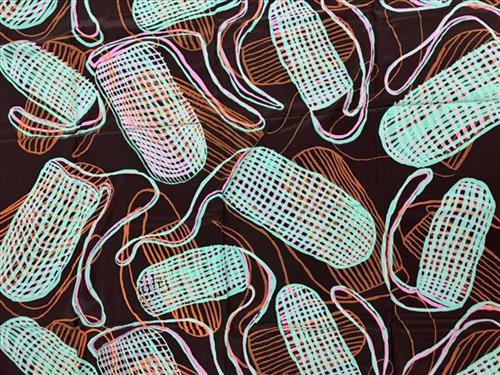
Mabbúlarr (Calm Still Water)

Mabbúlarr is the Ndjébbana word describing calm and stillness – both regarding people and the ocean.

This design tells the story of underwater life in the shallows. The turtle we call marláddja (green turtle, Chelonia mydas) and the stingray we call marnandjúbba (Cowtail Stingray, Pastinachus sephen).

‘When strong wind blows the sea is rough, when there’s no wind the sea is calm. We call that mábbularr. You can see through the water and look at the turtle and stingray eating karlómerr (sea grass) and dancing underwater to find their mate. When we go on the boat hunting, we go at times of mábbularr.

In the old days men used to hunt with a canoe and with traditional made harpoon.  Guided by our ancestors’ spirits they would paddle all day to find sea turtle and dugongs in the right places. The men had to be smart for the tide and know the weather to balance their canoes. They would go at times of mábbularr (calm), early morning in daytime or at night-time when there is no moon and the water glows. We call the night-time glimmer of phosphorescence mílarrng-milarrng. Today people still go hunting, it brings a lot of families together and they share eating down the beach.

We have songline for sea turtle, also men paint turtle on their back and dance turtle in the Míddjarn the same way turtle dance underwater. It is very important we look after our country and songline passed on from many generations’. Josephine James 2021
377810582350747


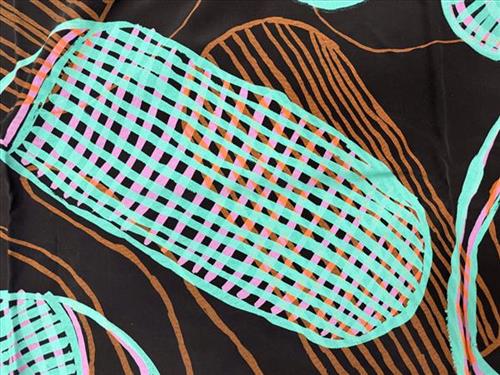
Mabbúlarr (Calm Still Water)

Mabbúlarr is the Ndjébbana word describing calm and stillness – both regarding people and the ocean.

This design tells the story of underwater life in the shallows. The turtle we call marláddja (green turtle, Chelonia mydas) and the stingray we call marnandjúbba (Cowtail Stingray, Pastinachus sephen).

‘When strong wind blows the sea is rough, when there’s no wind the sea is calm. We call that mábbularr. You can see through the water and look at the turtle and stingray eating karlómerr (sea grass) and dancing underwater to find their mate. When we go on the boat hunting, we go at times of mábbularr.

In the old days men used to hunt with a canoe and with traditional made harpoon.  Guided by our ancestors’ spirits they would paddle all day to find sea turtle and dugongs in the right places. The men had to be smart for the tide and know the weather to balance their canoes. They would go at times of mábbularr (calm), early morning in daytime or at night-time when there is no moon and the water glows. We call the night-time glimmer of phosphorescence mílarrng-milarrng. Today people still go hunting, it brings a lot of families together and they share eating down the beach.

We have songline for sea turtle, also men paint turtle on their back and dance turtle in the Míddjarn the same way turtle dance underwater. It is very important we look after our country and songline passed on from many generations’. Josephine James 2021
377810582350745


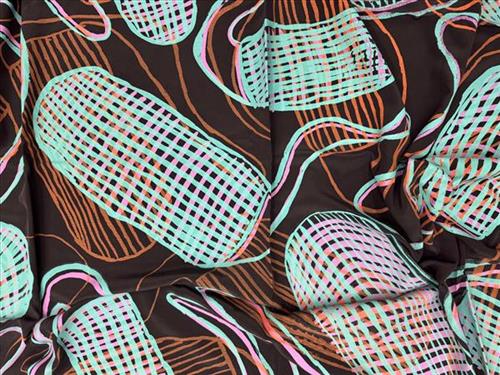
Mabbúlarr (Calm Still Water)

Mabbúlarr is the Ndjébbana word describing calm and stillness – both regarding people and the ocean.

This design tells the story of underwater life in the shallows. The turtle we call marláddja (green turtle, Chelonia mydas) and the stingray we call marnandjúbba (Cowtail Stingray, Pastinachus sephen).

‘When strong wind blows the sea is rough, when there’s no wind the sea is calm. We call that mábbularr. You can see through the water and look at the turtle and stingray eating karlómerr (sea grass) and dancing underwater to find their mate. When we go on the boat hunting, we go at times of mábbularr.

In the old days men used to hunt with a canoe and with traditional made harpoon.  Guided by our ancestors’ spirits they would paddle all day to find sea turtle and dugongs in the right places. The men had to be smart for the tide and know the weather to balance their canoes. They would go at times of mábbularr (calm), early morning in daytime or at night-time when there is no moon and the water glows. We call the night-time glimmer of phosphorescence mílarrng-milarrng. Today people still go hunting, it brings a lot of families together and they share eating down the beach.

We have songline for sea turtle, also men paint turtle on their back and dance turtle in the Míddjarn the same way turtle dance underwater. It is very important we look after our country and songline passed on from many generations’. Josephine James 2021

377810582350639


Djenj dja Komrdawh (Swordfish and Turtle)

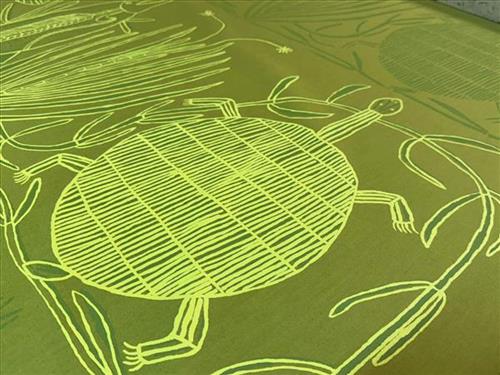
“My country is called Mankorlod. It is near the rock country. My dreaming is komrdawh (long neck turtle), the one I painted in my design. I like to eat komrdaw, it tastes really nice. We catch them in dry and wet season near Mankorlod. This is my first ever design, and I only have one design. I painted it with brush at Babbarra Women’s Centre and I feel proud when people print my design.” Margot Gurawiliwili

The vines depicted in this artwork are used by women to weave and create fibre sculpture. They grow naturally on the floodplains in Arnhem Land. The long-necked turtle and freshwater sword fish depicted are popular bush food.

220182350612


Family in Yalpirakinu

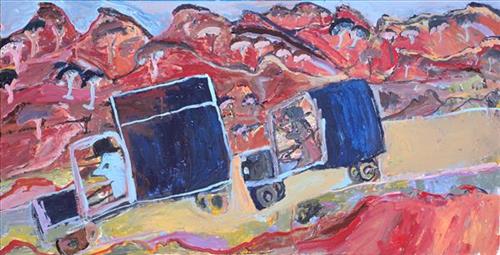
Yalpirakinu is Adrian’s mother’s country. Adrian’s mother is the late Eunice Napangardi, a well known painter herself. His artworks consistently refer to the desert mountains, ridges and trees which are part of Yalpirakinu. Using a restricted colour palette, Adrian’s brushwork is loaded with energy, drama and memories. In this painting Adrian has drawn from his memory to portray his family in Yalpirakinu.