115682343536


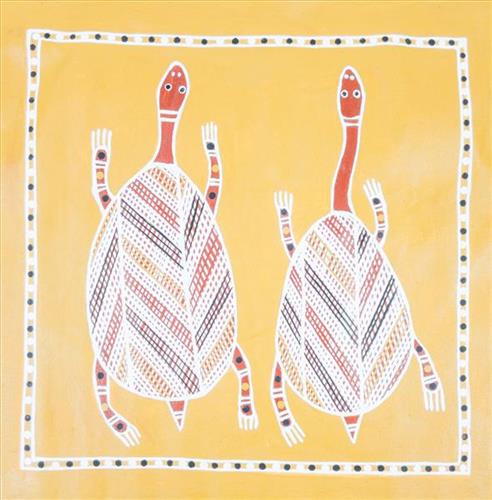
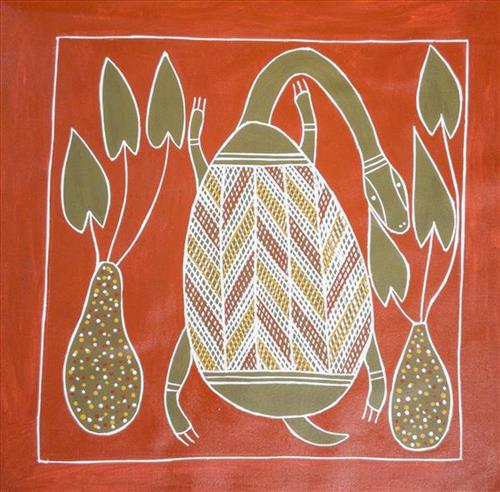
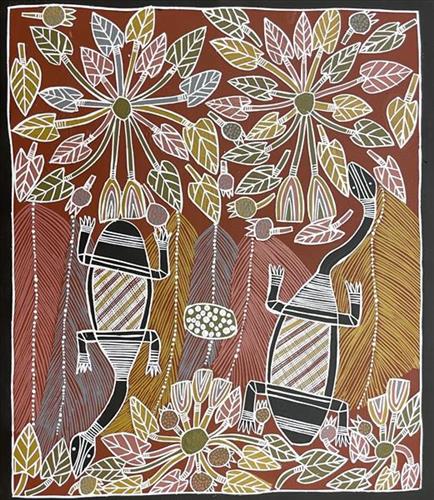
Ganalbingu – Banda (Long Necked Turtle)

The long necked turtle is a dreaming totem for the freshwater people, the Ganalbingu, whose country includes the World Heritage listed, Arafura Wetlands in Central Arnhem Land, Northern Territory

The Yolngu (people) of Arnhem Land originate from a spiritual source, fixed in a particular place in their land or the sea. These ‘Spiritual Reservoirs’ are often in the form of special waterholes made by Wangga (Creator Beings), long ago close to the beginning of time. These creator beings moved across the country side, shaping the land and implanting in each tract of country, the spiritual life force for the people who were to own it.

These creator spirits took many forms. When they gave the land to each group they also gave songs, dances, ceremony, the associated laws and language. The Creation story for Ganalbingu people took place near the middle section of the Glyde River where it becomes the Goyder River. Their land, Ngaliyindi, sits astride the Arafura Swamp in Central Arnhem Land. Some of their major Creative Beings include Banda (freshwater long neck turtle) and Yalman (water lilies).
115682343854


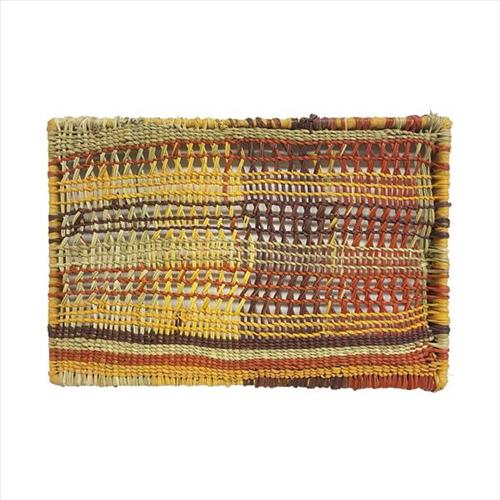
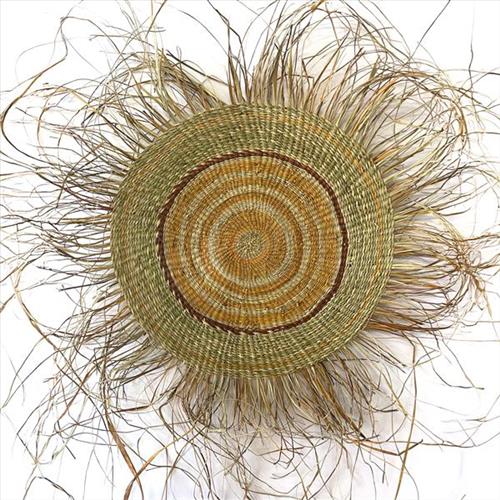
Woven Mat

Traditionally, Nganiyal (conical mats) were used as an insect screen when erected, and as a sitting mat when folded. They are used in Ceremony as well as a functional item. 

Nowadays, artists weave many different shapes including flat, round and oblong. 

115682343853


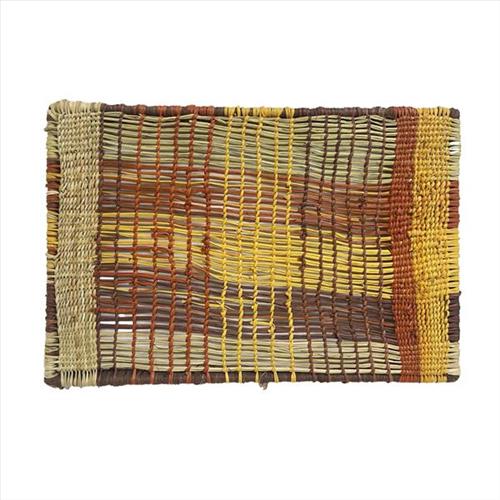
Gunga wungili (pandanus picture)

At the end of May 2024, Bula’bula artists, along with Milingimbi Arts and Culture, Maningrida Arts, and Gapuwiak Arts, were invited to attend the Langarra Bush Gallery—a three-day camp that included an exhibition, workshops, and discussions for the Weavers of Arnhem Land. Langarra is an island located a 20-minute boat ride from Elcho Island in the Arafura Sea.

The Bush Gallery provided weavers with an opportunity to create work that pushed their boundaries, encouraging them to experiment with new techniques or showcase unique skills. The goal was to foster a supportive environment where weavers could create and present work they were excited about, facilitate discussions, connections, growth, and instilling pride in their craft.

As a result of this project, our weavers produced traditional Yolngu items from hand-spun bush string, including bags, hunting and fishing items, and wearable ceremonial pieces. Additionally, they explored new approaches by creating canvas-shaped formats. This format invite viewers to examine the intricate details, colours, and craftsmanship, highlighting the inherent beauty of the gunga.

115682343852


Gunga wungili (pandanus picture)

At the end of May 2024, Bula’bula artists, along with Milingimbi Arts and Culture, Maningrida Arts, and Gapuwiak Arts, were invited to attend the Langarra Bush Gallery—a three-day camp that included an exhibition, workshops, and discussions for the Weavers of Arnhem Land. Langarra is an island located a 20-minute boat ride from Elcho Island in the Arafura Sea.

The Bush Gallery provided weavers with an opportunity to create work that pushed their boundaries, encouraging them to experiment with new techniques or showcase unique skills. The goal was to foster a supportive environment where weavers could create and present work they were excited about, facilitate discussions, connections, growth, and instilling pride in their craft.

As a result of this project, our weavers produced traditional Yolngu items from hand-spun bush string, including bags, hunting and fishing items, and wearable ceremonial pieces. Additionally, they explored new approaches by creating canvas-shaped formats. This format invite viewers to examine the intricate details, colours, and craftsmanship, highlighting the inherent beauty of the gunga.

221382343827


Lorrkon

Wood carving has always been part of Aboriginal culture and Djilpin artists continue this tradition. Men carved wood for many purposes – tools for hunting or gathering food, axes and knives for building shelters, spears and clubs for protection of their lives and territory, objects for ceremony and to mark sacred sites.

Hunting implements include the boomerang, woomera and spear. The woomera is a lever which helps to increase the speed and distance the spear travels. Clapsticks are used as percussion instruments by the Songmen to accompany dancing along with the didgeridoo (mago).

As well as the more functional carvings, artists portray animals and birds in wood, and these carvings are often painted. Ceremonial carvings include spirit creatures including mukuy (devil devils) and mimi.

Some fine mimi figures have been cast in bronze.

221382343820


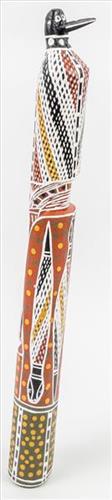
Bird

Wood carving has always been part of Aboriginal culture and Djilpin artists continue this tradition. Men carved wood for many purposes – tools for hunting or gathering food, axes and knives for building shelters, spears and clubs for protection of their lives and territory, objects for ceremony and to mark sacred sites.

Hunting implements include the boomerang, woomera and spear. The woomera is a lever which helps to increase the speed and distance the spear travels. Clapsticks are used as percussion instruments by the Songmen to accompany dancing along with the didgeridoo (mago).

As well as the more functional carvings, artists portray animals and birds in wood, and these carvings are often painted. Ceremonial carvings include spirit creatures including mukuy (devil devils) and mimi.

Some fine mimi figures have been cast in bronze.

221382343819


Long Neck Turtle – Nyangura

Nyangura the Long-Neck Tortoise is Yirritja. The two sacred ancestral Nyangura are found at a place called Djirringi in north-central Arnhem Lane on Ganalbingu land. The tracks left by the two ancestral totemic Nyangura, as they crawled over the land at Djirringi, is a sacred symbol. This symbol is used as a ground design or sand sculpture during cleansing ceremonies otherwise known as Bulu-Lup or Wan’tjirr. During this ceremony, water is poured over the bodies of Yolngu relatives of the deceased as they stand within the sacred ground design representing the marks left on the ground by the two original ancestral Nyangura at Djirringi. Yolngu also dance Nyangura during bunggul ceremonies. Here they may paint the design for Nyanguru and other designs. Nyangura is also food for Yolngu. It is cooked and cut according to age old tradition. The artist has depicted four Long Neck Turtle’s in this painting.

221382343818


Long Neck Turtle – Nyangura

Nyangura the Long-Neck Tortoise is Yirritja. The two sacred ancestral Nyangura are found at a place called Djirringi in north-central Arnhem Lane on Ganalbingu land. The tracks left by the two ancestral totemic Nyangura, as they crawled over the land at Djirringi, is a sacred symbol. This symbol is used as a ground design or sand sculpture during cleansing ceremonies otherwise known as Bulu-Lup or Wan’tjirr. During this ceremony, water is poured over the bodies of Yolngu relatives of the deceased as they stand within the sacred ground design representing the marks left on the ground by the two original ancestral Nyangura at Djirringi. Yolngu also dance Nyangura during bunggul ceremonies. Here they may paint the design for Nyanguru and other designs. Nyangura is also food for Yolngu. It is cooked and cut according to age old tradition. The artist has depicted four Long Neck Turtle’s in this painting.

116482343873


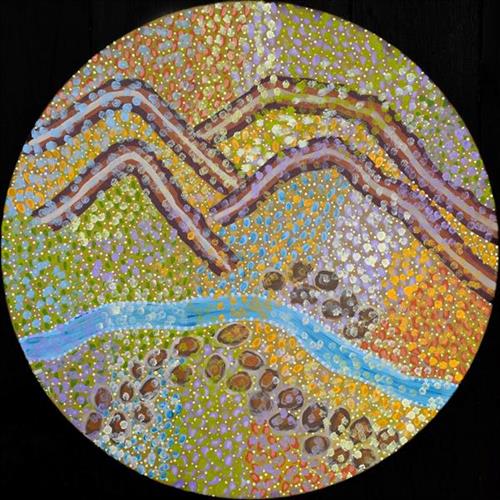
Pilbara Hills

In our country, we have many hills of all different shapes and sizes. When driving through country at different times the colours change and some of the hills look like velvet in the evening and morning light.

116482343867


Pilbara Wildflower Patch

In spring I can never get over the beauty of these purple, Mulla Mulla’s when they are in bloom along with the other yellow, pink and white flowers, and the yellow Blue Gum flower. It’s like a beautiful garden that you never have to water.