111582334929


Kumpupirntily (Kumpupintily, Lake Disappointment)

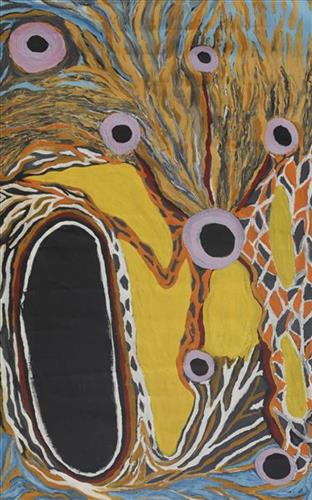
Kumpupirntily (Kumpupintily, Lake Disappointment) is a stark, flat and unforgiving expanse of blinding salt lake surrounded by sand hills, located in the Little Sandy and Gibson Desert of Western Australia. Kumpupirntily translates to ‘bladder burst’; the lake was formed when the bladder of the Jila Kujarra (Two Snakes) burst here. Jila Kujarra is one of the key Jukurrpa (Dreaming) narratives for the Martu. Though the story belongs to Warnman people, it is shared across the Western Desert with several other language groups. The narrative centres on the travels of two snakes as they are pursued by the Niminjarra, spiritual ancestors of the Warnman people. 

Later in the Jukurrpa period the Ngayurnangalku (cannibal beings) made Kumpupirntily their home, where they continue to remain today. For this reason Kumpupirntily is considered one of the most sacred and dangerous sites of the Western Desert. The Ngayurnangalku are fearsome ancestral cannibal beings said to resemble people in their appearance, except for their fangs and long, curved, knife like fingernails they use to catch and hold their human victims. Coming from Natawalu (Canning Stock Route Well 40) in the north, Mundiwinti (Mundawindi) in the west, and from the Country around Kiwirrkurra in the east, the Ngayurnangalku travelled across the desert, stopping near Puntawarri, at Jilukurru (Killagurra Springs, Canning Stock Route Well 17) and at Kupayura (Savory Creek) before finally reaching Kumpupirntily.

At Kumpupirntily, the Ngayurnangalku had a meeting to debate whether or not they would continue to live as cannibals, and eventually came to the decision to stop eating people. That night, a female baby cannibal was born. Following protocol, the baby also had to be consulted by the group. She determined that the Ngayurnangalku should continue to eat people. Her decision divided the group, and from this point the group from the east continued to live as ‘bad’ cannibals at Kumpupirntily, while the group from the west became ‘good’, thereafter consuming only animals. 

The cannibal Ngayurnangalku still live beneath the crust of Kumpupirntily lake in an underground world lit by their own sun. They surface only to feed on human flesh, coming in and out of the world we see through a small hill that acts as a gateway between worlds; Yapu Maparnpa (magical hill). Stored with the Ngayurnangalku in their underground world is an arsenal of maparnpa (holding power for sorcery) weapons, as well as deposits of pujurrpa (red ochre) that the Ngayurnangalku use to paint themselves with when they dance.

Several phenomena at Kumpupirntily act as a warning of the imminent appearance of the Ngayurnangalku; still skies, wilany (boomerang-shaped clouds), and the emergence of the parla-parla (type of lizard), smacking their mouths. The vigilance of the Martu as they travel in the Country around Kumpupirntily is so great that several other precautions are followed; fires are not lit, planes and helicopters are not flown directly over the area, and digging in the lake is strongly discouraged. All of these activities are believed to disturb the Ngayurnangalku, causing them to rise from their underground world. 
22023973704


Status: Stock


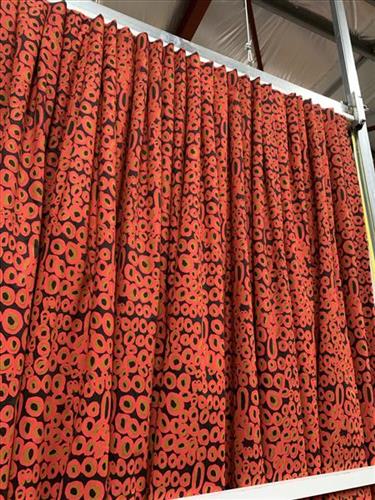
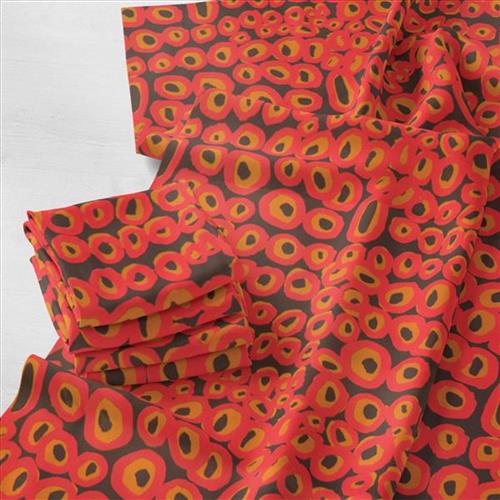
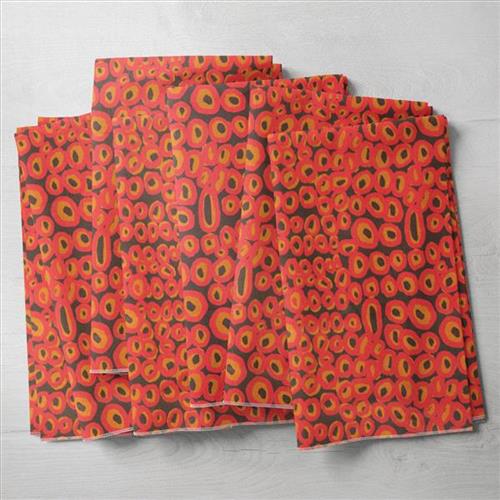
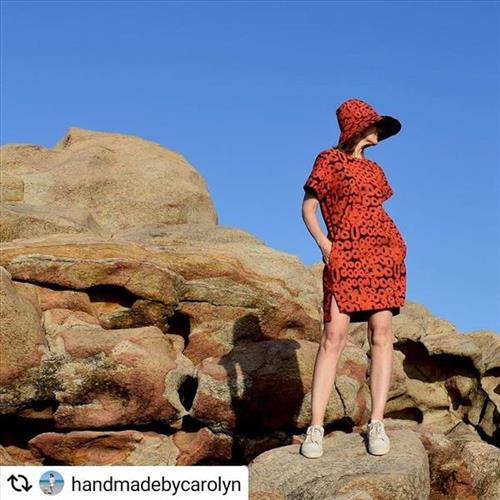
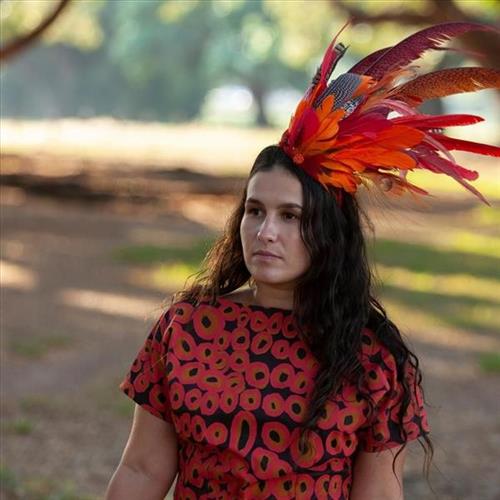
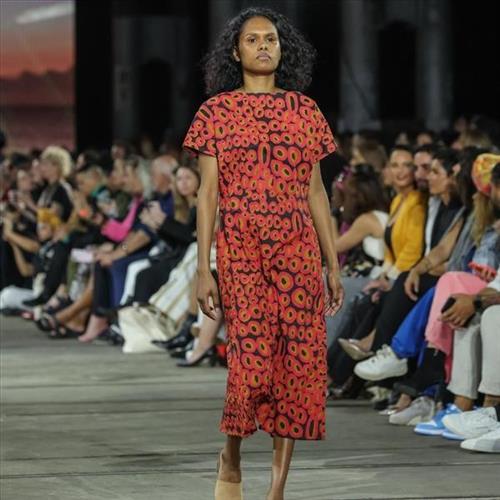
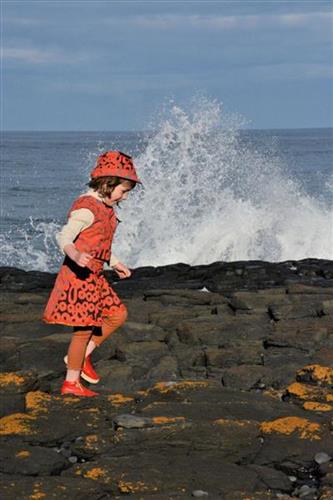
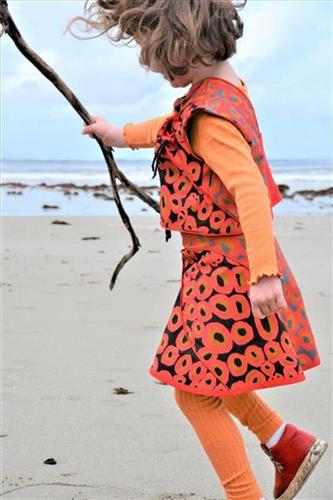
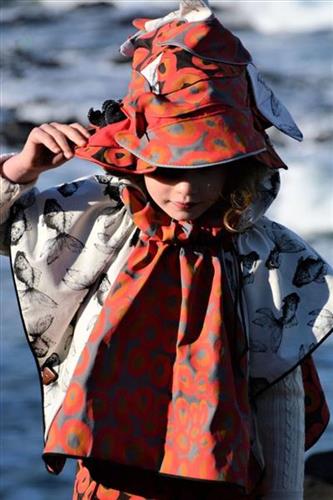
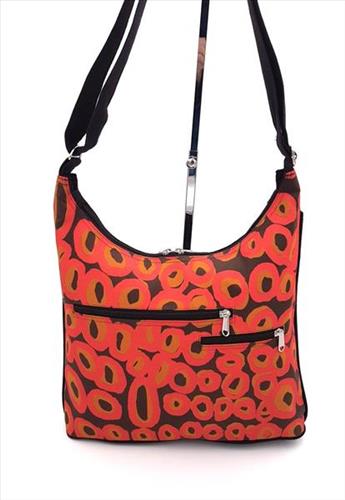
Tjilkamala Rockholes Fabric- Red and Orange on Brown (Cotton) 50cm

This design by Alice Nampitjinpa Dixon depicts Takupalangu west of Kintore. This is Uta Uta Tjangala’s country, which he has painted throughout his career. Nampitjinpa paints her father’s country of rockholes (puli) and sandhills (tali). There is plenty bushtucker – mangilpa, which are little black seeds around. The road to Kiwirrkurra passes Takupalangu on the side.
Alice describes the big swamp of Takupalangu, in her Fathers country. Takupalangu is filled up with bush vegetables called mungilpa. When Alice was a small girl she travelled this country with her family. Her mother used to collect mungilpa and pummel it into dough which she made into damper. It is also a good place for hunting bush meat as the swamp is surrounded by rock hills.

This fabric has been screen printed by hand by Publisher Textiles and Papers, ensuring the highest quality and longevity.

About the printers:

Publisher Textiles & Papers is one of Australia’s leading print houses. Focused on producing original patterns through traditional hand-screen printing methods we create bold and colourful textiles, hand printed wallpaper, clothing and fabric.

Our fabric is printed in small batches and is available in pre-cut lengths on the website, which we update regularly. For larger quantities, please email us to discuss pre-orders.

Fabric details:

This fabric is by continuous metreage going up in 50cm increments, priced at $110 per metre.

For 1m, please add 2 x 50cm to your cart and it will be cut as a continuous length ($110 for 1m).

For 2m, please add 4 x 50cm to your cart and it will be cut as a continuous length ($220 for 2m).

For 3m, please add 6 x 50cm to your cart and it will be cut as a continuous length ($330 for 3m).

Fabric care instructions (Trapper Drill): Gentle cold/ warm hand wash. Do not bleach, warm rinse well, do not tumble dry, line dry out of direct sunlight, warm iron, Wash dark colours separately.

115680583120


Mindirr (Pandanus Bag)

Commonly know as “dilly dags”, mindirr are woven from the split leaves of the Screw Palm (Pandanus Spiralis). They are made in various shapes and sizes and are worn hanging down the back with the string handle across the forehead.

115681631646


Mindirr (Pandanus Bag)

Commonly know as “dilly dags”, mindirr are woven from the split leaves of the Screw Palm (Pandanus Spiralis). They are made in various shapes and sizes and are worn hanging down the back with the string handle across the forehead.

115681633028


Djunggaliwarr ga wayanaka (conch shell and oysters)

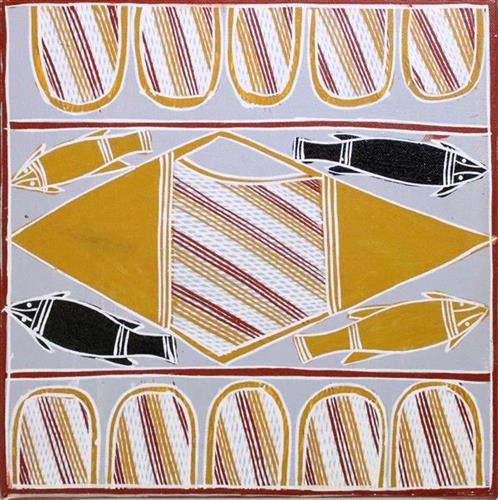
This painting is of a conch shell and the “U” shapes are oysters. The rrark (cross hatching) is representing water.

As part of Evonne’s family tradition To make these intricate table mats, artists collect the young leaves from the Pandanus Spiralis palm tree. They then strip the leaves of thorns and into thin strips before they are boiled with tree roots or leaves that are used to make natural dye. is lit over the conch shell and the smoke from this fire is used in a smoking ceremony. This ceremony has cleansing properties.

115681980503


Djerrk / Gay’wu (Bush String Bag)

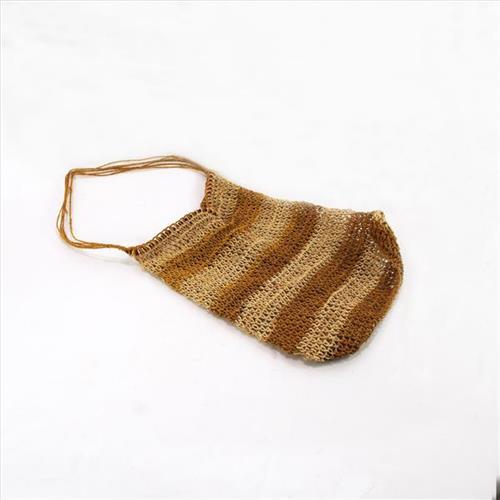
Hand spun bush string is made from the inner bark of the Banyan tree (ficus viarens), the Karrajong tree (brachychiton paradoxum) or the Cocky Apple tree (planchonia careya). The bark from the young tree is beaten or chewed whilst still fresh. It is than pounded with a stone to separate the fibres which are then rolled and spun on the thigh. The string is then knitted or knotted to create a bag.

115681995046


Fish Net

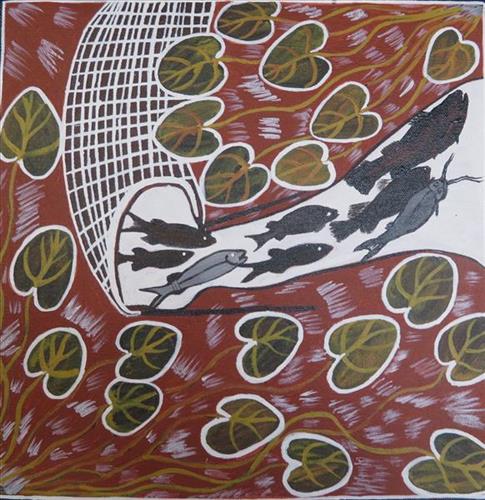
Fish Net – The story of Bululidj, the creek on the other side of Nangalala. Surrounded by the weeds and water lilies the fish trap is hidden in the creek, the fish entering are the saratoga, barramundi, catfish and other small ones.

115681998264


Djerrk / Gay’wu (Bush String Bag)

Hand spun bush string is made from the inner bark of the Banyan tree (ficus viarens), the Karrajong tree (brachychiton paradoxum) or the Cocky Apple tree (planchonia careya). The bark from the young tree is beaten or chewed whilst still fresh. It is than pounded with a stone to separate the fibres which are then rolled and spun on the thigh. The string is then knitted or knotted to create a bag.

115682094184


Woven Mat

Traditionally, Nganiyal (conical mats) were used as an insect screen when erected, and as a sitting mat when folded. They are used in Ceremony as well as a functional item. 

Nowadays, artists weave many different shapes including flat, round and oblong. 

115682124109


Mindirr (Pandanus Bag)

Commonly known as “dilly bags”, mindirr are woven from the split leaves of the Screw Palm (Pandanus Spiralis). They are made in various shapes and sizes and are worn hanging down the back with the string handle across the forehead.