111582446491


Untitled

“Jigalong, Doreen, [s]he been born there, [s]he been go Nullagine, as a little little one. [S]He gone Marble Bar staying there and Strelley. I been marry her father.

Every painting Jigalong, Punmu, Parnngurr, go back town. Make em painting big one town. Get em, you gotta get em maybe big one.”

 – May Chapman Mayiwalku (May Wokka)


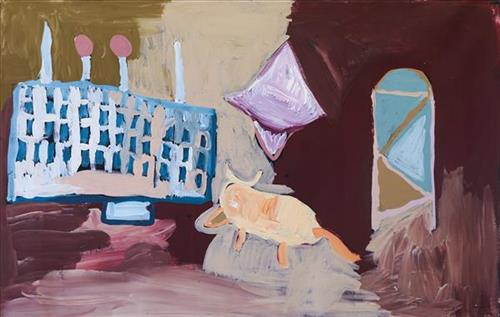
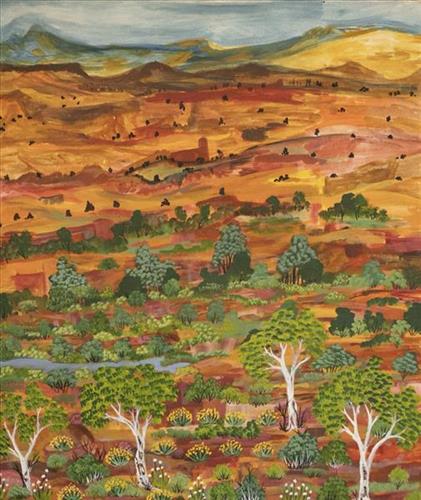
Most often explored in Doreen’s works are the motifs of her everyday modern Aboriginal community life; the animals hunted and plants gathered for bush tucker, the cars and aeroplanes used to travel to the cities and remote communities she regularly moves between, and depictions of the Country itself. 

Collectively this imagery, depicted with Doreen’s trademark wild palettes, painterly brushstrokes, and stark compositions, builds a layered representation of her Country. Doreen’s intimately known ngurra (home Country, camp) is viewed from multiple spatial perspectives, and in stylistic modes ranging from pure abstraction to images incorporating realist and traditional elements.

Doreen’s ngurra encompasses the Country between Western Desert communities and towns; Warralong, Strelley, Marble Bar, Port Hedland, and Jigalong, her birthplace. People identify with their ngurra in terms of specific rights and responsibilities, and the possession of intimate knowledge of the physical and cultural properties of one’s Country. Painting ngurra, and in so doing sharing the Jukurrpa (Dreaming) stories and physical characteristics of that place, has today become an important means of cultural maintenance.
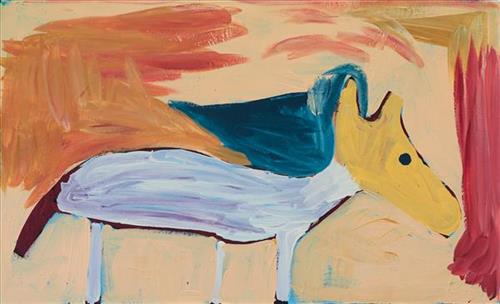
111582446488


Untitled

Martumili Artists work with over three hundred artists from remote Martu Aboriginal communities, including Punmu, Parnngurr, Kunawarritji, Jigalong, Irrungadji (Nullagine), and Warralong, as well as from the Parnpajinya (Newman) gallery and studio spaces. Known for their diverse, energetic, and unmediated painting styles, their works reflect the dramatic geography and scale of their homelands. Each artist, however, brings a unique approach to their craft.

Younger Martu artists often start painting alongside their parents, grandparents, and extended family, which fosters an organic learning process. This not only involves mastering painting techniques but also understanding specific locations, family histories, traditional ways of life, bush tucker, and Jukurrpa (Dreaming). Over time, with encouragement from their peers, they develop their own distinct styles and explore unique painting techniques and subject matter. In this work the artist brings a contemporary, evolving perspective to their work.

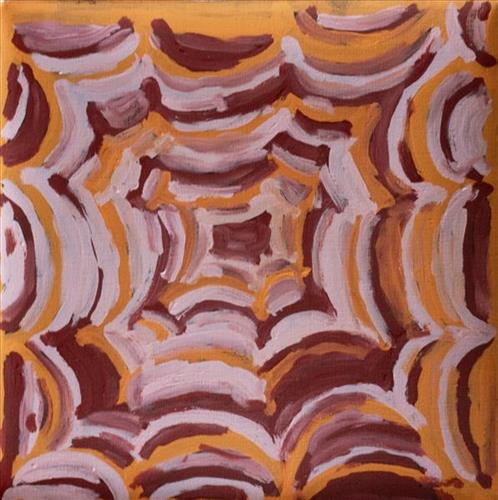
111582446487


Untitled

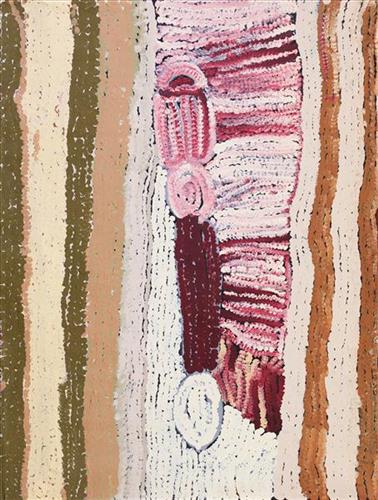
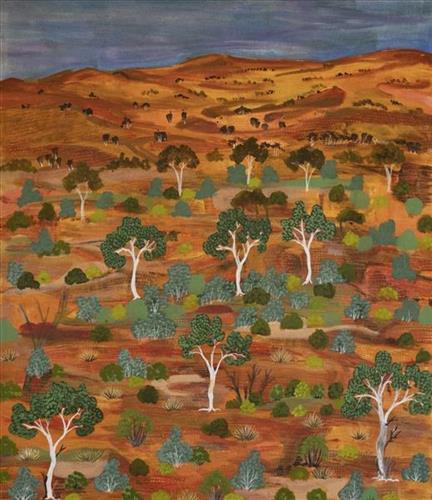
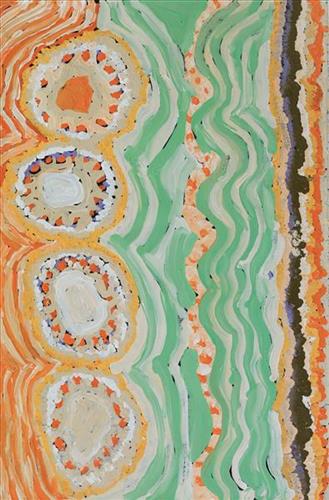
This is Lorna’s Country- her ‘ngurra’ (home Country, camp). People identify with their ngurra in terms of specific rights and responsibilities, and the possession of intimate knowledge of the physical and cultural properties of one’s Country. Painting ngurra, and in so doing sharing the Jukurrpa (Dreaming) stories and physical characteristics of that place, has today become an important means of cultural maintenance. 
Though Lorna was born in the Port Hedland hospital and she attended school from a young age, she still lived a somewhat traditional pujiman (traditional, desert dwelling) lifestyle, travelling in the Country between Marble Bar and Roebourne with ‘nomad people’. Today Lorna lives in Warralong Aboriginal community, 50km north of Marble Bar.

Portrayed in this work are features of Lorna’s ngurra, such as the dominant permanent red tali (sandhills), warta (trees, vegetation), and the individually named water sources she and her family camped at.

111582446480


Jarntinti

“This is a linyji (claypan). We find kalaru (seed used for making damper from samphire bush) there that we collect. Too much good tucker! 

I been go, everywhere, all over the place, and bush tucker. Get ‘em, collecting them and go back. I been jartu working, find ‘em, digging take em back. Piyarna piyarna piyarna put em in the wika, waru [fire], yamparl [damper].  

Kalaru [seed, samphire species], mirrka [making food], damper pirrangka

[talking about making damper at Jarntinti from Kalaru seed in the desert.]

Pirra, pirra country, desert long way. Ngarninya jiliku ngalka. Going hunting pujikatuku, and parnajarrpa, parnaparti, ngula, come back, lungkurta, nyiyari, take em back, cook em, (…) go back, right up, another one.

 Pararra pararra, kakarra Tarlpa, Tarlpa water, Jarntinti yaninpa kararra, kararra kararra, Jarntinti, Tarlpa water one, Jutupa long way. Parraja yalinyja Jutupa, Jutupa, yanikirninya palarri yanikirninya yanikirninya kakarra warrarn kakarra warrarn, yanikirninya kuwiyikarti pungkanyikinrinya pujikatu pujikatu, lungkurta everything. Kuwiyilangu yanikirninya malka wanikirninya.

Finished yankula nyarni Jarntinti… gone Jutupa, Jutupakarti.”

 – May Chapman Mayiwalku (May Wokka)

[Talks about travelling across a lot of country, collecting seed, yandying, grinding and making damper on the fire. 

Making damper from Kalaru seed in the desert at Jarntinti.

Hunting in the desert for cats, sand goannas, thorny devils, blue-tongue lizards.

She talks about travelling from Tarl springs to Jarntinti claypan, walking the country hunting all different bush meats, filling up and carrying the leftovers, travelling further towards Jutupa in the northwest, further away.]


Jarntinti is a large claypan at the Southern end of Nyayartakujarra (Lake Dora), a large salt lake surrounded by tali (sand hills) within the Karlamilyi (Rudall River) region. This area forms part of Mayiwalku’s ngurra (home Country, camp), the region which she traversed extensively as a young girl. Mayiwalku’s sister Nyanjilpayi was born at Jarntinti. 

During the pujiman (traditional, desert dwelling) era, Jarntinti was primarily used as a camping site in the wantajarra (wet season), when the claypan filled with kapi (water). Other nearby water sources include Tarl, Kartuny, Wawul, Warnkarr, Jutupa, and Kunalimpi. 

Jarntinti is known as a site where kalaru grows in abundance. In the pujiman era, the black kalaru seeds were seasonally harvested from this area. Once collected a labour intensive process began to produce damper, a type of flat bread. The kalaru seeds were first washed several times before being ground with a jiwa (stones used by women for grinding seeds) to make a type of flour, which was then mixed with water to create a dough that was finally cooked in the ashes of a fire.

111582446479


Untitled [Warralong]

“Jigalong, Doreen, [s]he been born there, [s]he been go Nullagine, as a little little one. [S]He gone Marble Bar staying there and Strelley. I been marry her father.

Every painting Jigalong, Punmu, Parnngurr, go back town. Make em painting big one town. Get em, you gotta get em maybe big one.”

 – May Chapman Mayiwalku (May Wokka)


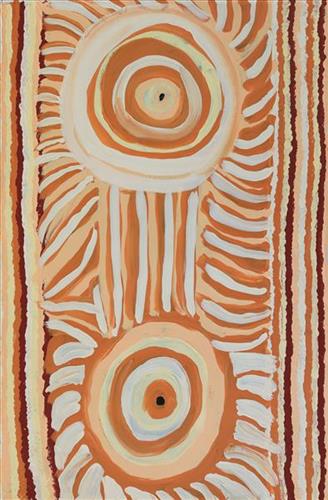
Most often explored in Doreen’s works are the motifs of her everyday modern Aboriginal community life; the animals hunted and plants gathered for bush tucker, the cars and aeroplanes used to travel to the cities and remote communities she regularly moves between, and depictions of the Country itself. 

Collectively this imagery, depicted with Doreen’s trademark wild palettes, painterly brushstrokes, and stark compositions, builds a layered representation of her Country. Doreen’s intimately known ngurra (home Country, camp) is viewed from multiple spatial perspectives, and in stylistic modes ranging from pure abstraction to images incorporating realist and traditional elements.

Doreen’s ngurra encompasses the Country between Western Desert communities and towns; Warralong, Strelley, Marble Bar, Port Hedland, and Jigalong, her birthplace. People identify with their ngurra in terms of specific rights and responsibilities, and the possession of intimate knowledge of the physical and cultural properties of one’s Country. Painting ngurra, and in so doing sharing the Jukurrpa (Dreaming) stories and physical characteristics of that place, has today become an important means of cultural maintenance.
220982442594


Leanne Teece – Anterrengeny – My Father’s Country

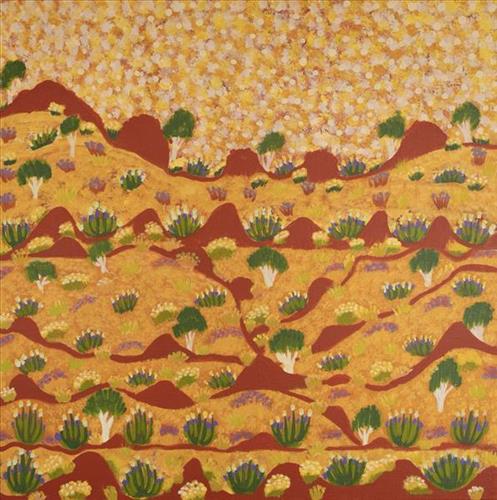
Anterrengeny is my Father’s country. I paint the country that I come from, the beautiful landscapes and the many colours as they change during the session.

220982442591


Jerome Ngwarraye Petrick – Atyenh Amper – (My Country)

I paint the country that I come from, the beautiful landscapes and the many colours as they change during the seasons.

Jerome is the Grandson of Elizabeth Ngwarraye Bonney and son of Sevania Kemarre Bonney, Jerome is inspired by the work of his family, especially his grandfather Alec Pula Lewis and uncle Gunderson Kemarre Lewis. He loves to paint the incredible landscapes found in Ampilatwatja

220982442875


Elizabeth Ngwarraye Bonney – Atyenh Anyany Amper (My Grandmothers Country)

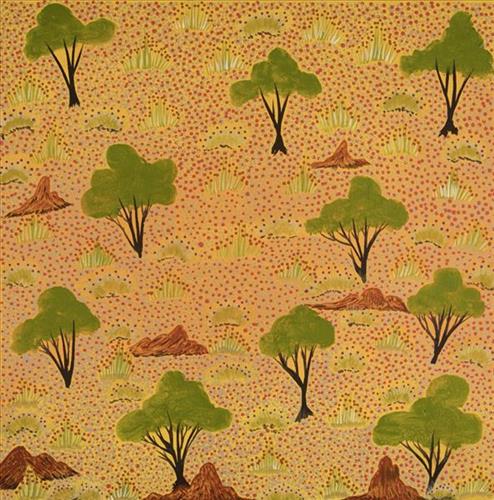
I still hunt my Grand Mothers country for goanna, bush medicine and yams.

I hunt all year round, hunting and walking through the country makes me happy.  When I look at the distant hills I can feel my grandmother.  Bush flowers are everywhere.

Painting and printing my grandmother’s country reminds about those times.

220982443072


Elizabeth Ngwarraye Bonney – Penh Kwaty (After Rain)

After we have big rain the land is full of flowers and the river is full of water. This makes me happy.

220982445978


Maisie Petyarre Bundey – Artna Tyap (Bush Tucker)

Maisie paints the bush tucker found in her country, the area that surrounds Boundary Bore in the Utopia homelands. She paints bush plums, bush bananas, bush potatoes and bush medicine plants. The main motif which recurs often in Maisie artworks is a full coolamon.
 
When she paints she always speaks of gathering and hunting on her country – long way from here, long time ago, filling up coolamons with bush potato, bush banana, goanna and porcupine. Maisie always says her family are happy ones and healthy ones.