My mum birth place dreamtime story-
My image in my mother’s boab birth tree
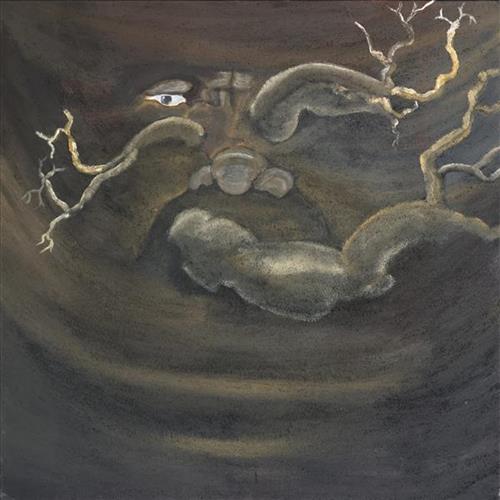
My image in my mother’s boab birth tree
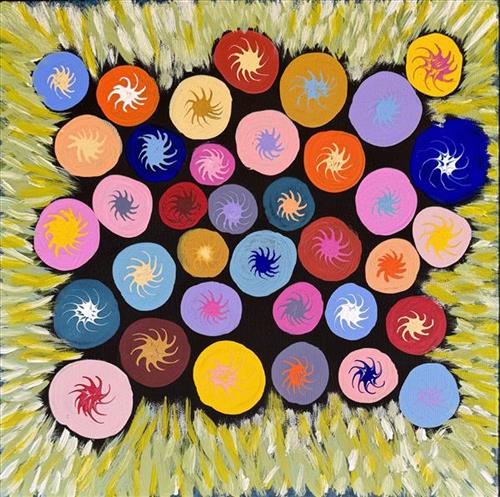
The artists of Ampilatwatja made a conscious decision not to paint ‘altyerr’ dreaming stories. The artists paint their country where those stories sit.
These bush flowers grow seasonly in Alyawarr country, some of which are also used in bush medicine remedies.
“When I go out hunting, I like to see all the bush flowers that are flowering and then when I come back, I paint them.”
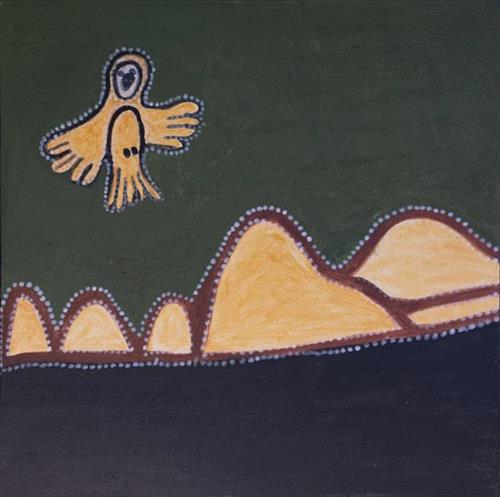
In the Ngarrangkarni (Dreaming) a number of birds came from Rhadigan Yard way to Turkey Creek to look for some fish. There was a crane, ibis, duck, pelican, jabiru and a night owl. While Barnungung, the night owl was tightening his spearhead, Ginyan the crane went down to Turkey Creek to look for fish. Ginyan came back from the creek and told Barunungung that there were no fish. Ginyan then threw his spear into the ground. That spear became a mangunji tree. When rubbed together and placed in the water, the leaves of this tree make the water soapy and poisons the fish. The fish rise to the surface, dead, but are still good to eat. That mangunji tree is still there on an island in the middle of Turkey Creek. This is a men’s place.
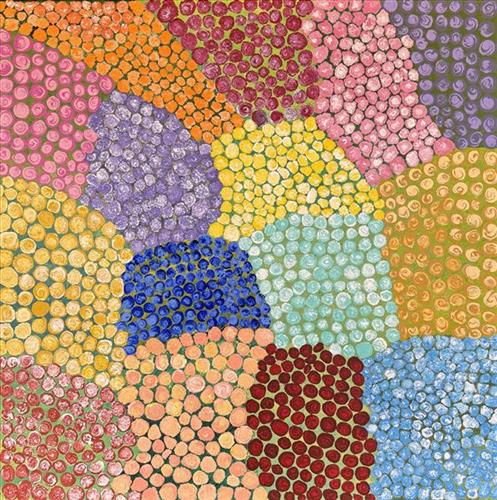
The artists of Ampilatwatja made a conscious decision not to paint ‘altyerr’ dreaming stories. The artists paint their country where those stories sit.
These bush flowers grow seasonly in Alyawarr country, some of which are also used in bush medicine remedies.
“When I go out hunting, I like to see all the bush flowers that are flowering and then when I come back, I paint them.”
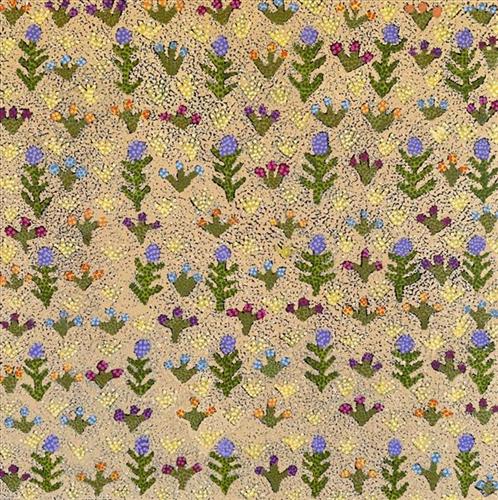
Ampilatwatja is my Mothers country, I come from a long line of artists.
My family still traditionally hunt and gather, I share my love for the land, plants, flowers and trees, with my children and grandchildren. My paintings are inspired by the changing seasons and I sometimes collect bush medicine plants which I make into tea to drink and bush medicine body lotions. My favourite is aherr-aherr (lemon grass) which I boil up and then use as a body and hair wash, this always makes me feel right and good.
Knowing your country is an important part of living in a remote community like Ampilatwatja. Knowing when and where to go hunting and gathering, knowing where there is ‘soakage’ (where you can dig for water), traveling with family for ceremonies, and maintaining a connection with the land.
The community of Ampilatwatja made a conscious decision not to paint ‘altyerr’ dreaming stories, the artists paint their country where those stories sit.
“This is my Mothers country, my view of country” Vicky Pula Holmes
The painting I do is all about my mother’s country, Texas Downs Station – there’s Old Texas and New Texas, which is the one still standing today. Ballangara is the name of country, the place goes back a long way, from early ages. Our old people, ancestors survived and were living on this rough and beautiful landscape, as you see it today. This Country goes a long way before my grandparents and mother came along this country.
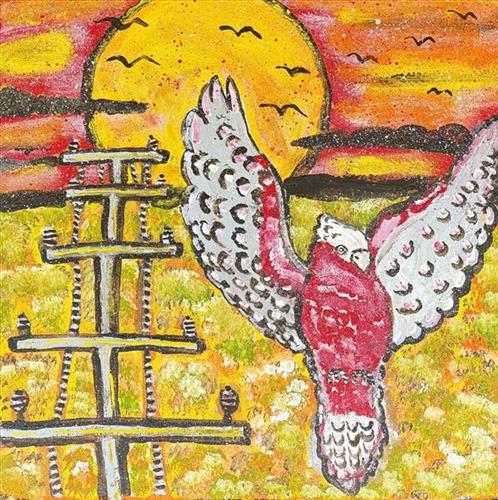
“The Galahs, our first pet was a galah. My dad caught him, it used to be in the house all the time, feeding on Weetabix, yeah, but when he grew old and that, he started to fly around and coming back to places, and start talking to us. We taught him how to speak, he used to speak language (Alyawarr), sometimes English. The Cloughs (owners of Epenarra Station in the 80s) used to have one in their homestead, that pet used to speak a lot of English and our galah came out there and started to pick things out. He started to come back and talking to us. Yeah. One day, he flew and never came back. Yeah.” Kelvin Ladd 10.11.20
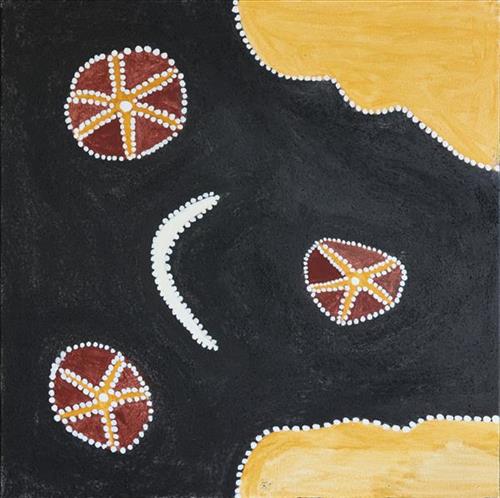
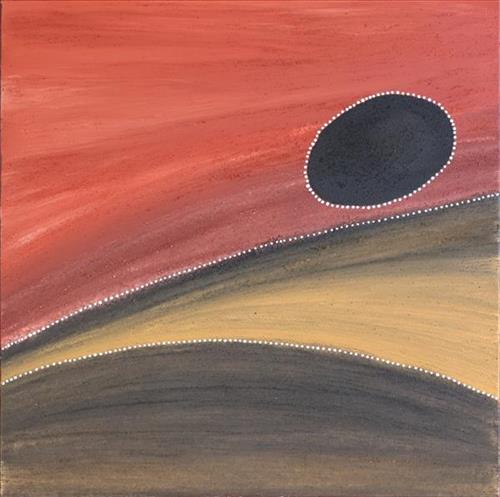
Well this the dreamtime story about Wardal and Garn’giny (star and moon). That’s what my mother and dad told me about that Dreamtime thing.
“Garn’giny ngelmang roord-ngarri nginji.
The moon sits in the east.
Wardal dal gerloorr ngarrgalen.
The star sits on top of the hills.
Laarne berdij nginiyi danyi garn’giny.
The moon went and climbed that hill.
Wijige-ngarri ngoorramangbe-ngiyiwa thamboorroo-gal.
They made him run away because he loved his mother-in-law.
(That moon loved his mother in-law, but they told him he couldn’t love her and to go away.)
Ganybelgbe nginini.
He felt shame (and climbed up the hill).
Gerlewirring deg nginini.
He was looking from on top [of the hill].
Nginini-birri “Nanggayib barrroonnha.”
He told all the people “You will all die.”
Nginini-birri “Ngayimoowana mooliyinde ngenben’ge.
He told them “I will be the only one living”.
(He cursed those people.)
“Boora-boorab ngeliyande” wanemayi-birri melagawoom dam, woorrji-ngarri berrani yilag.
“I will keep coming back” he told them all, while they were sitting down below.
(You are all going to die and I will be still alive, coming out.)
“Daam merrgernbem boorarrgarr ngeliyande.”
“After three days camp I will rise from the dead.”
Nanggayibwa berrayin-gili namoowana ngininji.
They all died and he was the only one that stayed alive.
Merrgern daam nginji boorab ngidji, daam merrgernbem.”
He camps (sleeps ~ dies) for three days then appears (again as the moon), after three days.
This is Yarin country in Darrajayin (Springvale Station) which lies south of Warmun. This is Juli’s traditional country.
The star in the paintings is the promised wife of the moon, the straight skin to be his wife. He wanted dawool, the woman who became the black headed python who was the mother of wardal, the star, i.e. his mother-in-law.
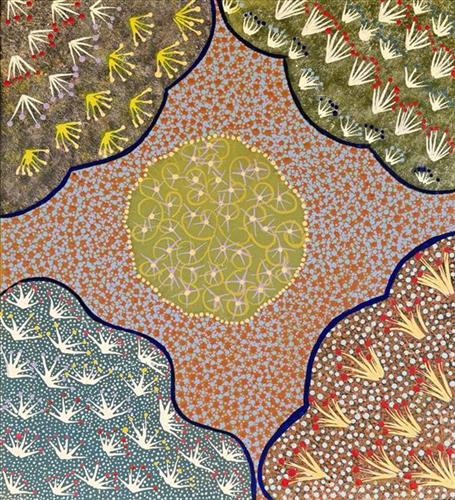
The artists of Ampilatwatja made a conscious decision not to paint ‘altyerr’ dreaming stories. The artists paint their country where those stories sit.
These bush flowers grow seasonly in Alyawarr country, some of which are also used in bush medicine remedies.
“When I go out hunting, I like to see all the bush flowers that are flowering and then when I come back, I paint them.”
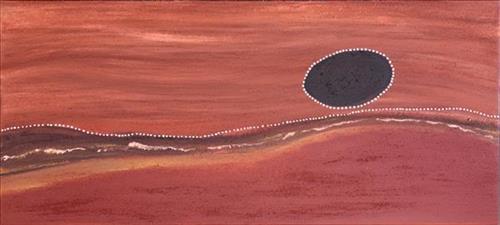
This is my Mothers’ Country.
My mother was born and grew up this country, with her father & mother.Also back way back from her great grandparents