115682324440
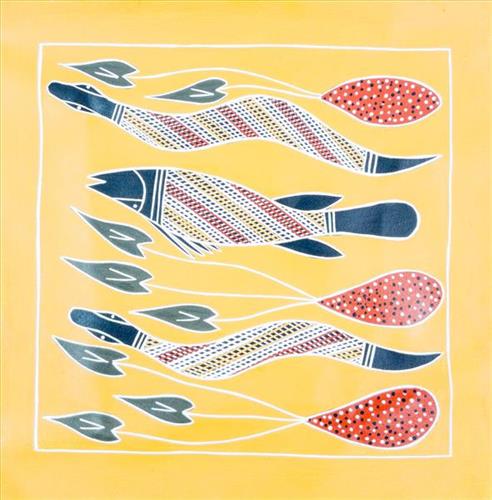
Raypiny Dhawu (Fresh Water Story)
All Aboriginal people originate from a spiritual source, fixed in a particular place in their land or the sea. These ‘spiritual reservoirs’ are often in the form of special waterholes made by Wangarr (creative spirits) that were created long ago close to the beginning of time. These creator beings moved across the countryside, shaping the land and implanting in each tract of country, the spiritual life force for the people who were to own it. These creative spirits took many forms and when they gave the land to each group, they also gave songs, dances, ceremony, the associated laws and language.
The creation story for Ganalbingu people took place near the middle section of the Glyde River where it becomes the Goyder River. Their land, Ngaliyindi, sits astride the Arafura Swamp in Central Arnhem Land. Many Ganalbingu artists paint totemic species significant to their clan. These can include baru (crocodile), banda (long necked turtle), buliya (catfish), yalman (waterlilies), gumang (magpie geese), dakawa (fresh water yabby), ratjuk (barramundi), warrnyu (flying fox) and more.
110682324610
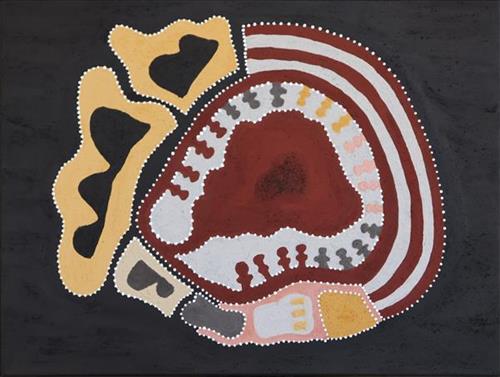
Fingerprints on Country by Kia Dowell
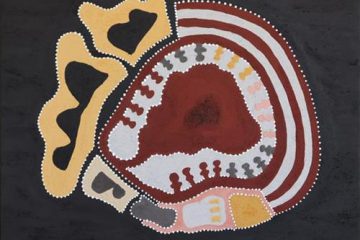
Kia has a strong traditional family Country connection to the Daiwul Ngarrangarni (Barramundi Dreaming) located at the place commonly known as Argyle Diamond Mine. She joined the Board of Gelganyem in 2017 and as Chair and female Director for the Tiltuwam daam, has focused on ensuring the voices, concerns, rights, and interests of Traditional Owners and Country are recognised by mining giant, Rio Tinto. This piece focuses on the tailings dam at Argyle. The centre of the image in deep red represents the bleeding of Country and the mixing of materials over the 30-plus-year life of the mine. The use of bloodwood is two-fold 1) to show level of harm to Country for the diamonds and 2) highlight the power of Country to heal. Bloodwood is a strong healer for us. To access and cover the tailings in closure, the company instructs contractors to create “fingers” working from the outside into the centre of the tailings dam. Traditional Owners have concerns about the environmental impact now and into the future. These fingers are symbolic of the many hands and fingers that have touched Country since the 1970’s and in my view, violated the rights of Country and the obligations of Traditional Owners to Country. Despite the impact of mining, there are areas of low impact as indicated by the hills. The pink and structures to the left are the ongoing changes to Country that take place in closure. The black represents the anger and grief of multiple generations of Traditional Owners.
115682324975
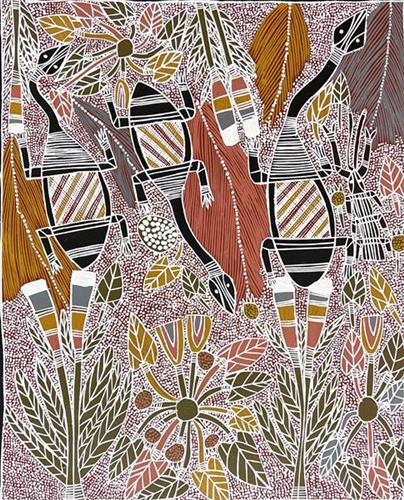
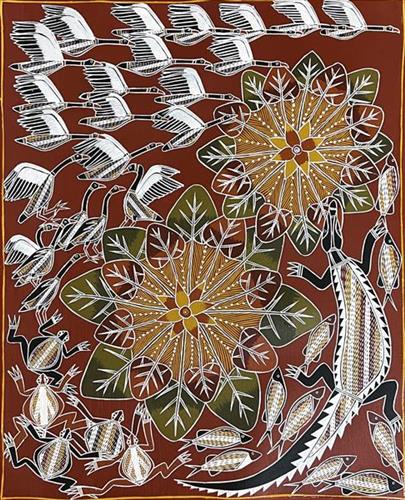
Raypiny Dhawu (Fresh Water Story)
All Aboriginal people originate from a spiritual source, fixed in a particular place in their land or the sea. These ‘spiritual reservoirs’ are often in the form of special waterholes made by Wangarr (creative spirits) that were created long ago close to the beginning of time. These creator beings moved across the countryside, shaping the land and implanting in each tract of country, the spiritual life force for the people who were to own it. These creative spirits took many forms and when they gave the land to each group, they also gave songs, dances, ceremony, the associated laws and language.
The creation story for Ganalbingu people took place near the middle section of the Glyde River where it becomes the Goyder River. Their land, Ngaliyindi, sits astride the Arafura Swamp in Central Arnhem Land. Many Ganalbingu artists paint totemic species significant to their clan. These can include baru (crocodile), banda (long necked turtle), buliya (catfish), yalman (waterlilies), gumang (magpie geese), dakawa (fresh water yabby), ratjuk (barramundi), warrnyu (flying fox) and more.
115682324986
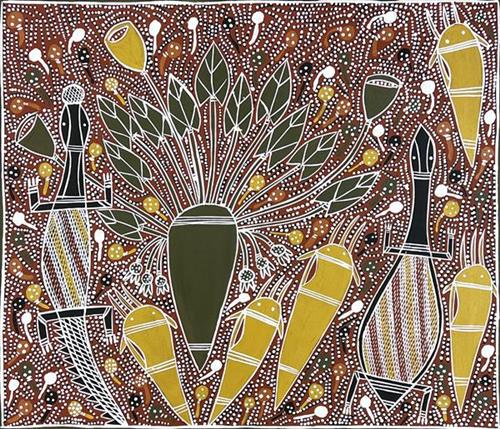
Raypiny Dhawu (Fresh Water Story)
All Aboriginal people originate from a spiritual source, fixed in a particular place in their land or the sea. These ‘spiritual reservoirs’ are often in the form of special waterholes made by Wangarr (creative spirits) that were created long ago close to the beginning of time. These creator beings moved across the countryside, shaping the land and implanting in each tract of country, the spiritual life force for the people who were to own it. These creative spirits took many forms and when they gave the land to each group, they also gave songs, dances, ceremony, the associated laws and language.
The creation story for Ganalbingu people took place near the middle section of the Glyde River where it becomes the Goyder River. Their land, Ngaliyindi, sits astride the Arafura Swamp in Central Arnhem Land. Many Ganalbingu artists paint totemic species significant to their clan. These can include baru (crocodile), banda (long necked turtle), buliya (catfish), yalman (waterlilies), gumang (magpie geese), dakawa (fresh water yabby), ratjuk (barramundi), warrnyu (flying fox) and more.
115682325314
Dhawurr/batjbarra fish trap
Fish traps are placed into the river to face the oncoming fish. The woven tunnel traps the fish and prevents their escape. The traps are tapered so when they are submerged in the water, the water pressure wedges them into place. Traditionally, the fish traps are operated at night time.
115682325313
Woven Mat
Traditionally, Nganiyal (conical mats) were used as an insect screen when erected, and as a sitting mat when folded. They are used in Ceremony as well as a functional item.
Nowadays, artists weave many different shapes including flat, round and oblong.
116482325242
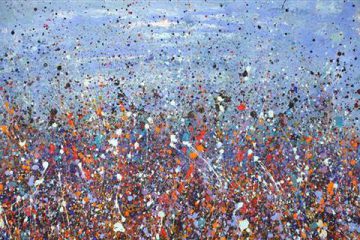
Wildflowers of the Pilbara
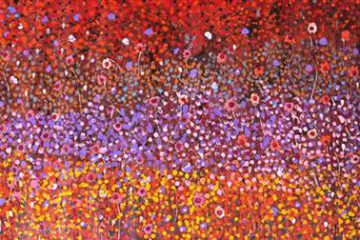
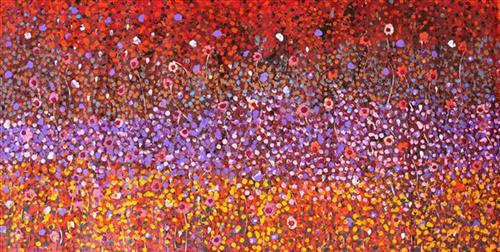
My great grandchild Zandaya (8 years old) also worked with me. It’s a painting of the wildflowers of the pilbara.
116482325241
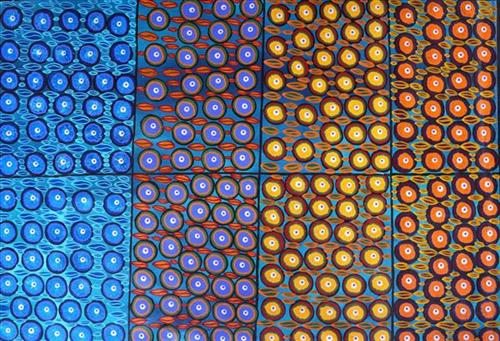
Untitled
116482325195
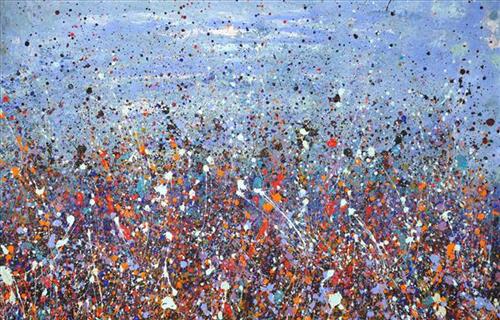
Spinifex Country
In September, when we are looking for gum from the Blue Gum Tree, we walk through the spinifex country. We pick the gum when it is crystal colour, and we eat it, or put it into hot water to make it like a toffee. We call it sugar lolly.