110682319846


Warlawoon& Bow River Country – Kathy Ramsay

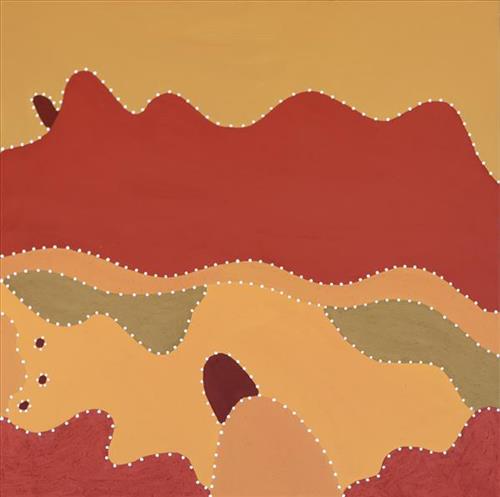
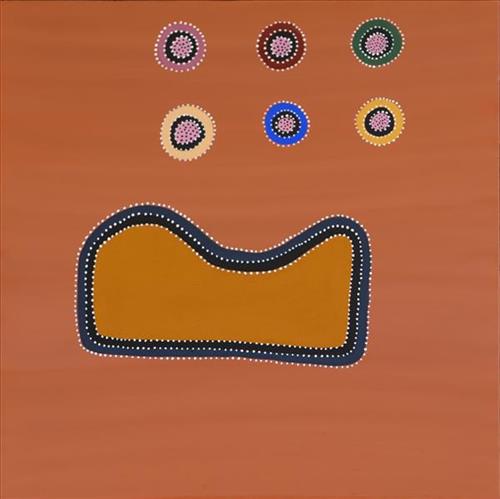
This painting represents two countries – Kathy’s dad’s country, Warlawoon, and her country where she grew up, Bow River.

 One half is about the Warlawoon Country my dad Rammie Ramsay country my beautiful old artist dad who left his memory with me to carry on after him. Trees, Camping areas, water holes, hills, and traditional stories of his mum and dad and their parents and so on he told me.

The other half is Bow River Country.Kathy says:

“My family has a strong history of this place. My grandfather Timmy Timms (Snr) named the dams here redrock damn, and the redrock itself called redrock and the damn near the hill is called marringarnji dam, meaning where dingos come to drink water with the horses and cattle. My families has drovin’ histories and traditional stories both.

The road is called the old Wyndham road back in the early days. In nowadays it’s been graded.

My ancestors used to live anywhere here, at camping areas near the river beds. They used to live off the land eating kangaroo, porcupine, all sorts of bush foods.

We are so blessed God gave us boundaries to keep and to hold our future generation children to have and to hold.”

110682319949


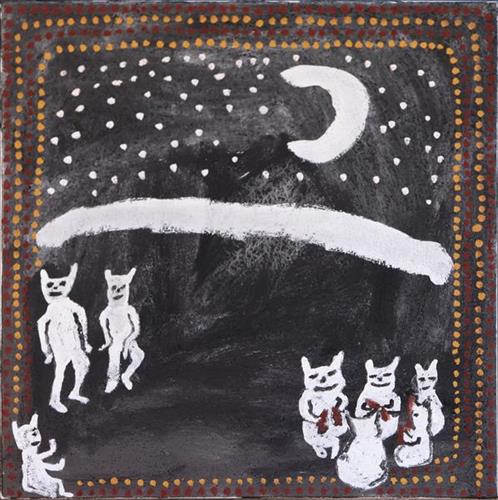
Juwari- The Devil Spirit – by Peter Thomas

The Juwari is the Devil Spirit.

He is the power, force and spirit of creation iitself, and everything within it and within us  He is the creation of country and the land, of the weather & seasons, of all the elements. He is the source of all forms of life and of death.

The Gija people present Rover Thomas’s dreamtime story, through performing the Joonba- A traditional dance and song ceremony called Gurrir Gurrir. Rover was given this dreamtime by the Juwari

This Gija story as told by senior Gija elder Patrick Mung and Cultural leader Jane Yalunga (Rover Thomas’s only daughter).

The story shares ‘there were three Juwari, from Wyndham side, from Gija country and down that way. Each one had a Joonba, it different each way. Them Juwari been fighting  who is the strongest  and who will bring them joonba to the Old man.

The Gija Juwari won and that was the start of the beginning, the birth of the corroboree and the Joonba- Gurrir Gurrir, as it is today’


115682323436


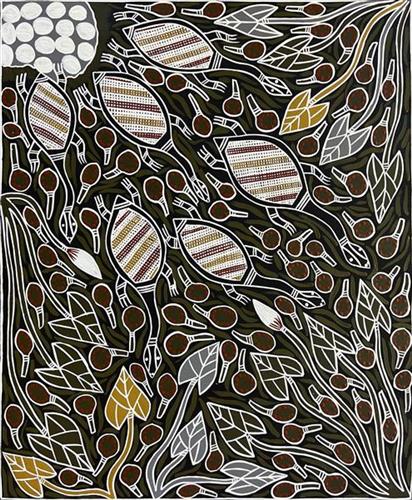
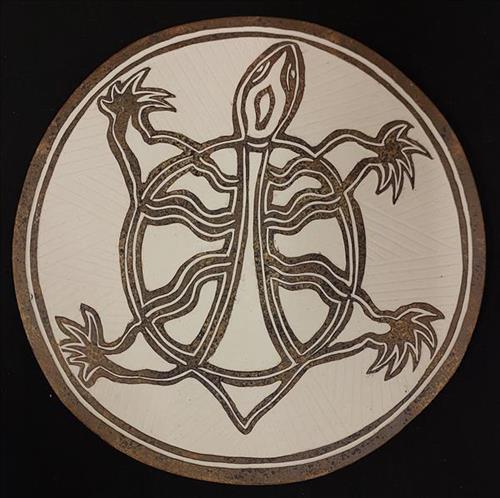
Raypiny Dhawu (Fresh Water Story)

All Aboriginal people originate from a spiritual source, fixed in a particular place in their land or the sea. These ‘spiritual reservoirs’ are often in the form of special waterholes made by Wangarr (creative spirits) that were created long ago close to the beginning of time. These creator beings moved across the countryside, shaping the land and implanting in each tract of country, the spiritual life force for the people who were to own it. These creative spirits took many forms and when they gave the land to each group, they also gave songs, dances, ceremony, the associated laws and language.


The creation story for Ganalbingu people took place near the middle section of the Glyde River where it becomes the Goyder River. Their land, Ngaliyindi, sits astride the Arafura Swamp in Central Arnhem Land. Many Ganalbingu artists paint totemic species significant to their clan. These can include baru (crocodile), banda (long necked turtle), buliya (catfish), yalman (waterlilies), gumang (magpie geese), dakawa (fresh water yabby), ratjuk (barramundi), warrnyu (flying fox) and more.


225182323444


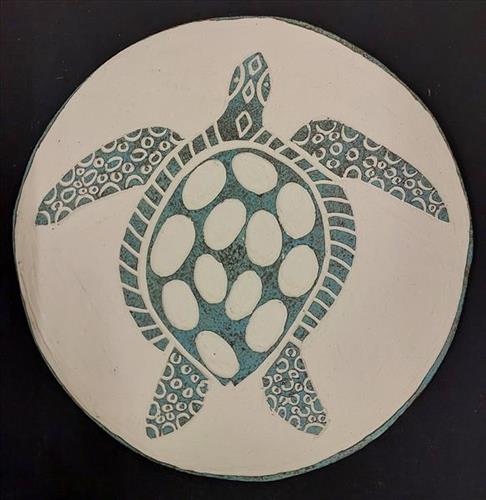
Ngawiya (Sea Turtle)

In the past, sea turtles were an important food source for Kuku Yalanji people. Only men were allowed to hunt them. The men were also responsible for cooking them in a ground oven and distributing the meat to all the families.

We ate turtle meat on special occasions such as the birth of a new born baby and during funeral ceremonies.

Our ancestors used the shell of sea turtles carrying, storing and serving food as well as making damper.

111982325098


Mimih Spirit

The mimih spirit exists in a realm that runs parallel to and mirrors many facets of human life, demonstrating the deep sense of time and place understood by Aboriginal and Torres Strait Islander people. Such spirits feature importantly in relation to Aboriginal spirituality, cosmology, social and moral tales as well as ritual. As is true with the multiple mediums employed by artists of West Arnhem Land, the development of artistic style and form is in line with an awareness by the artist that the work produced is predominantly made for a broader audience. Whether shown in a national or international context these works communicate and exist in a particular space that is cross-cultural and simultaneously particular to the Arnhem region.

The mimih sits within a complex pedagogical and religious body of knowledge which links Kuninjku people to their distinctive escarpment homelands. Young Kuninjku artists, or apprentices, employ the mimih as an important exercise for the practice of the rarrk technique, as it could be achieved on a smaller surface area before being attempted in larger scale on pieces of bark. The mimih serves a purpose for those young artists first learning to carve in a social space of sharing and innovating. The initial mimih manifestation was a large form that almost mirrored the anatomy of a human and at this stage the sculptures have been likened to mokuy carvings visible in eastern Arnhem Land. Contemporaneously, mimih are depicted in a refined, slender, even emaciated form with a broad range of facial expressions giving both individual character to, and denoting the potential volatility and humour that mimih spirits are notable for in their interaction with bininj (humans). The sculptures are frequently carved from the thin trunks of softwoods such as kapok (bombax ceiba or cottonwood) kurrajong, beach hibiscus or leichardt and are painted with earth pigments for their colouring and design.

A leading figure engaging the spirit in visual storytelling was Crusoe Kuningbal, a Kuninjku man, who while traveling was familiarised with carving styles from the east of Arnhem at the mission in Milingimbi pre-dating World War II. The connection and development of art forms informed by cross cultural dialogues within northern Aboriginal language groups is notable. The mimih became a valued inclusion in performance and public ceremony by Kuninjku people like Kuningbal. At times these ceremonies were performed for extended language groups in the local region. 

Now a familiar and broadly depicted figure of iconography, it is important to acknowledge the development of this quite recent sculptural tradition. The depiction of this particular spirit being, once used as an addition to the sharing of song cycles and ceremony, has since been elevated to a prominent form and subject of contemporary sculpture. Variation in the creation of mimih acts as an indication of the individualism of each artist and their stylistic markers. Additionally significant to note is that in the space of the past thirty years the mimih has begun being produced by multiple language groups residing in the Maningrida area including the traditional owners of Maningrida, the Ndjébbana, speaking Kunibidji as well as Gurrgoni people who have strong ties to Kuninjku. 

________
*Maningrida Arts & Culture acknowledge the work of many academic and non-academic voices when writing on this topic, it is important to note Luke Taylor, who’s broad research has informed this text.
115682325027


Mindirr (Pandanus Bag)

Miṉḏirr (dilly bags) are made from gunga (Pandanus spiralis), baḻgurr (kurrajong) and natural bush dyes. The body of the miṉḏirr is made from gunga, and the handles from baḻgurr. Once the gunga fronds and baḻgurr bark have been collected, they are stripped and prepared then boiled with the dyes.

Miṉḏirr were used traditionally for every day utilitarian purposes, particularly collecting bush foods such as bäḻtji (yam). Traditionally, the baḻgurr handles were worn across the forehead while the body of the miṉḏirr sat at the back, between the shoulder blades making it easily accessible when collecting ŋatha (food).

115682324979


Mewana

Mewana is a bush basket/scoop primarily made from mewana grass but sometimes from other fibres such as gunga (pandanus spiralis). Traditionally Yolngu made mewana baskets to carry bush foods such as baltji (yam) and warraga ngatha (cycad nuts). Sometimes mewana were used to scoop dhulumburrk (water lily) and other water reeds from the billabongs.

116482325047


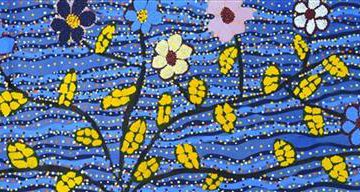
Wildflowers

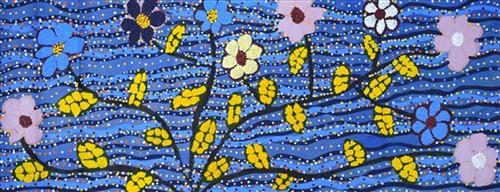
I paint my country in my own style. We have so many beautiful flowers that are watered by the rains. The Pilbara is a place of many beautiful colours.

110682325041


Old Man calling for his dog

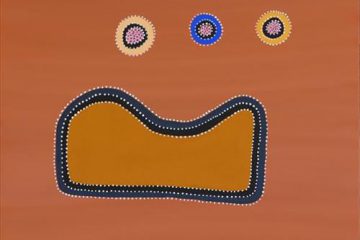
The old man there, he was hunting with his kid and dogs there. And then his dogs ran off chancing a kangaroo, so he climbed the big hill to see if he could see them, calling out for the dogs.

He left his wife and kid looking for yam.

He could see the three dogs there, not far, and they killed the big kangaroo, and was waiting for him to go and get it for dinner.