110682272715


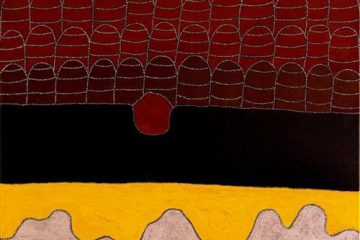
Cyclone Tracy – Jane Tinmarie-Yalunga

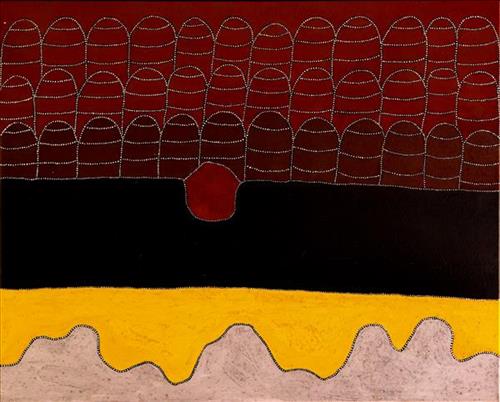
This is my old man’s [Rover Thomas] story about Cyclone Tracy in Darwin in 1974, two years after I was born.

Rover got his joonba, Goorirr Goorirr , from this Cyclone. Out near that store [Warmun’s Wungkul store] a woman had a crash and she went and visited my old man in a dream.

When I was first learning how to paint I was following my father and looking at him. I was looking after him and painting when he was at the old people home and I used to paint.

The Goorirr Goorirr was found by Rover in 1975, not long after the disastrous Cyclone Tracy had all but destroyed Darwin, the nearest large population centre to Turkey Creek. It came to him in his Dreams over period of time. As he shared the knowledge he had gained in this way, its significance was recognised. Out of this emerged the community celebration of Goorirr Goorirr. In the next few years Goorirr Goorirr was regularly performed at Turkey Creek and taken to other communities as well.
110682316184


BOOLARGYEE, Picinniny & Cathedral Gorge- Purnululu- by Dwayne Jessell

Story Inspired by Jack Britten- Dwayne Jessell’s adopting father.

This is my father’s country- Jack Britten

The hills in the foreground are the limestone hills found in Purnululu (the Bungle Bungles). The red hills behind are the brilliant shining cliffs that are seen at sunset anywhere in the Kimberley on a west-facing wall.

Here Dwayne Jessel has painted Piccinniny Gorge on the side of the Bungle Bungles, Purnululu.

He says, These are all the fruits around that country. Picinniny River with all the rocks.

There are a big mob of gorges round Bungle Bungle area. I’ve done two of them here, Picinniny Gorge and the other is Cathedral Gorge.

221382319736


Mako – Mularra (Key: D, Toot: E)

Key: D
Toot: E
Tuned for Mularra ceremony.

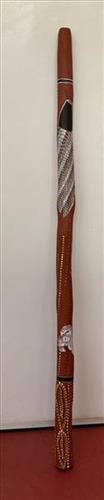
Didjeridus from this region are made in the West Arnhem style. Called Mago, they’re different and special and follow the tradition made famous by Beswick’s Mago Master, elder David Blanasi.

Ghunmarn didjeridus are sourced on country, and hand cut from Woolybutt trees. Artists travel considerable distances on foot to find the right woolybutt tree naturally hollowed out by termites. Good instruments are hand-cut and taken back to camp to be worked, shaped, sanded, tuned and then finally painted.

These are top quality musical instruments, highly regarded worldwide, and still used in ceremony and performance today. Featuring traditional designs handed painted with a Jarlk grass brush.

 Most Ghunamrn didjeridus are high pitch D, low pitch D, F, C or G. The longer the dij the lower the pitch, a shorter didj will give a higher sound.

110682324021


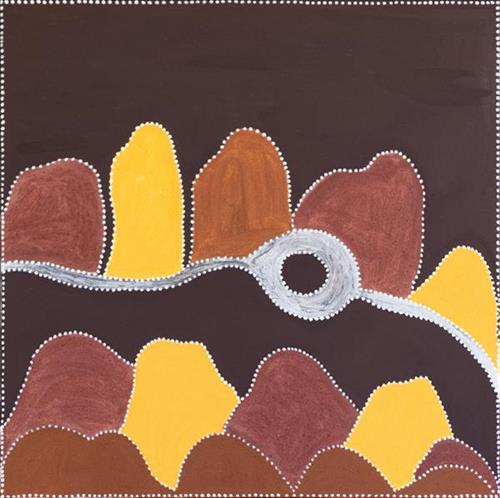
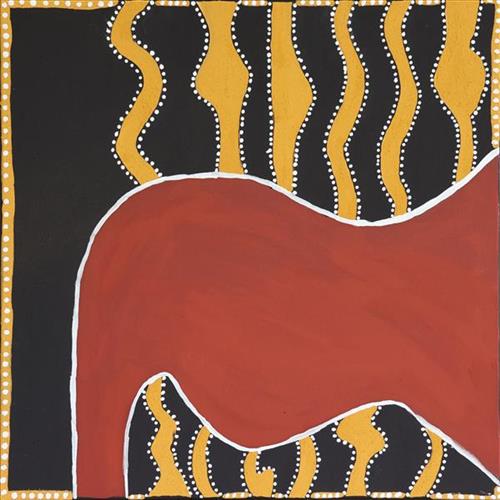
Birnoo Country- Lorraine Daylight

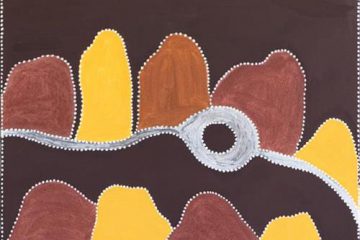
This is a painting of Birnoo Country – Birnoo is on what is now known as Alice Downs Station and belonged to Lorraine’s paternal grandmother.

Lorraine was taught to paint this Country by her father, Warmun artist Gordon Barney.

Gordon was a skilled stockman, horsebreaker and buckjumper and spent much of his early adulthood mustering cattle through this Country. As a result he was intimately familiar with Birnoo and would take his family, including Lorraine, out on to Country during holidays from station work.

As a result of these trips Lorraine learned of her father and grandmother’s Country and gradually began to paint it herself. Birnoo was also rich in ochre, so these trips could double as ochre collection trips, returning to Warmun with a fresh connection to Country and a renewed batch of ochre.


221382324175


Three Prong Spear

Wood carving has always been part of Aboriginal culture and Djilpin artists continue this tradition. Men carved wood for many purposes – tools for hunting or gathering food, axes and knives for building shelters, spears and clubs for protection of their lives and territory, objects for ceremony and to mark sacred sites.

Hunting implements include the boomerang, woomera and spear. The woomera is a lever which helps to increase the speed and distance the spear travels. Clapsticks are used as percussion instruments by the Songmen to accompany dancing along with the didgeridoo (mago).

As well as the more functional carvings, artists portray animals and birds in wood, and these carvings are often painted. Ceremonial carvings include spirit creatures including mukuy (devil devils) and mimi.

Some fine mimi figures have been cast in bronze.

221382324173


Single Point Spear

Wood carving has always been part of Aboriginal culture and Djilpin artists continue this tradition. Men carved wood for many purposes – tools for hunting or gathering food, axes and knives for building shelters, spears and clubs for protection of their lives and territory, objects for ceremony and to mark sacred sites.

Hunting implements include the boomerang, woomera and spear. The woomera is a lever which helps to increase the speed and distance the spear travels. Clapsticks are used as percussion instruments by the Songmen to accompany dancing along with the didgeridoo (mago).

As well as the more functional carvings, artists portray animals and birds in wood, and these carvings are often painted. Ceremonial carvings include spirit creatures including mukuy (devil devils) and mimi.

Some fine mimi figures have been cast in bronze.

221382324140


Bush Pipe

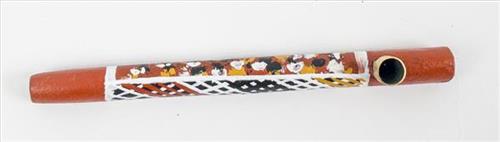
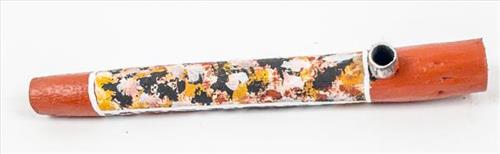
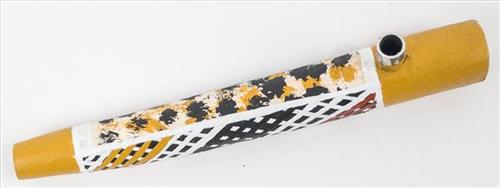
This pipe has been hand carved from Moyi (green plum tree), and hollowed out using a burning hot wire. Finished using modern acrylic paints. Cone piece is either from a discarded rifle case, or other similar round tube.

Wood carving has always been part of Aboriginal culture and Djilpin artists continue this tradition. Men carved wood for many purposes – tools for hunting or gathering food, axes and knives for building shelters, spears and clubs for protection of their lives and territory, objects for ceremony and to mark sacred sites.

Hunting implements include the boomerang, woomera and spear. The woomera is a lever which helps to increase the speed and distance the spear travels. Clapsticks are used as percussion instruments by the Songmen to accompany dancing along with the didgeridoo (mago).

As well as the more functional carvings, artists portray animals and birds in wood, and these carvings are often painted. Ceremonial carvings include spirit creatures including mukuy (devil devils) and mimi.

Some fine mimi figures have been cast in bronze.

221382324136


Bush Pipe

This pipe has been hand carved from Moyi (green plum tree), and hollowed out using a burning hot wire. Finished using modern acrylic paints. Cone piece is either from a discarded rifle case, or other similar round tube.

Wood carving has always been part of Aboriginal culture and Djilpin artists continue this tradition. Men carved wood for many purposes – tools for hunting or gathering food, axes and knives for building shelters, spears and clubs for protection of their lives and territory, objects for ceremony and to mark sacred sites.

Hunting implements include the boomerang, woomera and spear. The woomera is a lever which helps to increase the speed and distance the spear travels. Clapsticks are used as percussion instruments by the Songmen to accompany dancing along with the didgeridoo (mago).

As well as the more functional carvings, artists portray animals and birds in wood, and these carvings are often painted. Ceremonial carvings include spirit creatures including mukuy (devil devils) and mimi.

Some fine mimi figures have been cast in bronze.

221382324135


Bush Pipes

This pipe has been hand carved from Moyi (green plum tree), and hollowed out using a burning hot wire. Finished using modern acrylic paints. Cone piece is either from a discarded rifle case, or other similar round tube.

Wood carvings has always been part of Aboriginal culture and Djilpin artists continue this tradition. Men carved wood for many purposes – tools for hunting or gathering food, axes and knives for building shelters, spears and clubs for protection of their lives and territory, objects for ceremony and to mark sacred sites.

Hunting implements include the boomerang, woomera and spear. The woomera is a lever which helps to increase the speed and distance the spear travels. Clapsticks are used as percussion instruments by the Songmen to accompany dancing along with the didgeridoo (mago).

As well as the more functional carvings, artists portray animals and birds in wood, and these carvings are often painted. Ceremonial carvings include spirit creatures including mukuy (devil devils) and mimi.

Some fine mimi figures have been cast in bronze.

221382324134


Didjeridu (Key: D#, Toot: F#)

Key: D#
Toot: F#

Didjeridus from this region are made in the West Arnhem style. Called Mago, they’re different and special and follow the tradition made famous by Beswick’s Mago Master, elder David Blanasi.

Ghunmarn didjeridus are sourced on country, and hand cut from Woolybutt trees. Artists travel considerable distances on foot to find the right woolybutt tree naturally hollowed out by termites. Good instruments are hand-cut and taken back to camp to be worked, shaped, sanded, tuned and then finally painted.

These are top quality musical instruments, highly regarded worldwide, and still used in ceremony and performance today. Featuring traditional designs handed painted with a Jarlk grass brush.


Most Ghunamrn didjeridus are high pitch D, low pitch D, F, C or G. The longer the dij the lower the pitch, a shorter didj will give a higher sound.