222082307576


Long weekend on the Dungala

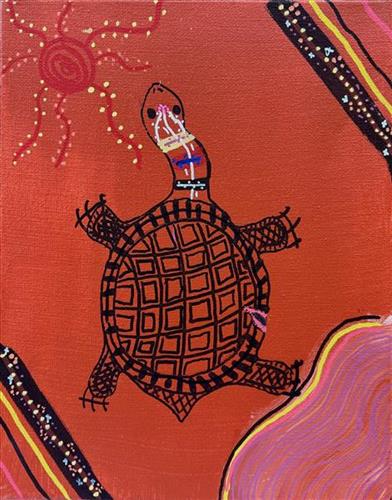
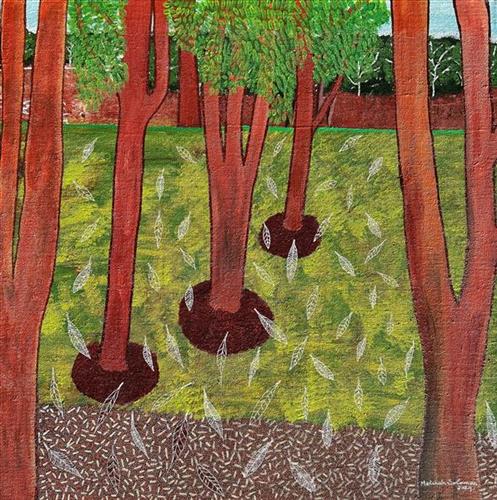
I recently spent the long weekend at Morning Glory River Resort by the Dungala. My view every morning was the beautiful tall gum trees leading me to the banks of the river. In the morning the kookaburras are loud, and the grass is crisp and vibrant. Around each gum tree is a ring of mulch, encouraging new growth. The gum leaves flutter to the bush floor, and the ground crackles to life. Although, it is cold this time of day the sun still filters through the trees and is warm to touch. The water is low at this time of the year, too low to see from our cabin.

222082307573


Winter Days

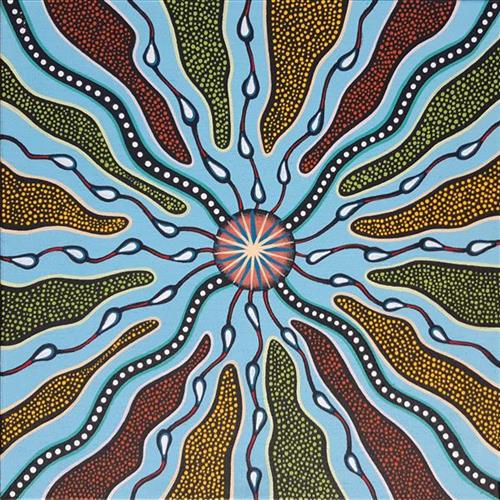
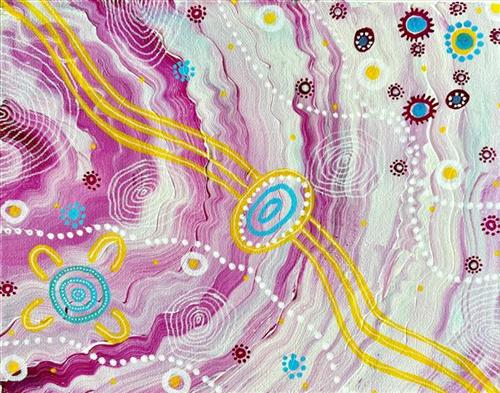
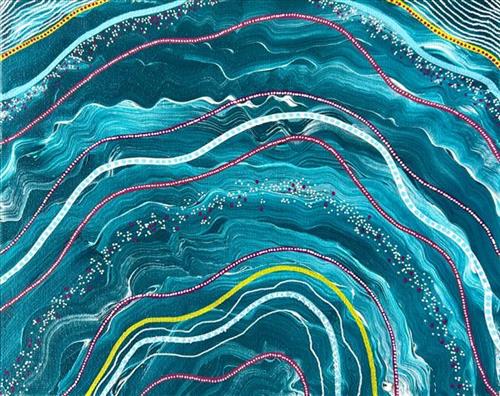
Winter days for me in this when Aboriginal people would move from the outlands to inland to avoid the cold ocean breezes. Also a time on my home land that the river would burst its banks and flood the countryside nourishing the land. In this piece i have done rain falling down on country (Woka).

222082307429


Dhaagun – Ashes

In the continuation of “Garraba – Body,” I present “Dhaagun – Ashes,” a meditation on the cyclical nature of existence and the connection between all forms of life. This piece delves deeper into the essence of our being, exploring the concept of matter and energy as infinite, continually transforming from one state to another.

“Dhaagun”, Wiradjuri word for ashes, a powerful symbol of both end and beginning. Ashes are what remain after the fire, a reminder of the transience of form and the perpetuity of substance. In this piece, I seek to illuminate the reality that we, as living beings, are part of an eternal cycle. We are born, we live, we die, and in death, we return to the earth, our essence re-joining the elemental dance fundamental particles.

Our existence is a testament to the intricate connection between us and Country. The earth beneath our feet, the air we breathe, the plants that nourish us, and the animals that share our world—all are composed of the same basic elements. We are not separate from our surroundings; we are an integral part of the cosmos, participating in a continuous exchange of matter and energy. I reflected on the impermanence of form and the constancy of essence. We are matter; we are energy. From what we were, we will return. In our perpetual transformation, we find our infinity.
111582307600


Untitled

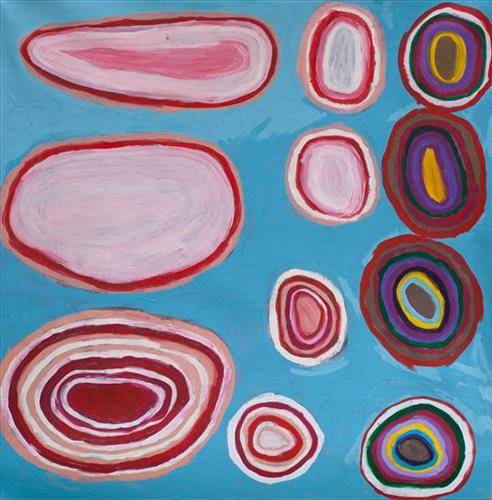
This painting is a collaborative work between Dadda Samson and her granddaughter Judith Anya Samson. It is an area of their country east of the Community of Jigalong, where the artists are from. While growing up at Jigalong mission Dadda returned to her ngurra (home Country, camp) most weekends to hunt and camp. Dadda is recognised as a great authority in Jigalong and has been teaching Judith to paint for a number of years, sharing her knowledge of Country and jukurrpa (dreaming) for those areas.

111982307772


Wak Wak

This painting depicts a sacred site at ‘Kurrurldul’, an outstation south of Maningrida.

The ‘rarrk’, or abstract crosshatching, on this work represents the design for the crow totem ancestor called ‘Djimarr’. Today this being exists in the form of a rock, which is permanently submerged at the bottom of Kurrurldul Creek. The ‘Djimarr’ rock in the stream at Kurrurldul is said to move around and call out in a soft hooting tone at night. Both the stone itself and the area around it are considered sacred.

The imagery represents the rock mentioned above at the bottom of Kurrurldul creek, which is the final transmutation of the dreaming ancestor ‘Djimarr’. Finally, the pattern used here is also the crow design used in the sacred ‘Mardayin’ ceremony, which is a large regional patri-moiety ceremony now rarely conducted in central and eastern Arnhem Land.

111982307771


Warraburnburn

In Burarra and Gun-nartpa languages the figure represented in this artwork is generally known as a wangarra ‘ghost spirit’. For the Warrawarra clan ghost spirits have their own particular characteristics and their own name – Warraburnburn.

The Warraburnburn and the closely related Galabarrbarr spirit (owned by the Balkarranga clan) are also manikay song topics.  The spirits are related to each other as maternal grandparent and grandchild, just as the people of Warrawarra and Balkarranga are. The dancing of the two ghost spirit figures forms the finale performance for funerals, and is the final goodbye to a deceased family member.

In many ways the Warraburnburn and Galabarrbarr ghost spirits are like people. They emerge from the patches of jungle on Warrawarra and Balkarranga country in the late afternoon and go hunting in family groups of men, women and children. They stay in contact with each other by calling out as the men hunt for fish and the women walk with their dillybags looking for vegetable food. 

The ghost spirits are associated closely with white ochre and artists commonly paint the bodies of carved figures in white. Different types of ghost spirit wear different patterns. Warraburnburn is decorated with uniform white dots while others are painted white all over. Some ghost spirits are shown with a design painted on their chest infilled with rarrk ‘cross-hatching’, the same designs that are painted onto japi an-guyinda ‘male initiations’. 

They also have supernatural characteristics including superhuman size (jarra anbaykarda ‘super tall’). They know the country intimately – some are malevolent towards humans and will lead people astray, taking them to unfamiliar and dangerous places. These malevolent spirits are likened to an-muburda ‘sorcerers’ and can conduct dangerous rituals that cause harm to people. Others are benign and will lead humans back to familiar paths and their own camps.


111982307770


Nawarlah – Brown River Stingray

We hunt the Nawarlah (Brown River Stingray) during the wet season.  There is a plant with a yellow flower that tells us that it is the right time.  We know it will be fat. 

It is well known that Aboriginal art often depicts images of sacred totems or dreamings of Aboriginal culture. However, the world of the non-sacred also provides a rich source of subject matter for Aboriginal art. Much of the rock art of western Arnhem Land for example features secular topics such as common food animals and plants, depicted because of their economic importance but also merely because of their existence in the environment.