Painted Shell
This shell was collected from Arnhem Land and brought back to Beswick to be painted. Painted using a stippling effect as well as dots using the end of a modern paintbrush. Acrylic paint has been used.

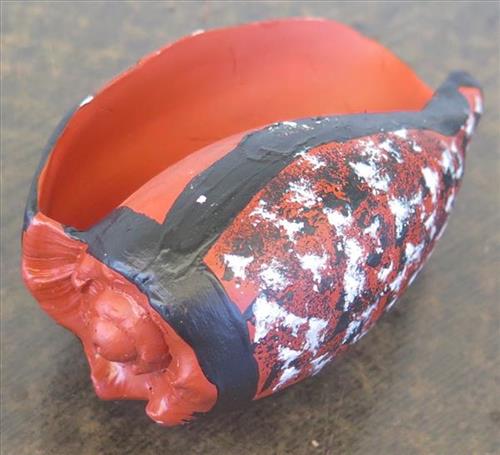
This shell was collected from Arnhem Land and brought back to Beswick to be painted. Painted using a stippling effect as well as dots using the end of a modern paintbrush. Acrylic paint has been used.

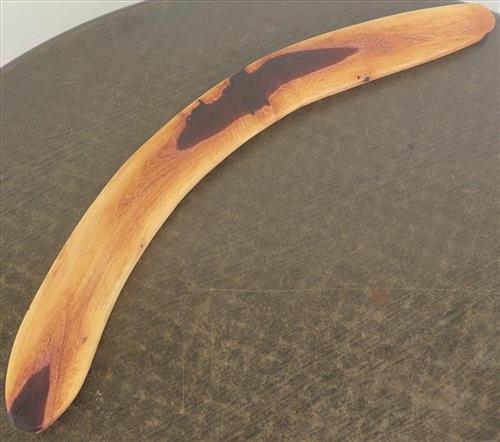
Wood carving has always been part of Aboriginal culture. Men carved wood for many purposes – tools for hunting or gathering food, axes and knives for building shelters, spears and clubs for protection of their lives and territory, objects for ceremony and to mark sacred sites.
Artists source the timber on country, walking from tree to tree to find the right piece for the desired functional outcome. Once found, it is cut and then brought back to camp to be worked, shaped, sanded and finally finished.
Boomerangs from this region are made from a variety of materials. Lighter weight woods such as Milkwood and Sandpaper Fig are used for “come back” style boomerangs. These tools are best used for birds, bats, and fruit in trees. Heavier woods such as that from Eucalypts, Ironwood and Kerosene wood are used for a more deadly boomerang on larger animals. These you don’t want returning!
Artists prefer to source branches which have a natural bend so that the wooden grain follows around the curved boomerang shape. This results in a stronger tool which can be used repeatedly.

Wood carving has always been part of Aboriginal culture. Men carved wood for many purposes – tools for hunting or gathering food, axes and knives for building shelters, spears and clubs for protection of their lives and territory, objects for ceremony and to mark sacred sites.
Artists source the timber on country, walking from tree to tree to find the right piece for the desired functional outcome. Once found, it is cut and then brought back to camp to be worked, shaped, sanded and finally finished.
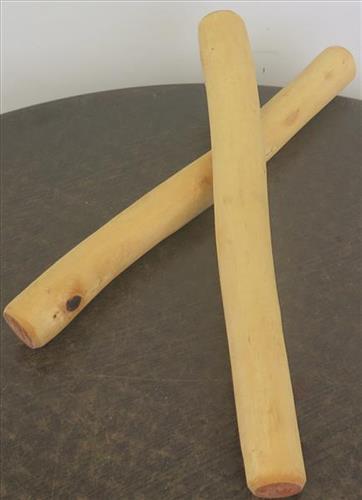
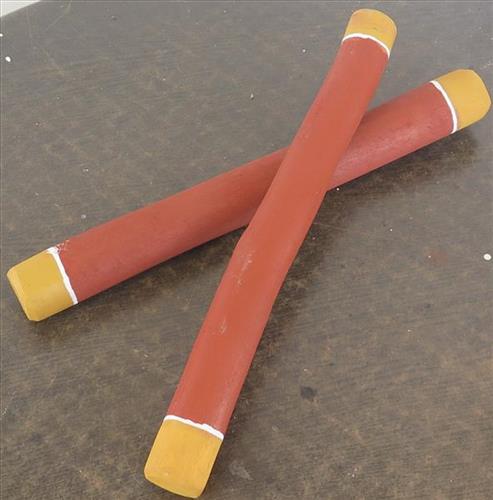
Clapsticks are used in traditional ceremony and dance as a percussion instrument to accompany Mako (didjeridu). Denser woods such as Ironwood or Kerosene wood are preferred due to their crisper clap sound. Clapsticks can be left raw or painted and decorated. Straight timber from younger trees is preferred as it requires less work to make functional.


Wood carving has always been part of Aboriginal culture and Djilpin artists continue this tradition. Men carved wood for many purposes – tools for hunting or gathering food, axes and knives for building shelters, spears and clubs for protection of their lives and territory, objects for ceremony and to mark sacred sites.
Hunting implements include the boomerang, woomera and spear. The woomera is a lever which helps to increase the speed and distance the spear travels. Clapsticks are used as percussion instruments by the Songmen to accompany dancing along with the didgeridoo (mago).
As well as the more functional carvings, artists portray animals and birds in wood, and these carvings are often painted. Ceremonial carvings include spirit creatures including mukuy (devil devils) and mimi.
Some fine mimi figures have been cast in bronze.

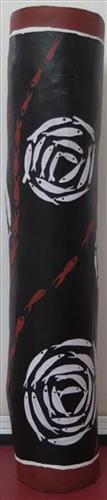
Bernadette’s painted logs are often offcuts from mako or didjeridu manufacture. Rather than wasting the pieces or relegating them to the fire, Bernadette collects these, sands them smooth and then experiments with different painting techniques.
Painted using a combination of brushes; handmade traditional Jarlk grass reed brush harvested from local billabongs and wet areas, along with modern paintbrushes. Bernadette sometimes paints using a stippling effect (modern paintbrush), a modern panting style (fish using a modern brush for example), raark (fine line work using a jarlk brush), or dots (using the end of a jarlk brush).
Painted entirely using modern acrylic paints.

Wood carving has always been part of Aboriginal culture. Men carved wood for many purposes – tools for hunting or gathering food, axes and knives for building shelters, spears and clubs for protection of their lives and territory, objects for ceremony and to mark sacred sites.
Artists source the timber on country, walking from tree to tree to find the right piece for the desired functional outcome. Once found, it is cut and then brought back to camp to be worked, shaped, sanded and finally finished.
Clapsticks are used in traditional ceremony and dance as a percussion instrument to accompany Mako (didjeridu). Denser woods such as Ironwood or Kerosene wood are preferred due to their crisper clap sound. Clapsticks can be left raw or painted and decorated. Straight timber from younger trees is preferred as it requires less work to make functional.
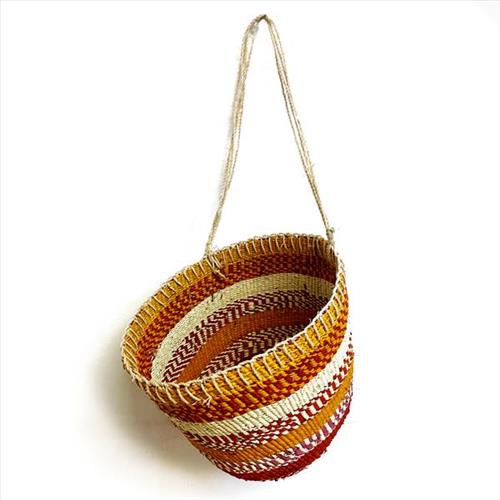
Miṉḏirr (dilly bags) are made from gunga (Pandanus spiralis), baḻgurr (kurrajong) and natural bush dyes. The body of the miṉḏirr is made from gunga, and the handles from baḻgurr. Once the gunga fronds and baḻgurr bark have been collected, they are stripped and prepared then boiled with the dyes.
Miṉḏirr were used traditionally for every day utilitarian purposes, particularly collecting bush foods such as bäḻtji (yam). Traditionally, the baḻgurr handles were worn across the forehead while the body of the miṉḏirr sat at the back, between the shoulder blades making it easily accessible when collecting ŋatha (food).
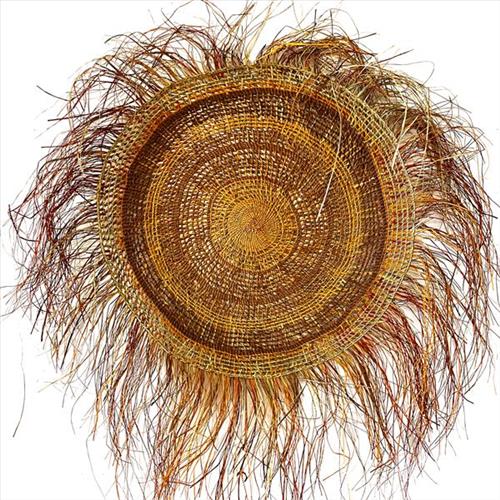
Traditionally, Nganiyal (conical mats) were used as an insect screen when erected, and as a sitting mat when folded. They are used in Ceremony as well as a functional item.
Nowadays, artists weave many different shapes including flat, round and oblong.
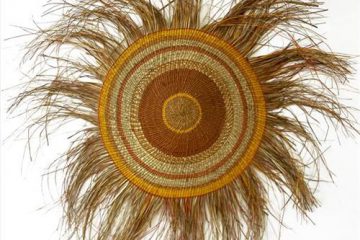
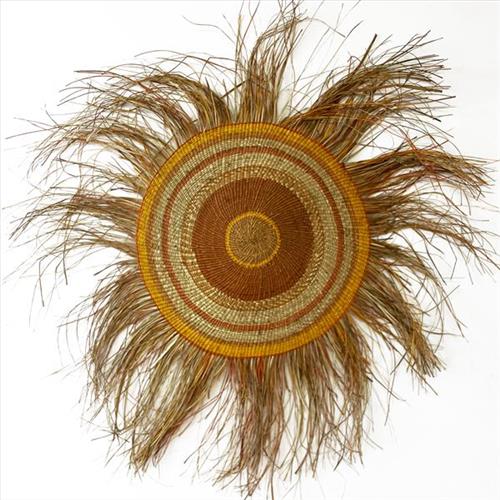
Traditionally, Nganiyal (conical mats) were used as an insect screen when erected, and as a sitting mat when folded. They are used in Ceremony as well as a functional item.
Nowadays, artists weave many different shapes including flat, round and oblong.