Buliya (catfish)
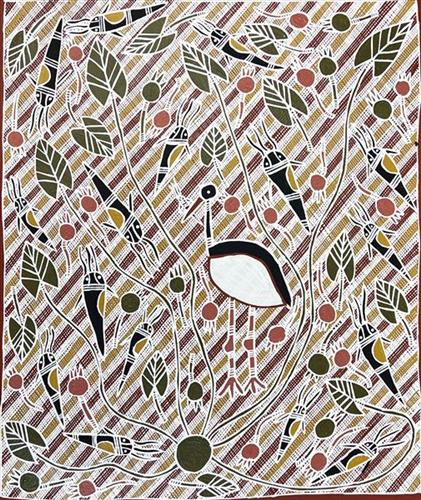
Buliya (catfish) are a favourite fish for Yolngu, They are often depicted amongst the waterlillies, leeches and natural debris such as leaves and reeds.
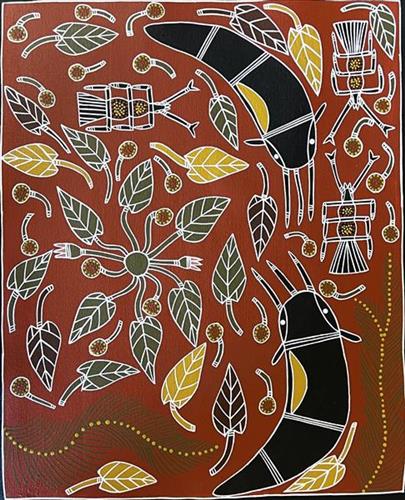
Buliya (catfish) are a favourite fish for Yolngu, They are often depicted amongst the waterlillies, leeches and natural debris such as leaves and reeds.
Bathi are woven from the split leaves of the Screw Palm (Pandanus Spiralis). Coil weaving was introduced to Arnhem Land in the 1930s. It was adapted from techniques used by Indigenous women throughout South East Australia.
Bathi are woven from the split leaves of the Screw Palm (Pandanus Spiralis). Coil weaving was introduced to Arnhem Land in the 1930s. It was adapted from techniques used by Indigenous women throughout South East Australia.
Bathi are woven from the split leaves of the Screw Palm (Pandanus Spiralis). Coil weaving was introduced to Arnhem Land in the 1930s. It was adapted from techniques used by Indigenous women throughout South East Australia.
All Aboriginal people originate from a spiritual source, fixed in a particular place in their land or the sea. These ‘spiritual reservoirs’ are often in the form of special waterholes made by Wangarr (creative spirits) that were created long ago close to the beginning of time. These creator beings moved across the countryside, shaping the land and implanting in each tract of country, the spiritual life force for the people who were to own it. These creative spirits took many forms and when they gave the land to each group, they also gave songs, dances, ceremony, the associated laws and language.
The creation story for Ganalbingu people took place near the middle section of the Glyde River where it becomes the Goyder River. Their land, Ngaliyindi, sits astride the Arafura Swamp in Central Arnhem Land. Many Ganalbingu artists paint totemic species significant to their clan. These can include baru (crocodile), banda (long necked turtle), buliya (catfish), yalman (waterlilies), gumang (magpie geese), dakawa (fresh water yabby), ratjuk (barramundi), warrnyu (flying fox) and more.
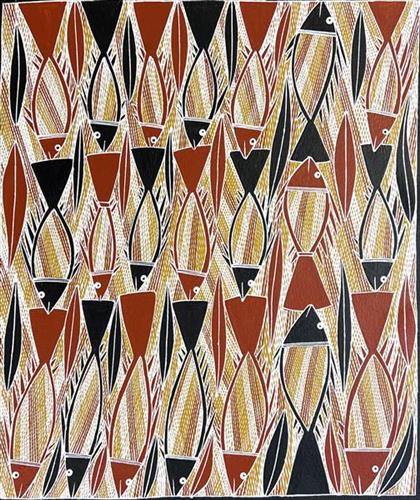
JB paints stories from his Dhuwa homeland in northeast Arnhem Land. Stories are passed on either paternally or maternally, and JB would have learnt these stories from his ancestors. The cross-hatching style is a traditional painting style of this area and can represent elements such as water, air and wind.
JB’s paintings often feature totemic animals of the fresh waters of north east Arnhem Land.
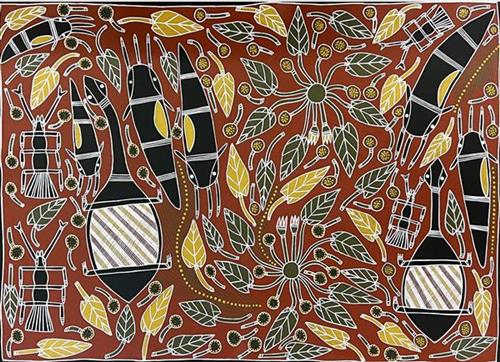
All Aboriginal people originate from a spiritual source, fixed in a particular place in their land or the sea. These ‘spiritual reservoirs’ are often in the form of special waterholes made by Wangarr (creative spirits) that were created long ago close to the beginning of time. These creator beings moved across the countryside, shaping the land and implanting in each tract of country, the spiritual life force for the people who were to own it. These creative spirits took many forms and when they gave the land to each group, they also gave songs, dances, ceremony, the associated laws and language.
The creation story for Ganalbingu people took place near the middle section of the Glyde River where it becomes the Goyder River. Their land, Ngaliyindi, sits astride the Arafura Swamp in Central Arnhem Land. Many Ganalbingu artists paint totemic species significant to their clan. These can include baru (crocodile), banda (long necked turtle), buliya (catfish), yalman (waterlilies), gumang (magpie geese), dakawa (fresh water yabby), ratjuk (barramundi), warrnyu (flying fox) and more.
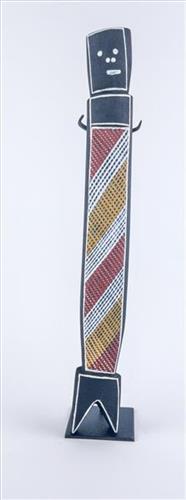
“Mimi go through rock country. Hide in cracks. May be cheeky. Mimi look after and renew country.”
This stunning Mimi Spirit has been hand crafted from native beach hibiscus sourced in Darwin. Carved using a mix of sharp hand tools it has then been finished in modern acrylic paints.
Painting has been completed using a handmade Jarlk grass reed brush harvested from local billabongs and wet areas. Raark or fine line work has been completed using this brush and is in Yirritja style. This style consists of multiple lines before alternating colour.
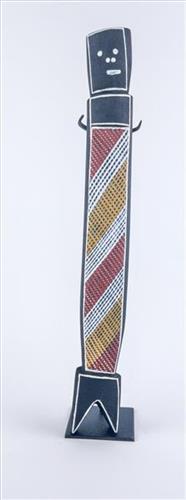
“Mimi go through rock country. Hide in cracks. May be cheeky. Mimi look after and renew country.”
This stunning Mimi Spirit has been hand crafted from native beach hibiscus sourced in Darwin. Carved using a mix of sharp hand tools it has then been finished in modern acrylic paints.
Painting has been completed using a handmade Jarlk grass reed brush harvested from local billabongs and wet areas. Raark or fine line work has been completed using this brush and is in Yirritja style. This style consists of multiple lines before alternating colour.
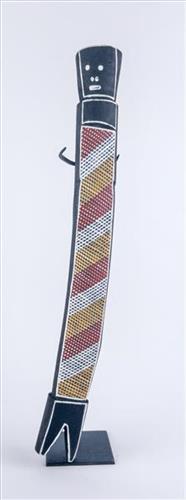
“Mimi go through rock country. Hide in cracks. May be cheeky. Mimi look after and renew country.”
This stunning Mimi Spirit has been hand crafted from native beach hibiscus sourced in Darwin. Carved using a mix of sharp hand tools it has then been finished in modern acrylic paints.
Painting has been completed using a handmade Jarlk grass reed brush harvested from local billabongs and wet areas. Raark or fine line work has been completed using this brush and is in Yirritja style. This style consists of multiple lines before alternating colour.