377810582288269


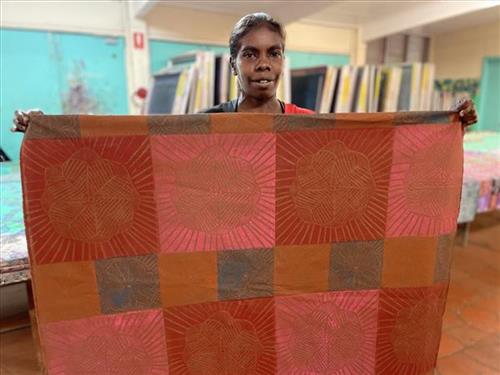
Flower design with Rarrk

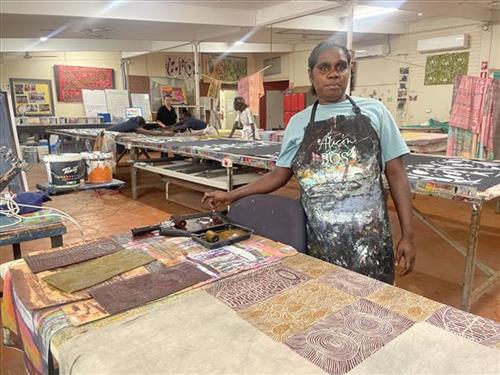
This fabric was created using the linocut printing technique. The lino tile has been carved by the artist in Maningrida, and has been printed by hand using a variety of colours and layers. The linocut technique ensures each textile piece is a one-off, limited edition piece. Bábbarra Women’s Centre supports the economic independence of Indigenous women in the Arnhem Land community of Maningrida, Northern Territory, Australia. Designs created by the women at Bábbarra reflect strong cultural knowledge, which is passed down to younger generations through their textile design practice.


222082288267


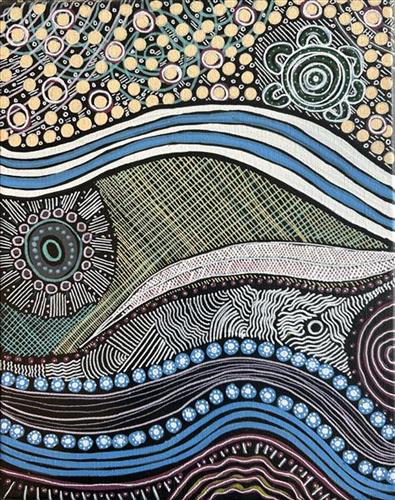
The water serpent

I see a snake in the water it just came back from the sea, it flows down, I look closer. It’s the water serpent i followed it all the way down to Barmah, Yorta Yorta country. The end.

377810582288244


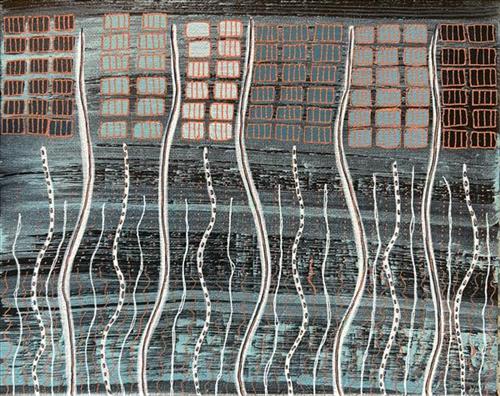
Kunmadj and Cheeky Yam

Deborah has depicted kunmadj (dillybag), which is a large woven collecting basket. These large bags are often made from the burney vine (Trophis scandens), a strong, pliable plant that grows along the ground and into the canopy of monsoon vine thickets. The bags are used to collect heavy foods, such as fish caught in conical fish traps, or yams. They can also be made from kun-dayarr (Pandanus spiralis), a palm that grows in many areas of Arnhem Land. Tightly woven dillybags are used to collect sugarbag, the native honey.

As well as being of practical use, dillybags are of cultural significance to Arnhem Land people. They are totemic objects associated with particular sites in the landscape.

111982287462


Ngokngok (Owl)

Ngokngok or mun-ngokngok is the Southern Boobook owl. Their clan is Warrawarra and the are connected to witch doctors and traditional healers.


111982287461


Marrchila (Saltwater crocdile)

Marrchila, ana-munya gu-nirra, gu-bugula a-waywunga a-boya, lika guna-gepiya, a-warrchinga a-rracha a-yurra. Nipa a-weya a-workiya, a-yinaga, “Garr-rru.”

The crocodile swims around at night, then after sunrise it climbs up out of the water and lies in the sun getting warm. It always makes a sound, it goes “Garr-rru.”


An-guna mernda a-jirra Gupanga. Ana-mernda a-bawuna, gojilapa Murlulu marrchila a-yurra rrapa gu-gapala.

This is the river at Gupanga. The crocodile came up out of the river and is lying on the island and at Murlulu.


Michpa jal nyi-ni ny-boy barra galang, ny-jarlapiya barra ny-boy, marrchila nula. Galaypa bi-barda.


If you want to go fishing, you should take care of yourself as you go, because of crocodiles. Otherwise, one might bite you.

Rrapa nyina barra ny-boy bugula gochila gu-jirra, o gun-nga gu-waywa barra gu-bamba, gun-gora. Nyi-na barra lorr, waygiji gun-nerranga nipa galaypa a-waywin a-bambun, marrchila.
 

You should always look out to the middle of the water, and at whatever is floating along, it might be harmless. You should look carefully, maybe it’s something else, it might be a crocodile swimming along

111982287416


An-gujechiya (Fish Trap)

To make fish traps and fish net fences artists firstly get vine (mirlarl) from the jungle and they put it in water for one night to make it soft. Next they start weaving it; they make rings for the inside to keep the fish trap’s shape. Artists work for three or four weeks on the fish trap. They also make string from kurrajong (burdaga) to attach the hibiscus (bardainy) rings and to tie the conical end of the fish trap. This fish trap is used in saltwater and freshwater. People also use fish net fences called mun-dirra. A long time ago they would put the mun-dirra across rivers and creeks. In the middle they would place the an-gujechiya. They also used small things like sticks, rocks, mud and grass to block the fish from going through. People would then catch fish like saltwater barramundi rajarra, freshwater barramundi (janambal), small black freshwater catfish (buliya), bonefish (an-guwirrpiya), and sand bass (dalakan) in these fish traps.

111982287415


An-gujechiya (Fish Trap)

To make fish traps and fish net fences artists firstly get vine (mirlarl) from the jungle and they put it in water for one night to make it soft. Next they start weaving it; they make rings for the inside to keep the fish trap’s shape. Artists work for three or four weeks on the fish trap. They also make string from kurrajong (burdaga) to attach the hibiscus (bardainy) rings and to tie the conical end of the fish trap. This fish trap is used in saltwater and freshwater. People also use fish net fences called mun-dirra. A long time ago they would put the mun-dirra across rivers and creeks. In the middle they would place the an-gujechiya. They also used small things like sticks, rocks, mud and grass to block the fish from going through. People would then catch fish like saltwater barramundi rajarra, freshwater barramundi (janambal), small black freshwater catfish (buliya), bonefish (an-guwirrpiya), and sand bass (dalakan) in these fish traps.