377810582287525


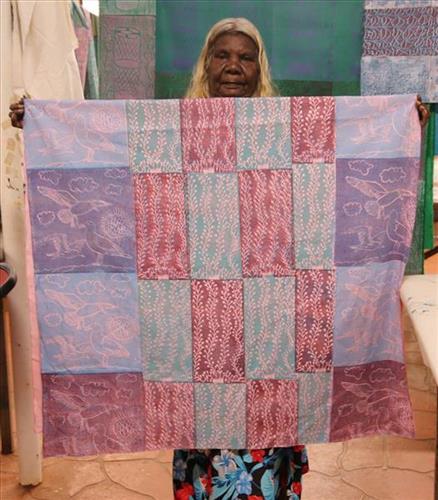
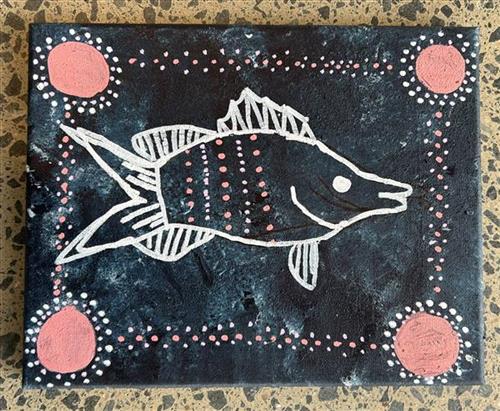
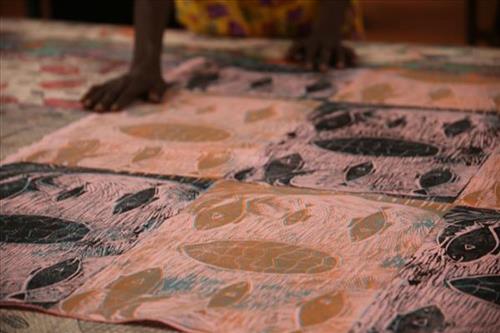
Yokkarra (fish), Ngaduna (palm tree) & Barruar (Seagull egg)

‘Hi it’s me Marilyn! I’m the age of 52. I like working at the women centre and doing lino printing but I prefer screen printing. I have one design, that’s lorrkkon (hollow log). My great grandfather used to make lorrkkon and do bark paining. I never met him but I heard a lot of stories about him. My mother used to tell me history stories. When I was 16 my parents passed away. I’m was on my own but now I’ve got my own family and my partner who helps me. I’ve got 6 grandchildren.

My homeland is Entrance island, Haulround island and Juda point. I really like Haulround island and that’s where we collect barruar (seagull egg). Entrance island is my favourite camping area, I go across with boat. Balanda (non-Aboriginal or European people) can’t go into those islands or Juda point without permission from me.

Come and chat to me if you want to go to any of those places. We have a sacred totem ngaduma (palm tree) at those places and if people destroy it, we will have a strong wind and maybe a cyclone.’

Marilyn James 2021
111982287507


String Bag


String bags can vary greatly. Artists commonly use a mix of naturally dyed and undyed fibre to create a striking variation of coloured bands. Some artists also incorporate different types of looping to produce different patterns and textured finishes. Each type of fibre bag, mat, basket and dilly bag has its own name in the various languages spoken in the Maningrida region.

111982287506


String Bag


String bags can vary greatly. Artists commonly use a mix of naturally dyed and undyed fibre to create a striking variation of coloured bands. Some artists also incorporate different types of looping to produce different patterns and textured finishes. Each type of fibre bag, mat, basket and dilly bag has its own name in the various languages spoken in the Maningrida region.

11151029269


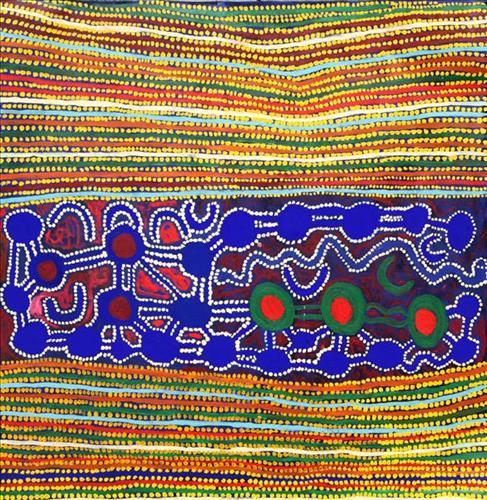
Untitled

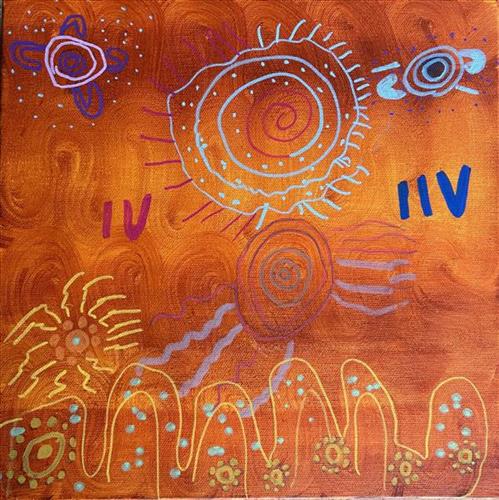
This painting depicts the waterholes and tali (sandhills) in the artist’s country near Punmu. Rockholes, waterholes, soaks and springs were important sites for Martu people during pujiman (bush) days. The Martu lived very nomadically moving from water source to water source hunting and gathering bush tucker as they went. They would traverse very large distances visiting some areas in the dry and some in the wet season depending on the availability of water. As they travelled and hunted they would also burn areas of country creating a larger diversity of plant and animal life.

377810582287172


Djomi (Fresh Water Spirit)

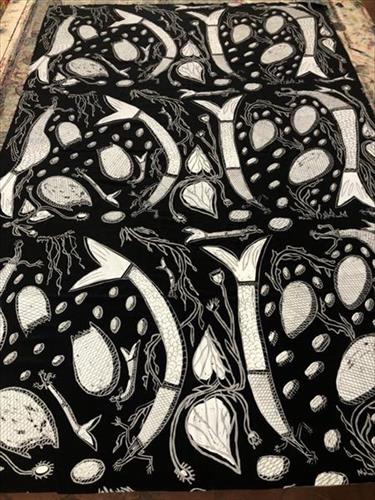
This design depicts the story of the artist’s ancestral dreaming, the Djomi fresh water spirit mermaid.

The Djomi figure is a mermaid like spirit with fish tail that lives in the fresh water stream that flows out to the sea cliff near Maningrida. Djomi is a known to be a very powerful fertility symbol.

‘If you go there you can get pregnant easily. Djomi has babies, and they can give others babies too. The Djomi spirit is so powerful, that women can end up with multiple babies at once, twins or sometimes even more. The Djomi spirits lay eggs near the sacred freshwater stream in Maningrida. Inside the eggs are human babies as well as young Djomi.

Men do not go near that swamp, because Djomi is so powerful that men might get pregnant there too. So men, they are too scared of that Djomi. When we visit the Djomi freshwater spring, we can hear young Djomi crying. They sound like normal babies crying, those Djomi spirits. They are looking for a mother.

This Djomi is my dreaming, I got permission from my djunguys to paint this Djomi design. For me I always ask my djunguy permission to paint, because that is our cultural way.

This design also depicts the fresh water lily leaves, and seaweed from the base of the sea floor.

222082287349


Camping

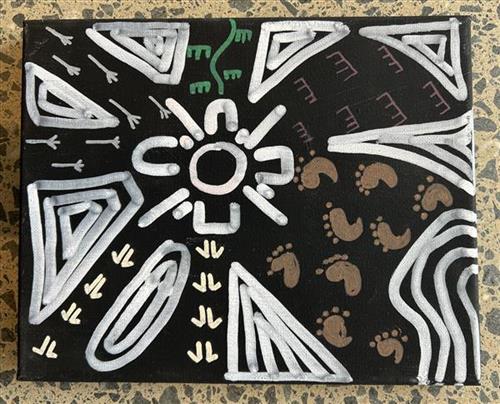
Four men and four girls are camping and they come across a Goanna hole they shake the dirt off them and go see the sunset. The sun is going down so they head back to their tents and meeting place.

222082287345


Silver Perch

Silver Perch are native to the Murray Darling river system. They are critically endangered.

111982287344


Warraburnburn

In Burarra and Gun-nartpa languages the figure represented in this artwork is generally known as a wangarra ‘ghost spirit’. For the Warrawarra clan ghost spirits have their own particular characteristics and their own name – Warraburnburn.

The Warraburnburn and the closely related Galabarrbarr spirit (owned by the Balkarranga clan) are also manikay song topics.  The spirits are related to each other as maternal grandparent and grandchild, just as the people of Warrawarra and Balkarranga are. The dancing of the two ghost spirit figures forms the finale performance for funerals, and is the final goodbye to a deceased family member.

In many ways the Warraburnburn and Galabarrbarr ghost spirits are like people. They emerge from the patches of jungle on Warrawarra and Balkarranga country in the late afternoon and go hunting in family groups of men, women and children. They stay in contact with each other by calling out as the men hunt for fish and the women walk with their dillybags looking for vegetable food. 

The ghost spirits are associated closely with white ochre and artists commonly paint the bodies of carved figures in white. Different types of ghost spirit wear different patterns. Warraburnburn is decorated with uniform white dots while others are painted white all over. Some ghost spirits are shown with a design painted on their chest infilled with rarrk ‘cross-hatching’, the same designs that are painted onto japi an-guyinda ‘male initiations’. 

They also have supernatural characteristics including superhuman size (jarra anbaykarda ‘super tall’). They know the country intimately – some are malevolent towards humans and will lead people astray, taking them to unfamiliar and dangerous places. These malevolent spirits are likened to an-muburda ‘sorcerers’ and can conduct dangerous rituals that cause harm to people. Others are benign and will lead humans back to familiar paths and their own camps.