225682273048


Bulbuji

I’m Kuku-Yalanji woman. My mum is from Wujal Wujal and my dad is from Laura, Chillagoe and Cooktown. For us Bama (Kuku-Yalanji people), we can’t touch bulbuji or wurarr-wurarr. They are sacred. Bulbuji start flying around once the rains come, they are also maja (boss) for bana (water) and the walkurr (water goanna).

After the rains come everything comes to life.  It’s the time when special plants flower and tell us to go hunting for different animals.  Everything is connected for us.  The plants and animals.  Everything.
225682273046


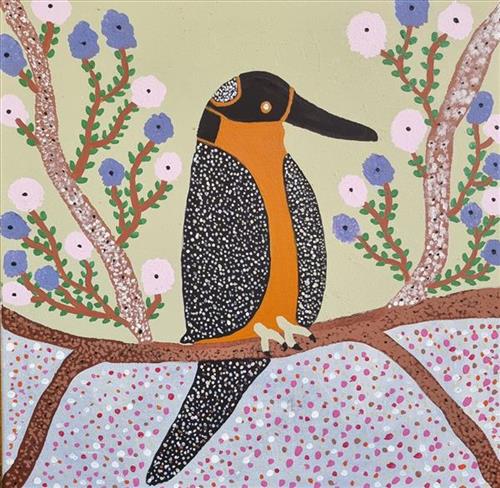
Dikal, Bird

There are many Dikal’s living on our bubu, country. I love camping with my families, anywhere, down the beach or at the river and listening to the Dikal’s singing. 

225682273045


Kababina & Kunjuri

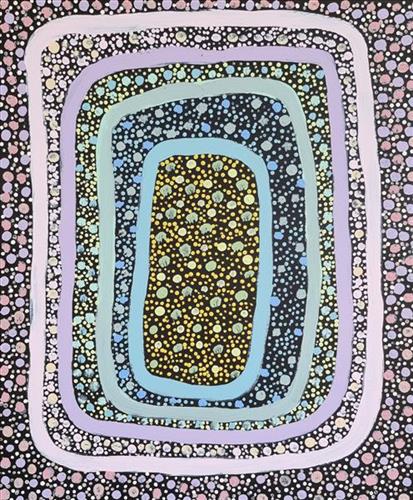
I am a Nyungul woman. My art depicts cultural, historical and contemporary stories from my bubu (Country) located in the Helensvale and Shipton’s Flat areas in Far North Queensland.

I wanted to paint one of the many lagoons from my Country. A kunjuri (shield) shape represents the lagoon and I have then painted my water lilies floating in the water.  This lagoon has lots of long-neck turtles. The spaces between the kababina represent the turtles pushing aside the plants and making corridors as they swim through the water.  

There are many species of kababina (water lilies) that grow in the lagoons and wetlands on my bubu (Country). There are lots of different colours, big and small ones.

My father told me that in the old days bama (people) would harvest the water lilies for food. I love going out bush with my family and enjoy looking at the wetlands, plants and animals.

Nature is the inspiration for my artwork. Anne Nunn

377810582273043


man-kurdudjumuk – yellow colour

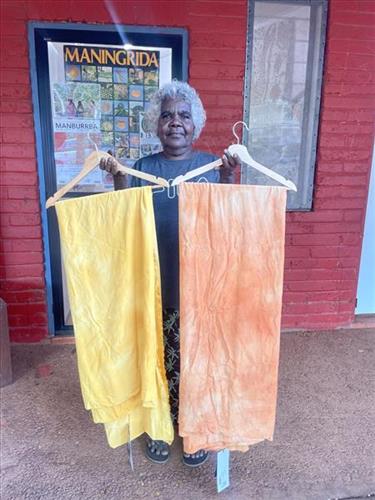
The striking yellow – gold hue comes from the root of the man-kurdudjumuk plant (coelospermum reticulatum) which has been harvested from the sandy country near the flood plains. This laborious and tiring process requires digging up the entire shrub. The root is shaven into a pot of water and the colour is released into water through the boiling process. 

377810582273040


man-kurdudjumuk and ashes

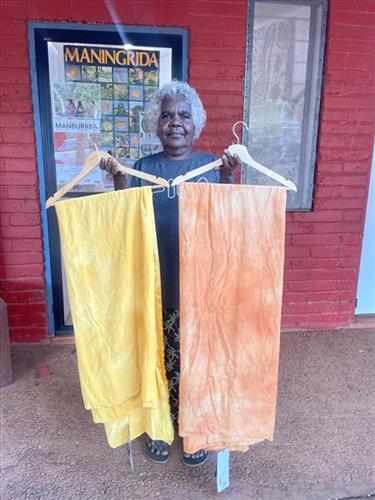
The striking yellow – gold hue comes from the root of the man-kurdudjumuk plant (coelospermum reticulatum) which has been harvested from the sandy country near the flood plains. This laborious and tiring process requires digging up the entire shrub. The root is shaven into a pot of water and the colour is released into water through the boiling process. Ashes sprinkled into the mix create beautiful orange tones. 

This silk has been dyed by Jocelyn at Bolkjam Outstation where she has been attending ceremony

111982273405


Coil Basket

Coil basketry is a well-established fibre art form in the Maningrida region, especially for women from the Kuninjku, Rembarrnga, Ndjebbana and Nakkara language groups. 

Artists make coiled baskets of many shapes and sizes, ranging from small round baskets to large oval baby baskets, and made mostly from pandanus fibre that is dyed with natural pigments. Bundles of fibre are formed into coils which are covered and stitched together with strands of fibre threaded onto a needle. Artists combine colours and patterns to obtain intricate new graphic patterns.

These techniques are believed to have been introduced to Arnhem Land by Greta Matthews, a missionary on Goulburn Island in the 1920s. She had probably learnt coil basketry from Aboriginal people in the south-east of Australia, possibly the Murray River people such as the Yorta Yorta or the coastal Ngarrindjeri. 

The coiling technique spread quickly from Goulburn Island to people on mainland Arnhem Land. 


111982273404


Coil Basket

Coil basketry is a well-established fibre art form in the Maningrida region, especially for women from the Kuninjku, Rembarrnga, Ndjebbana and Nakkara language groups. 

Artists make coiled baskets of many shapes and sizes, ranging from small round baskets to large oval baby baskets, and made mostly from pandanus fibre that is dyed with natural pigments. Bundles of fibre are formed into coils which are covered and stitched together with strands of fibre threaded onto a needle. Artists combine colours and patterns to obtain intricate new graphic patterns.

These techniques are believed to have been introduced to Arnhem Land by Greta Matthews, a missionary on Goulburn Island in the 1920s. She had probably learnt coil basketry from Aboriginal people in the south-east of Australia, possibly the Murray River people such as the Yorta Yorta or the coastal Ngarrindjeri. 

The coiling technique spread quickly from Goulburn Island to people on mainland Arnhem Land. 


111982273403


Coil Basket

Coil basketry is a well-established fibre art form in the Maningrida region, especially for women from the Kuninjku, Rembarrnga, Ndjebbana and Nakkara language groups. 

Artists make coiled baskets of many shapes and sizes, ranging from small round baskets to large oval baby baskets, and made mostly from pandanus fibre that is dyed with natural pigments. Bundles of fibre are formed into coils which are covered and stitched together with strands of fibre threaded onto a needle. Artists combine colours and patterns to obtain intricate new graphic patterns.

These techniques are believed to have been introduced to Arnhem Land by Greta Matthews, a missionary on Goulburn Island in the 1920s. She had probably learnt coil basketry from Aboriginal people in the south-east of Australia, possibly the Murray River people such as the Yorta Yorta or the coastal Ngarrindjeri. 

The coiling technique spread quickly from Goulburn Island to people on mainland Arnhem Land.