111582267585


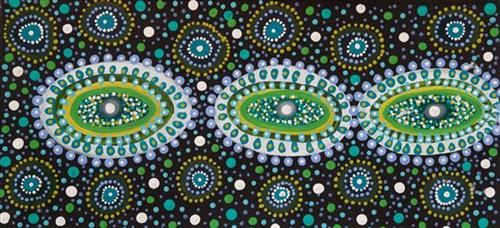
Kaalpa – Kartarru – Wantili

“This is my Grandmother’s [Bugai Whyoulter’s] Country, my Country. Wantili (Warntili, Canning Stock Route Well 25) is old Law Grounds from Dreaming days and very important to Martu people. My grandmother always tells me about Wantili because she grew up around Wantili. It is close to her birthplace and is her ngurra (home Country, camp). She was a young girl walking around at Wantili. Her family would travel between Wantili, Kaalpa, Juntu-juntu, Raarki, and Wuranu Wells along the Canning Stock Route. Big mob of people they been walking around there. She saw whitefellas there for the first time, Canning mob when they were traveling up and down the stock route with the bullock. They were running away from those whitefellas, watching them from a distance. She was a teenager when she was travelling around there with her four mothers and one daddy. They used to travel around in family groups, Bugai and Jakayu [Biljabu], and Jakayu’s nyupa (partner) Phillip Biljabu. They met Kumpaya [Girgirba] coming from Kun Kun (Kuny-Kuny), Kunawarritji area. Bugai returned to the Wantili area as a young woman, when she worked driving cattle along the Stock Route. 

Wantili is good for painting and telling stories. Our stories are still strong. I wanted to take Bugai back to Wantili. It is an important place; she hadn’t been there for a long time. My nana [Pinyirr] Nancy took me there as a young boy. Bugai is the older sister of Nancy. I been… three times going there. It’s important that place, out a long way from Newman… Those old people like going to Wantili, where the creation started. Jakayu and Kumpaya… them two aunties told me a story about Dreamtime, and how important Wantili was. People from different tribes…from all over the place could come there for the initiation ceremony. The Jukurrpa (Dreaming) stories from Wantili are just for Martu but the site is open, and anyone can go there. 

It’s a lovely part of the Country to take the kids for a swim. The place has changed. The water used to be muddy like chocolate, now the water is clear. Maybe from climate change, maybe from mining, maybe from something else. The changes don’t have to be bad; the landscape is always changing, same way as Martu people. It’s good to make work sitting out in Country, but I can make these paintings anywhere, just like those old people. Wherever I am, painting Country takes me back there in my head, back to Jukurrpa times, back to pujiman (traditional, desert dwelling) days when my grandmother walked around there, and back to days going there for a swim as a kid. I hope this painting carries people there too. I’m proud to be able to share my culture and stories with younger Martu people and whitefellas.”

111582267584


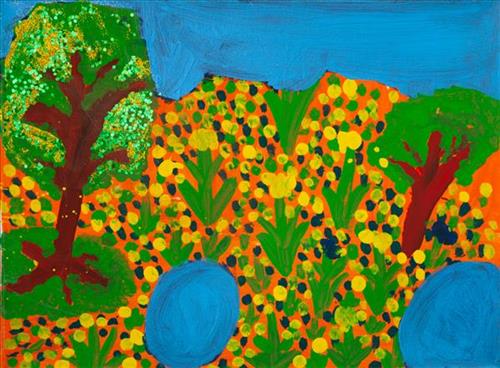
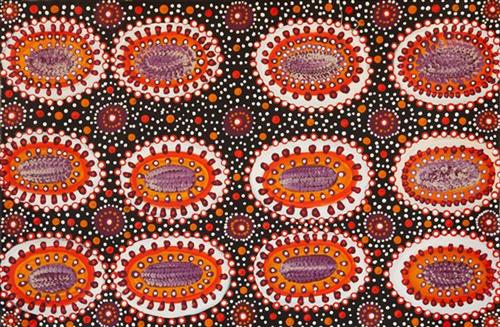
Linyji (claypan)

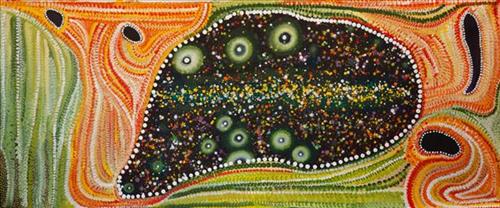
This work depicts a linyji (claypan) within the artists’ ngurra (home Country, camp), typically represented with circular forms. Claypans were visited more often during the wet seasons as they filled with water. 

During the pujiman (traditional, desert dwelling) period, knowledge of water sources was critical for survival, and today Martu Country is still defined in terms of the location and type of water. Each of the hundreds of claypans, rockholes, waterholes, soaks and springs found in the Martu desert homelands is known through real life experience and the recounting of Jukurrpa (Dreaming) narratives by name, location, quality and seasonal availability. This encyclopedic knowledge extends even to the nature and movement of arterial waterways, and sustained Martu as they travelled across their Country, hunting and gathering, visiting family, and fulfilling ceremonial obligations. They would traverse very large distances annually, visiting specific areas in the dry and wet season depending on the availability of water and the corresponding cycles of plant and animal life on which hunting and gathering bush tucker was reliant.

111582267583


All the Martu communities

“This is my Grandmother’s [Bugai Whyoulter’s] Country, my Country. Wantili (Warntili, Canning Stock Route Well 25) is old Law Grounds from Dreaming days and very important to Martu people. My grandmother always tells me about Wantili because she grew up around Wantili. It is close to her birthplace and is her ngurra (home Country, camp). She was a young girl walking around at Wantili. Her family would travel between Wantili, Kaalpa, Juntu-juntu, Raarki, and Wuranu Wells along the Canning Stock Route. Big mob of people they been walking around there. She saw whitefellas there for the first time, Canning mob when they were traveling up and down the stock route with the bullock. They were running away from those whitefellas, watching them from a distance. She was a teenager when she was travelling around there with her four mothers and one daddy. They used to travel around in family groups, Bugai and Jakayu [Biljabu], and Jakayu’s nyupa (partner) Phillip Biljabu. They met Kumpaya [Girgirba] coming from Kun Kun (Kuny-Kuny), Kunawarritji area. Bugai returned to the Wantili area as a young woman, when she worked driving cattle along the Stock Route. 

Wantili is good for painting and telling stories. Our stories are still strong. I wanted to take Bugai back to Wantili. It is an important place; she hadn’t been there for a long time. My nana [Pinyirr] Nancy took me there as a young boy. Bugai is the older sister of Nancy. I been… three times going there. It’s important that place, out a long way from Newman… Those old people like going to Wantili, where the creation started. Jakayu and Kumpaya… them two aunties told me a story about Dreamtime, and how important Wantili was. People from different tribes…from all over the place could come there for the initiation ceremony. The Jukurrpa (Dreaming) stories from Wantili are just for Martu but the site is open, and anyone can go there. 

It’s a lovely part of the Country to take the kids for a swim. The place has changed. The water used to be muddy like chocolate, now the water is clear. Maybe from climate change, maybe from mining, maybe from something else. The changes don’t have to be bad; the landscape is always changing, same way as Martu people. It’s good to make work sitting out in Country, but I can make these paintings anywhere, just like those old people. Wherever I am, painting Country takes me back there in my head, back to Jukurrpa times, back to pujiman (traditional, desert dwelling) days when my grandmother walked around there, and back to days going there for a swim as a kid. I hope this painting carries people there too. I’m proud to be able to share my culture and stories with younger Martu people and whitefellas.”

111582267582


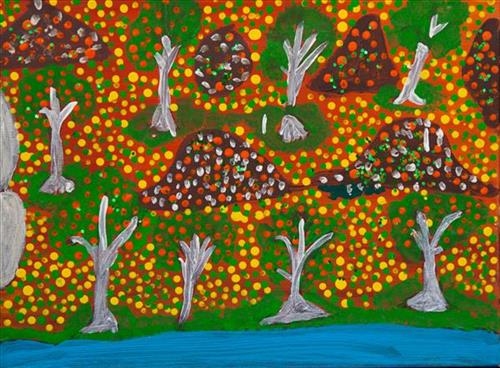
Wantili (Warntili, Canning Stock Route Well 25)

“This is my Grandmother’s [Bugai Whyoulter’s] Country, my Country. Wantili (Warntili, Canning Stock Route Well 25) is old Law Grounds from Dreaming days and very important to Martu people. My grandmother always tells me about Wantili because she grew up around Wantili. It is close to her birthplace and is her ngurra (home Country, camp). She was a young girl walking around at Wantili. Her family would travel between Wantili, Kaalpa, Juntu-juntu, Raarki, and Wuranu Wells along the Canning Stock Route. Big mob of people they been walking around there. She saw whitefellas there for the first time, Canning mob when they were traveling up and down the stock route with the bullock. They were running away from those whitefellas, watching them from a distance. She was a teenager when she was travelling around there with her four mothers and one daddy. They used to travel around in family groups, Bugai and Jakayu [Biljabu], and Jakayu’s nyupa (partner) Phillip Biljabu. They met Kumpaya [Girgirba] coming from Kun Kun (Kuny-Kuny), Kunawarritji area. Bugai returned to the Wantili area as a young woman, when she worked driving cattle along the Stock Route. 

Wantili is good for painting and telling stories. Our stories are still strong. I wanted to take Bugai back to Wantili. It is an important place; she hadn’t been there for a long time. My nana [Pinyirr] Nancy took me there as a young boy. Bugai is the older sister of Nancy. I been… three times going there. It’s important that place, out a long way from Newman… Those old people like going to Wantili, where the creation started. Jakayu and Kumpaya… them two aunties told me a story about Dreamtime, and how important Wantili was. People from different tribes…from all over the place could come there for the initiation ceremony. The Jukurrpa (Dreaming) stories from Wantili are just for Martu but the site is open, and anyone can go there. 

It’s a lovely part of the Country to take the kids for a swim. The place has changed. The water used to be muddy like chocolate, now the water is clear. Maybe from climate change, maybe from mining, maybe from something else. The changes don’t have to be bad; the landscape is always changing, same way as Martu people. It’s good to make work sitting out in Country, but I can make these paintings anywhere, just like those old people. Wherever I am, painting Country takes me back there in my head, back to Jukurrpa times, back to pujiman (traditional, desert dwelling) days when my grandmother walked around there, and back to days going there for a swim as a kid. I hope this painting carries people there too. I’m proud to be able to share my culture and stories with younger Martu people and whitefellas.”
111982268269


Bush Jewellery – Earrings

The women of Maningrida and surrounding homelands use a combination of locally found seeds, bone and shells to make a variety of jewellery including necklaces. earrings and bracelets.  Many of the artists use complex patterns and designs to make their beautiful creations.

115682268245


Woven Mat

Traditionally, Nganiyal (conical mats) were used as an insect screen when erected, and as a sitting mat when folded. They are used in Ceremony as well as a functional item. 

Nowadays, artists weave many different shapes including flat, round and oblong. 

115682268226


Woven Mat

Traditionally, Nganiyal (conical mats) were used as an insect screen when erected, and as a sitting mat when folded. They are used in Ceremony as well as a functional item. 

Nowadays, artists weave many different shapes including flat, round and oblong. 

116482268071


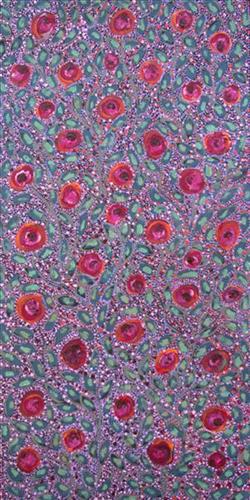
Wildflowers of the Pilbara

These are the Pilbara wildflowers that grow on the ground they have a beautiful orange and red colour blending into the country during flower season.

111582268036


Yimiri – Mama Country (Father’s Country)

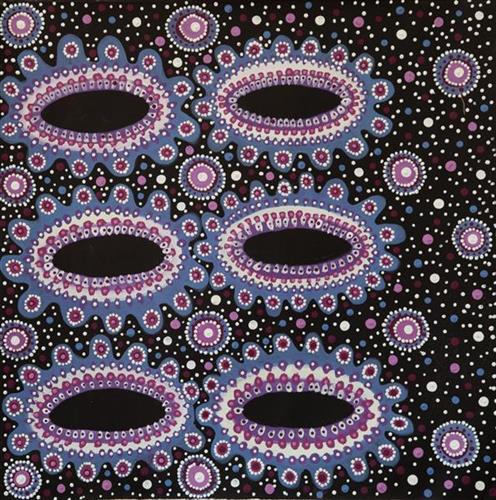
Yimiri comprises two freshwater soaks situated in the middle of a salt lake in the Percival Lakes area, within Western Australia’s Great Sandy Desert. Around these soaks the Country is dominated by permanent tuwa (sand hills). When visiting this site to drink water, the bulrushes surrounding the soaks are pushed back to access the kapi (water). 

Yimiri is home to an ancestral jila (snake). The Western Desert term jila is used interchangeably to describe springs considered to be ‘living’ waters and snakes, both of which play a central role in Martu culture and Jukurrpa (Dreaming). During the pujiman (traditional, desert dwelling) period, knowledge of water sources was critical for survival, and today Martu Country is still defined in terms of the location of water sources. Of the many permanent springs in Martu Country, very few are ‘living waters’; waters inhabited by jila. Before they became snakes, these beings were men who made rain, formed the land and introduced cultural practices like ceremonies and ritual songs. Some of the men travelled the desert together, visiting one another, but they all ended their journeys at their chosen spring alone, transformed into a snake. These important springs are named after their jila inhabitant, guarding their waters.

The region surrounding Yimiri was formed by Wirnpa, one of the most powerful of the ancestral jila (snake) men and the last to travel the desert during the Jukurrpa. Wirnpa is a rainmaking jila who lived and hunted in the Percival Lakes area. His travels are described in the songs and stories of many language groups across the Western Desert, even those far removed from his home site. In his epic travels, Wirnpa met and feasted with many other ancestral beings, exchanged ceremonial objects, and created a series of different laws and ceremonies. When he finally returned home, he searched for his many children only to discover that they had already died. They had laid down and become the salt springs of the Percival Lakes. Wirnpa wept for his children before himself transforming into a snake and entering the soak where he still resides. 

During the pujiman period, Martu would traverse very large distances annually in small family groups, moving seasonally from water source to water source, and hunting and gathering bush tucker as they went. At this time knowledge of water sources was critical for survival, and today Martu Country is still defined in terms of the location and type of water. Each of the hundreds of claypans, rockholes, waterholes, soaks and springs found in the Martu desert homelands is known by name, location, quality and seasonal availability through real life experience and the recounting of Jukurrpa narratives.

111582268021


Yimiri

Yimiri comprises two freshwater soaks situated in the middle of a salt lake in the Percival Lakes area, within Western Australia’s Great Sandy Desert. Around these soaks the Country is dominated by permanent tuwa (sand hills). When visiting this site to drink water, the bulrushes surrounding the soaks are pushed back to access the kapi (water). 

Yimiri is home to an ancestral jila (snake). The Western Desert term jila is used interchangeably to describe springs considered to be ‘living’ waters and snakes, both of which play a central role in Martu culture and Jukurrpa (Dreaming). During the pujiman (traditional, desert dwelling) period, knowledge of water sources was critical for survival, and today Martu Country is still defined in terms of the location of water sources. Of the many permanent springs in Martu Country, very few are ‘living waters’; waters inhabited by jila. Before they became snakes, these beings were men who made rain, formed the land and introduced cultural practices like ceremonies and ritual songs. Some of the men travelled the desert together, visiting one another, but they all ended their journeys at their chosen spring alone, transformed into a snake. These important springs are named after their jila inhabitant, guarding their waters.

The region surrounding Yimiri was formed by Wirnpa, one of the most powerful of the ancestral jila (snake) men and the last to travel the desert during the Jukurrpa. Wirnpa is a rainmaking jila who lived and hunted in the Percival Lakes area. His travels are described in the songs and stories of many language groups across the Western Desert, even those far removed from his home site. In his epic travels, Wirnpa met and feasted with many other ancestral beings, exchanged ceremonial objects, and created a series of different laws and ceremonies. When he finally returned home, he searched for his many children only to discover that they had already died. They had laid down and become the salt springs of the Percival Lakes. Wirnpa wept for his children before himself transforming into a snake and entering the soak where he still resides. 

During the pujiman period, Martu would traverse very large distances annually in small family groups, moving seasonally from water source to water source, and hunting and gathering bush tucker as they went. At this time knowledge of water sources was critical for survival, and today Martu Country is still defined in terms of the location and type of water. Each of the hundreds of claypans, rockholes, waterholes, soaks and springs found in the Martu desert homelands is known by name, location, quality and seasonal availability through real life experience and the recounting of Jukurrpa narratives.