Bathi (Pandanus Basket)
Bathi are woven from the split leaves of the Screw Palm (Pandanus Spiralis). Coil weaving was introduced to Arnhem Land in the 1930s. It was adapted from techniques used by Indigenous women throughout South East Australia.
Bathi are woven from the split leaves of the Screw Palm (Pandanus Spiralis). Coil weaving was introduced to Arnhem Land in the 1930s. It was adapted from techniques used by Indigenous women throughout South East Australia.


Bana Yirriji Art Centre represents artists from the Yalanji, Nyungkul and Jalunji clan groups.
Bama (local people) have had a long history of artistic expression, including ceremonial body painting, weavings made from local plants, rainforest shields and weaponry decorated with clan designs using earth pigments.
Today, artists create stunning contemporary arts and crafts; including paintings, prints, works on paper, textiles, weavings, artefacts and a range of merchandise. Artists draw on their rich cultural, historic, and contemporary stories and profound connection to country as inspiration.
These clapsticks have been hand painted and represents the artists country and culture through designs and mark making.
Each pair is unique.
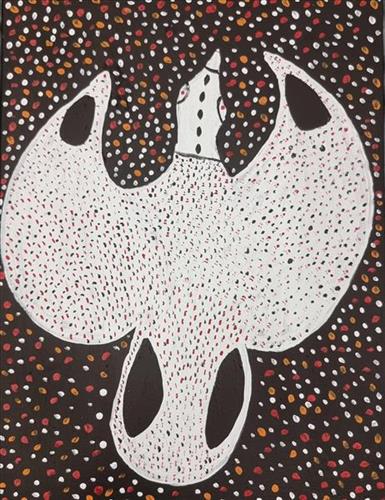
There are many Dikal’s living on our bubu, country. I love camping with my families, anywhere, down the beach or at the river and listening to the Dikal’s singing.
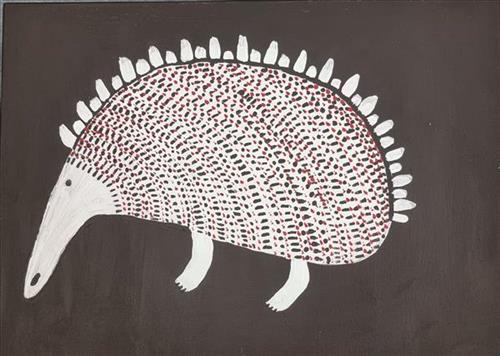
When I was growing up as a kid and living in Mossman with my family, we used to hunt for Ngangkin. We would see them all the time, on the side of the road digging. There are not so many around anymore and people don’t hunt them as much.

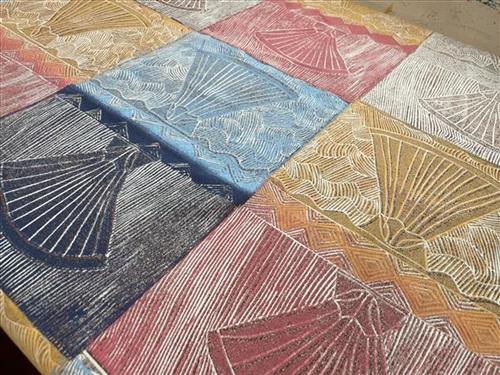
Dakarra is the Burrara Gun-nartpa word for a type of cockle shell with prominant scaled ribs and an orange colour. This is part of a diet of shellfish which has been enjoyed by people whose country lies on the saltwater estuaries at the opening of rivers throughout Arnhem Land.
Elizabeth Wullunmingu’s mother country is Djunawunya, near Gupunga on the Blyth river. This is saltwater country. Her design Dakarra represents a songline for this particular type of edible shellfish and the fishing lifestyle that is enjoyed by her people.
Elizabeth’s grandfather Frank Gurrmanamana was seen in the documentary ‘Waiting For harry’ 1978 by Ronin films which is filmed on Elizabeth’s mother country, Djunawunya. In this documentary, the late Frank Gurrmanamana is preparing the final mortuary ceremonies for his brother who died six years before. Central to the ceremonies is Harry Diama, the senior blood-relative of the deceased man, but Harry lives in Maningrida and is pre-occupied with a pending court-case there involving his son.
https://www.sbs.com.au/topics/video/1068702275809/Waiting-For-Harry

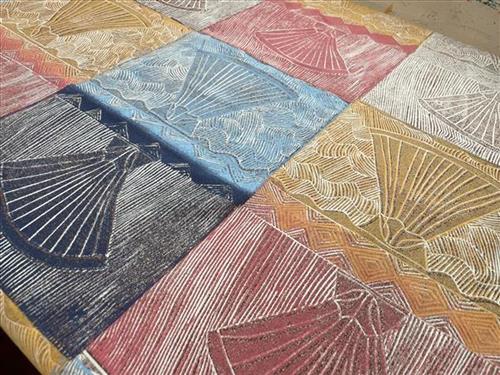
Dakarra is the Burrara Gun-nartpa word for a type of cockle shell with prominant scaled ribs and an orange colour. This is part of a diet of shellfish which has been enjoyed by people whose country lies on the saltwater estuaries at the opening of rivers throughout Arnhem Land.
Elizabeth Wullunmingu’s mother country is Djunawunya, near Gupunga on the Blyth river. This is saltwater country. Her design Dakarra represents a songline for this particular type of edible shellfish and the fishing lifestyle that is enjoyed by her people.
Elizabeth’s grandfather Frank Gurrmanamana was seen in the documentary ‘Waiting For harry’ 1978 by Ronin films which is filmed on Elizabeth’s mother country, Djunawunya. In this documentary, the late Frank Gurrmanamana is preparing the final mortuary ceremonies for his brother who died six years before. Central to the ceremonies is Harry Diama, the senior blood-relative of the deceased man, but Harry lives in Maningrida and is pre-occupied with a pending court-case there involving his son.
https://www.sbs.com.au/topics/video/1068702275809/Waiting-For-Harry

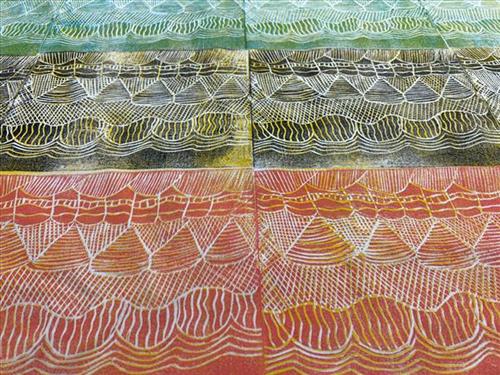
This is a Kune word that refers to the flattening out of items stones, flat leaves and kunbad (money).
This design shows different items that have flattened out. Carol designed this for her grandkids to show them the tradition of Welebme.

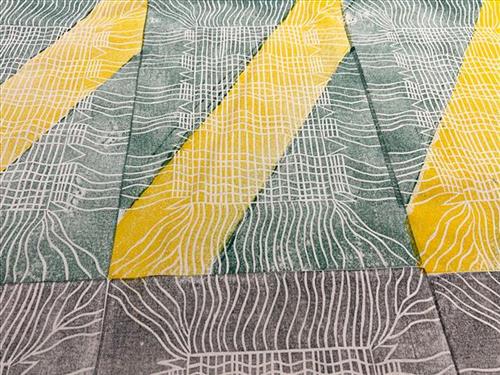
A beautiful, one off, hand printed, lino cut design by Joy Garlbin.

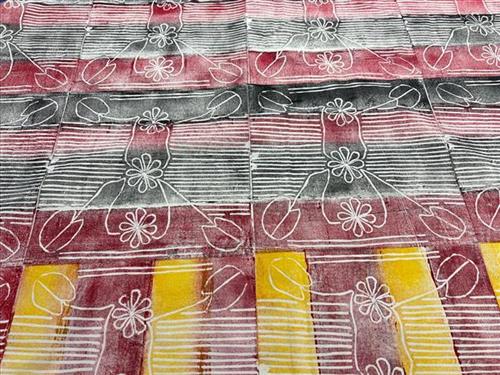
Hand printed fabric made by pressing intricately carved lino tiles onto fabric using layers of colour.