Mangroo
This print is about when I go diving in the mangroves for fishes in our language its named azum or we would hunt and fish for tother fishes which the best time for those fishing and hunting times would be when the tides going low.

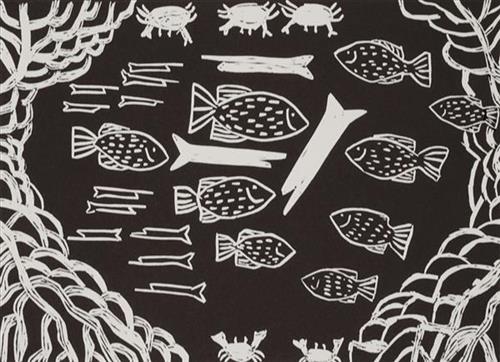
This print is about when I go diving in the mangroves for fishes in our language its named azum or we would hunt and fish for tother fishes which the best time for those fishing and hunting times would be when the tides going low.
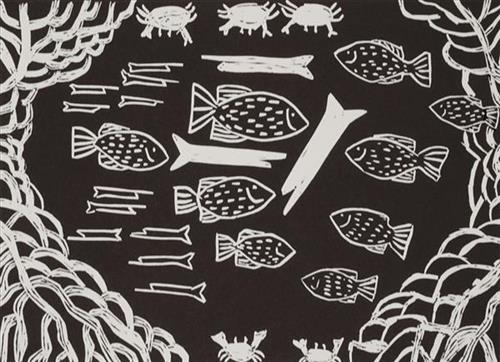
This print is about when I go diving in the mangroves for fishes in our language its named azum or we would hunt and fish for tother fishes which the best time for those fishing and hunting times would be when the tides going low.
Status: Stock
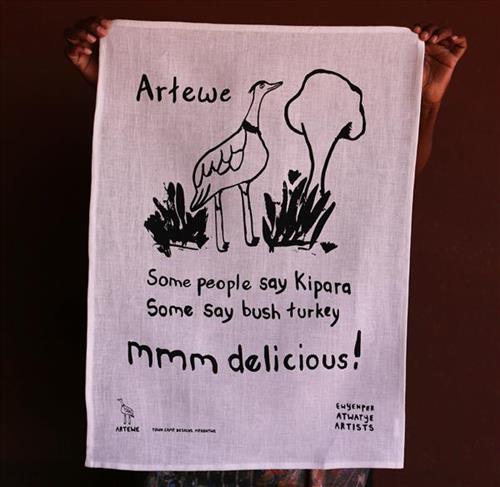
Designed by Christopher McMillan and Emily John of Ewyenper Atwatye Artists. “Artewe, some people say Kipara, some say bush turkey, mmm delicious!’
Available in white, oatmeal and flax linen.
Town Camp Designs is a collection of products created by Ewyenper Atwatye, Tangentyere and Yarrenyty Arltere Artists. We are a 100% Aboriginal owned and run art centre. All sales directly support the artists, with all profit going towards artists fees and future projects.
Ewyenper Atwatye is the Central Arrernte place name for Hidden Valley, and the chosen name for the textile enterprise established by the community of Hidden Valley Town Camp in 2015. It is a satellite project of Tangentyere Artists. Each year, Tangentyere Artists run workshops in collaboration with the community, and out of these workshops new designs are released at Darwin Aboriginal Art Fair in August and Desert Mob in Alice Springs every September.
All Ewyenper Atwatye Artists’ products are ethically produced on high quality, natural fabrics. Sales directly support Ewyenper Atwatye, with the profit returning to artist fees and investment in future projects.
Status: Stock
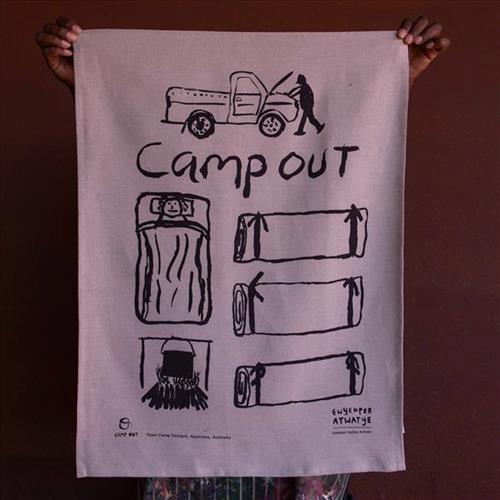
Camp Out by Alan Collins of Ewyenper Atwatye (Hidden Valley Town Camp).
Town Camp Designs is a collection of products created by Ewyenper Atwatye, Tangentyere Artists and Yarrenyty Arltere Artists.
We are a 100% Aboriginal owned and run art centre. All sales directly support the artists, with all profit going towards artists fees and future projects.
This design depicts a freshly cooked kangaroo tail. Kangaroo tails are regularly enjoyed by Aboriginal families in Central Australia. The tail is cooked buried beneath a fire.
The design was created by Ewyenper Atwatye artists from (Hidden Valley Town Camp). Ewyenper Atwatye is the Central Arrernte place name for Hidden Valley, and the chosen name for the textile enterprise established by the community of Hidden Valley Town Camp in 2015. It is a satellite project of Tangentyere Artists. Each year, Tangentyere Artists run workshops in collaboration with the community, and out of these workshops new designs are released at Darwin Aboriginal Art Fair in August and Desert Mob in Alice Springs every September.
All Ewyenper Atwatye Artists’ products are ethically produced on high quality, natural fabrics. Sales directly support Ewyenper Atwatye, with the profit returning to artist fees and investment in future projects.
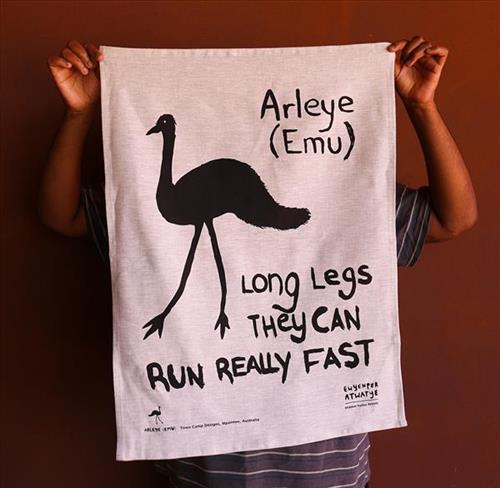
Status: Stock
Designed by Millie Abbott from Ewyenper Atwatye Artists
Available in Oatmeal, off-white and flax.
Town Camp Designs is a collection of products created by Ewyenper Atwatye, Tangentyere Artists and Yarrenyty Arltere Artists.
We are a 100% Aboriginal owned and run art centre. All sales directly support the artists, with all profit going towards artists fees and future projects.
Ewyenper Atwatye is the Central Arrernte place name for Hidden Valley, and the chosen name for the textile enterprise established by the community of Hidden Valley Town Camp in 2015. It is a satellite project of Tangentyere Artists. Each year, Tangentyere Artists run workshops in collaboration with the community, and out of these workshops new designs are released at Darwin Aboriginal Art Fair in August and Desert Mob in Alice Springs every September.
All Ewyenper Atwatye Artists’ products are ethically produced on high quality, natural fabrics. Sales directly support Ewyenper Atwatye, with the profit returning to artist fees and investment in future projects.
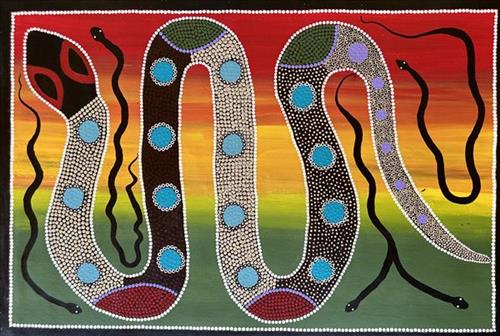
In our country we have snakes that live in the trees and they wait for flying foxes and birds to eat.
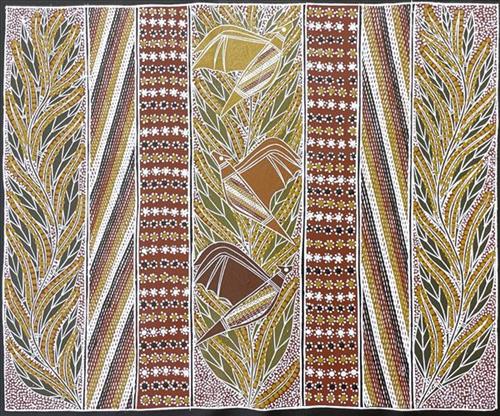
Back in the Creation time, Warrnyu (Flying Foxes) once lived, like men, in the cave at the place called Kurrki Warrnyu Yirri Djaringal (they also lived in caves called Wadatilmurr & Gurngurmirrngu). Warrnyu lived in these caves for many years and then one day Djanyarr (The Dog), an ancestral being in the form of a man, came along. He was looking around for a place to live. Djanyarr heard the sound of a Flying Fox screaming. He went down to the cliff and pushed the rock and the water came out at the Ganalbingu place called Gurrkawakarrmurr. He then went into the cave and into the sacred hole, frightening all the Flying Fox away. When he went into the hole he left his dilly bag in the tree and went out on the other side of the sacred cave and leaving his spear and woomera. He sat there for a long time. The Dog made three streams and the water went inside the cave. Two of these streams are good drinking water. In the middle it is a sacred water. No-one drinks from the middle of the stream. Children, men, women, young boys or girls are not allowed to drink from the middle of the stream. If they drink the water from the middle of the stream they will go grey too early.
At Kurrki Warrnyu Yirri Ngilaya Djaringal, the Flying Fox made himself into a young man… that’s what Aboriginal people do today. They have ceremonies and dances to make the young boys into men. The songs are called Yirrarwu, Gulumu, Rruburra and Burryun. Dhapi (initiation ceremony) happen today because the Warrnyu (Flying Fox) people performed them a long time ago before the Yolgnu people. It was the Warrnyu people who first performed circumcision of the young boys to make them into men. It all happened at Kurrki Warrnyu Yirri Ngilaya Djaringal, this is how this place got its name.
Leaving behind the cave at Kurrki Warrnyu Yirri Djaringal, the Dog travelled west across the Arafura Swamp and came to Djalkulmurr (Mount Delight). From there he travelled north and came to Dunganda (a hill situated a few kilometres east of Ramingining). There he met a female Dog, then they both headed north and came to a place called Garanydjirrmurr where they spoke the Mildjingi language. From Garanydjirrmurr they changed their direction and went west through Guliny’barra, Burgumara and onto the plains. When they reached the plains they smelled something cooking, way up in the north – at Wessel Islands. The aroma they smelt was so enticing that they decided to go there. Lungurrma (the north-east wind) was carrying the smell. One Dog headed north again, but the other Dog decided not to go with him and went back the opposite way. The first Dog that went to Malwanatharra (Sandy Point) went into the sea following its nose to wherever the smell was coming from. It is believed that this Dog still lives in the sea…
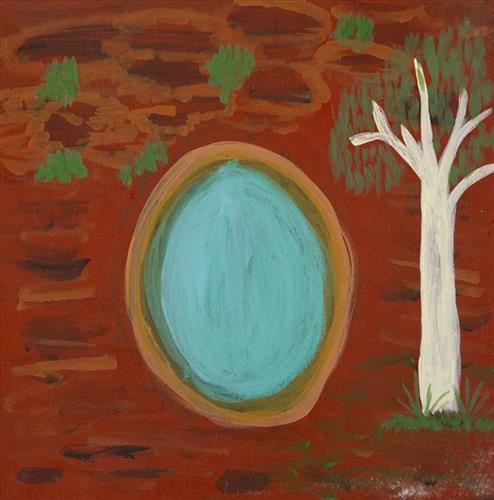
Parnngurr rockhole is located just south of Parnngurr Aboriginal community. At the junction of three linguistic groups; Manyjilyjarra, Kartujarra, and Warnman, it was a critical and permanent source of water during the pujiman (traditional, desert born) era that supported many ritual large gatherings. During this nomadic period families stopped and camped here depending on the seasonal availability of water and the corresponding cycles of plant and animal life on which hunting and gathering bush tucker was reliant. At Parnngurr and other similarly important camp sites families would meet for a time before moving to their next destination. Parnngurr and its surrounds are physically dominated by distinctively red tali (sandhills), covered sparingly with spinifex and low lying shrub.
The nearby Parnngurr Aboriginal community was created during the return to Country movement of the 1980s, and named after Parnngurr rockhole, its original primary water source. However, until recently the community was widely known as Cotton Creek, after the European name for the ephemeral creek running alongside the community.
Parnngurr is an important site chronicled in the epic Jukurrpa (Dreaming) story of the Minyipuru (Jakulyukulyu, Seven Sisters). The sisters stopped to rest on Parnngurr Hill before continuing on their long journey east. Minyipuru is a central Jukurrpa narrative for Martu, Ngaanyatjarra, Pitjantjatjara and Yankunytjatjara people that is associated with the seasonal Pleiades star constellation. Relayed in song, dance, stories and paintings, Minyipuru serves as a creation narrative, a source of information relating to the physical properties of the land, and an embodiment of Aboriginal cultural laws. Beginning in Roebourne on the west coast of Western Australia, the story morphs in its movement eastward across the land, following the women as they walk, dance, and even fly from waterhole to waterhole. As they travel the women camp, sing, wash, dance and gather food, leaving markers in the landscape and creating landforms that remain to this day, such as groupings of rocks and trees, grinding stones and seeds. During the entirety of their journey the women are pursued by a lustful old man, Yurla, although interactions with other animals, groups of men, and spirit beings are also chronicled in the narrative.
For many Martu, Parnngurr also signifies the location at which their nomadic bush life came to an end. It was here that a group of 29 Martu were picked up by the Native Welfare Department to be taken to Jigalong Mission in 1963. Collectively the group had come to the decision to move to the mission as a result of an extended drought, which had caused a scarcity in food and water resources. The group also wanted to join their families, who had already moved to Jigalong. Among them were Martumili artists Jakayu Biljabu, Kumpaya Girgirba, Bugai Whyoulter and Ngamaru Bidu.
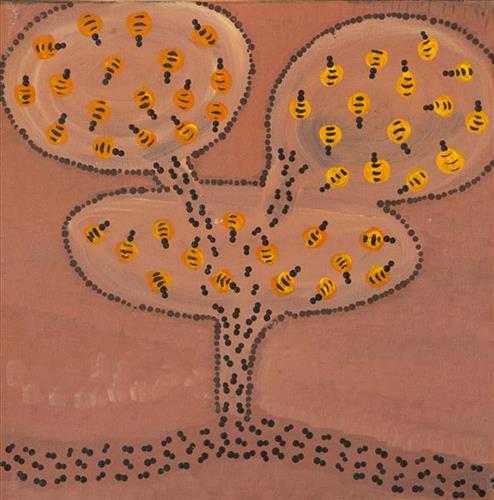
Wuukurta (honey ants) are found in a variety of arid or semiarid environments, with nests of up to two metres deep and more than two metres across. Wuukurta are a highly sought after bush tucker, known otherwise as ‘bush lollies’ due to their sweet, honey like taste. They are eaten whilst still alive by holding the head and legs between two fingers and biting off the thorax. Martu dig for wuukurta nests through the seasons, but they are known to be especially abundant following the rains.
During the pujiman (traditional, desert dwelling) period, Martu would traverse very large distances annually in small family groups, moving seasonally from water source to water source, and hunting and gathering bush tucker as they went. Whilst desert life has moved away from mobile hunter-gatherer subsistence throughout the course of the twentieth century, bush tucker continues to be a significant component of the modern Martu diet. Hunting and gathering bush tucker remains equally valuable as an important cultural practice that is passed on intergenerationally. Though hunting and gathering implements have been modernised, methods of harvesting, tracking and the use of fire burning to drive animals from their retreats are still commonly practiced today.
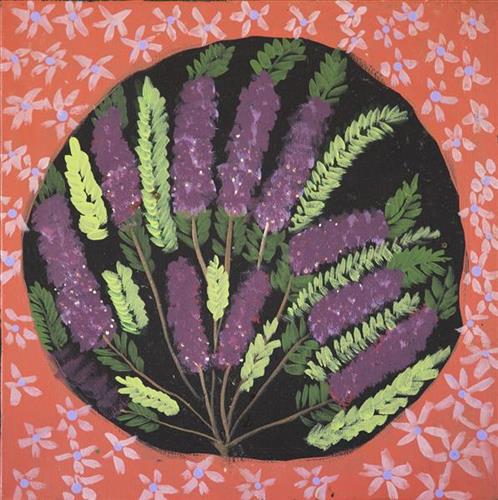
“It’s their home for them, real ngurra (home Country, camp). Real ngurra is where they been born and grow up.”
– Corban Clause Williams
The Western Desert term ‘ngurra’ is hugely versatile in application. Broadly denoting birthplace and belonging, ngurra can refer to a body of water, a camp site, a large area of Country, or even a modern house. People identify with their ngurra in terms of specific rights and responsibilities, and the possession of intimate knowledge of the physical and cultural properties of one’s Country. This knowledge is traditionally passed intergenerationally through family connections. Country for Martu is full of memory; not just the memory of their own movement through it, but also of their family. As summarised by Ngalangka Nola Taylor, “painting the ngurra, they do it to remember their connections.”
Painting ngurra, and in so doing sharing the Jukurrpa (Dreaming) stories and physical characteristics of that place, has today become an important means of cultural maintenance. Physical maintenance of one’s ngurra, like cultural maintenance, ensures a site’s wellbeing, and is a responsibility of the people belonging to that area.