Kayawa (baby floor mat)
Baby floor mat

Baby floor mat

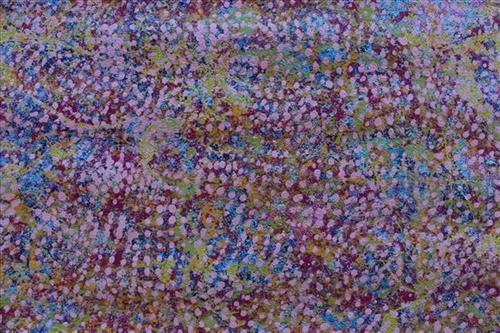
Springtime is a beautiful blending of colours in our country. After the rain all the wild flowers come up in a pattern like a puzzle. The artist often sponges her background using colours which include red, pink, yellow’s and orange. She painted over this background with her own unique style and bright colours. As in much aborigional art, the artist has represented her country from an aerial perspective.
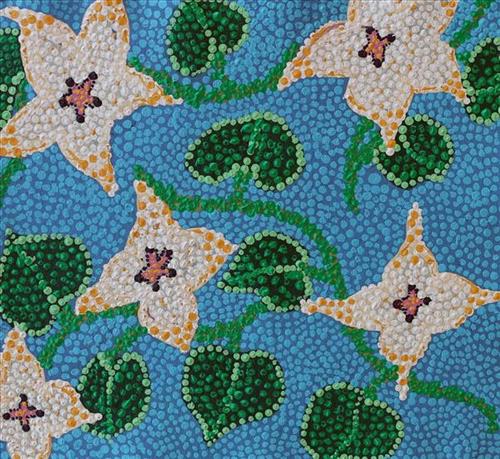
Millstream Lily pond is at the Millstream Homestead.The early settlers brought the water lilies with them and created a beautiful oasis with a large lily pond. This place is a significant site for the Yinjibarndi people and one they like to visit frequently.
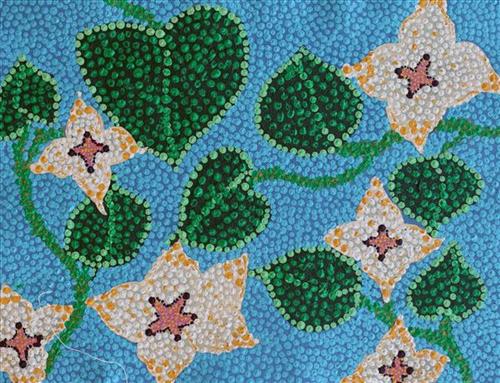
Millstream Lily pond is at the Millstream Homestead.The early settlers brought the water lilies with them and created a beautiful oasis with a large lily pond. This place is a significant site for the Yinjibarndi people and one they like to visit frequently.
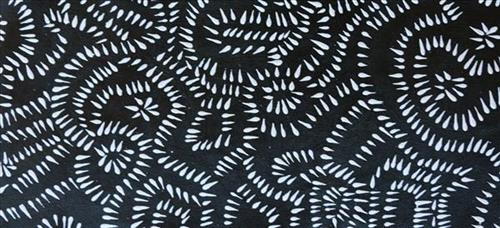
My Grandfather as a young man used to work on a station in a stockyard breaking in horses and bringing in cattle and sheep to the yard.After finishing this painting although being simple from my other design’s I was very happy to have thought of it because now I can say that I have done a painting with my loving Grandfather in mind.
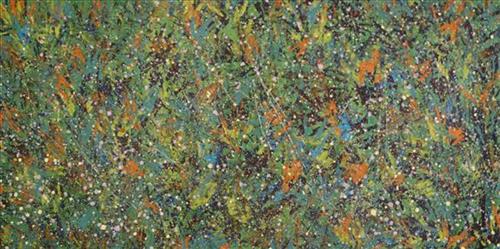
This painting represents the colours of the leaves during the autumn season. The leaves tend to lose their green color and turn into the beautiful yellows and oranges.
Moa Arts (Ngalmun Lagau Minaral) is an Indigenous-owned and operated art centre on Mua Island in the Torres Strait western cluster of islands. One of the primary aims of the art centre is to keep Muglal traditions of Zenadth Kes arts and culture strong for everyone through the production and sale of art.
The reputation of Moa Arts is built on the calibre of its limited edition lino-prints, etchings, weavings and island-style jewellery. Creative inspiration for these works comes from Mualgal ancestral stories, totemic representation and connections to sea, land, sky and family. Mua’s artists don’t have to look far to be inspired. The island and its surrounding waters and reefs hold a diverse set of land and marine ecosystems with niches for many rare and unique species such as dugong and sea turtle.
Art Centre notes:
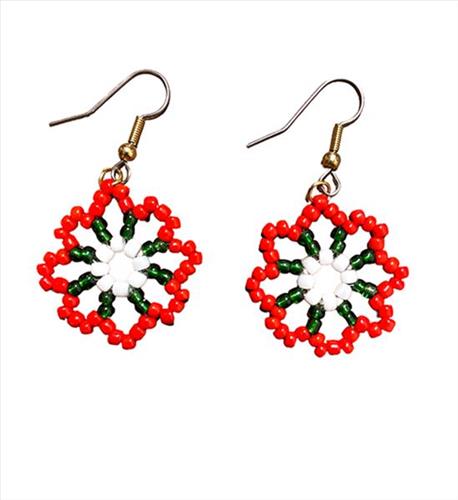
These earrings are made from glass beads and fishing line following traditional colour palettes. The findings are sterling silver.

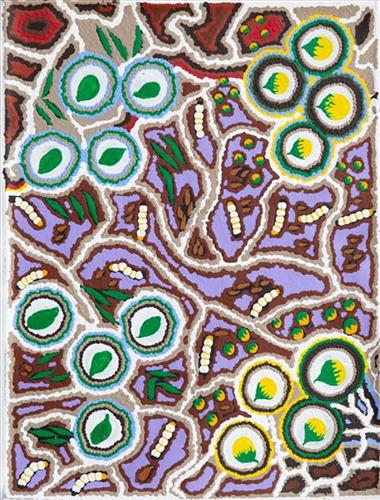
Depicted in this work are traditional types of bush tucker, their habitats, and their related hunting and gathering methods. During the pujiman (traditional, desert dwelling) period, Martu would traverse very large distances annually in small family groups, moving seasonally from water source to water source, and hunting and gathering bush tucker as they went. Whilst desert life has moved away from mobile hunter-gatherer subsistence throughout the course of the twentieth century, bush tucker continues to be a significant component of the modern Martu diet. Hunting and gathering bush tucker remains equally valuable as an important cultural practice that is passed on intergenerationally. Though hunting and gathering implements have been modernised, methods of harvesting, tracking and the use of fire burning to drive animals from their retreats are still commonly practiced today.
Typically, animals hunted for their kuwiyi (meat) include kirti-kirti (euro kangaroo) and marlu (plains kangaroo), parnajarrpa (sand goanna), kipara (Australian bustard, bush turkey) and karlaya (emu). Lunki (witchetty grub) and wuukurta (honey ants) are dug from tree and bush trunks, or from underground nests. Popular mayi (plant food) includes minyarra (bush onion), collected from small, grass like plants; root vegetables dug from underground such as kulyu and mata (types of bush potato); and seeds such as kalaru (samphire, salt bush), yuwinyji, and marnkalpa (spinifex species). Jawirli (quondong), wamurla (bush tomatoes), jinyjiwirrily (wild gooseberry), ngaputa (melon), and karlkula (bush banana) are some of the most popular bush fruits. These are often collected in the wantajarra (cool season) and tuulpara (spring) months, along with juri (sweet) botanical gums and wama (nectar), obtained from various plant species.
Traditional tools used for hunting and gathering bush tucker were carved from wanari (mulga), mulunturu (desert oak), yurungkura (river red gum) and mijarrpa (bloodwoods), and included kurlata (spears), jurna (hitting stick), karli (boomerangs), wana (digging-sticks), piti (timber bowls used for carrying food and water), and jiwa (grinding stones for grinding seeds into flour). While carved objects retain enormous social and ceremonial importance in Martu life, they are no longer used for hunting and gathering.

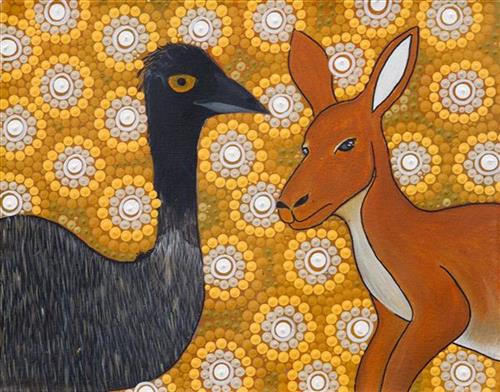
KARLAYA (EMU)
Depicted in this work are karlaya (emus); large, flightless birds endemic to Australia, and found across the whole country. Emus have been hunted by Martu people as a source of bush tucker from the pujiman (traditional, desert dwelling) era through to today. Typically emus were tracked using their distinctive jina (tracks, footprints). Acute skill in track observation and identification traditionally possessed by Aboriginal people developed directly in relation to their past hunter-gatherer existence, when survival depended in large part on the successful tracking of hunted animals. In the absence of an actual animal sighting, tracks act as an identifier that an animal was present, which were then followed to the animal’s location.
Once caught, the emu and its eggs were consumed, fat was harvested for several medicinal applications, bones were shaped into tools, feathers were used for adornment, and tendons substituted for string.
MARLU (KANGAROO)
Marlu (kangaroo) are one of the largest species that form part of the Martu diet, and are typically hunted by men on specific trips targeting major game. Marlu are prized not only for the high yield of meat which they represent, but also for the level of skill and stamina required to hunt them. When hunted, marlu are typically directed via fire and then tracked for a lengthy period of up to several hours. Effective hunting also relies on one’s knowledge of seasonal conditions and preferred foods and habitats. Traditionally, marlu were stalked and then speared. Today, marlu are generally hunted with rifles at the beginning of yalijarra (hot season), before the rains.
During the pujiman (traditional, desert dwelling) period, Martu would traverse very large distances annually in small family groups, moving seasonally from water source to water source, and hunting and gathering bush tucker as they went. Whilst desert life has moved away from mobile hunter-gatherer subsistence throughout the course of the twentieth century, bush tucker continues to be a significant component of the modern Martu diet. Hunting and gathering bush tucker remains equally valuable as an important cultural practice that is passed on intergenerationally. Though hunting and gathering implements have been modernised, methods of harvesting, tracking and the use of fire burning to drive animals from their retreats are still commonly practiced today.