
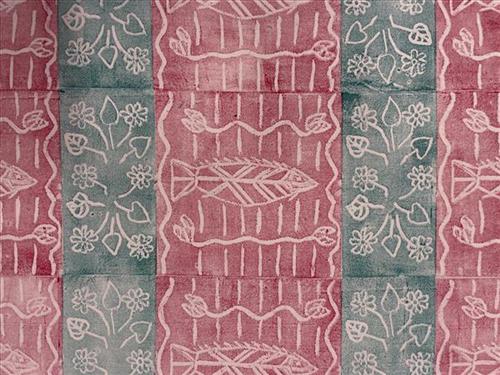

377810582231413
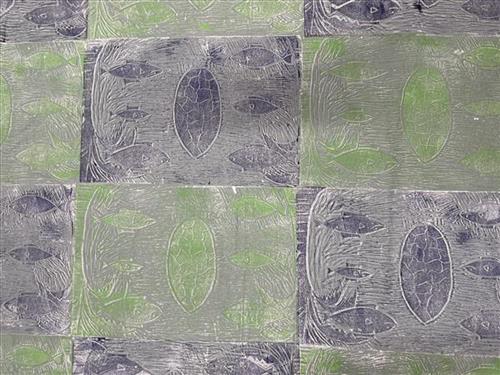
Yokkarra (fish), Ngaduna (palm tree) & Barruar (Seagull egg)
‘Hi it’s me Marilyn! I’m the age of 52. I like working at the women centre and doing lino printing but I prefer screen printing. I have one design, that’s lorrkkon (hollow log). My great grandfather used to make lorrkkon and do bark paining. I never met him but I heard a lot of stories about him. My mother used to tell me history stories. When I was 16 my parents passed away. I’m was on my own but now I’ve got my own family and my partner who helps me. I’ve got 6 grandchildren.
My homeland is Entrance island, Haulround island and Juda point. I really like Haulround island and that’s where we collect barruar (seagull egg). Entrance island is my favourite camping area, I go across with boat. Balanda (non-Aboriginal or European people) can’t go into those islands or Juda point without permission from me.
Come and chat to me if you want to go to any of those places. We have a sacred totem ngaduma (palm tree) at those places and if people destroy it, we will have a strong wind and maybe a cyclone.’
Marilyn James 2021

377810582231406
Ngalyod
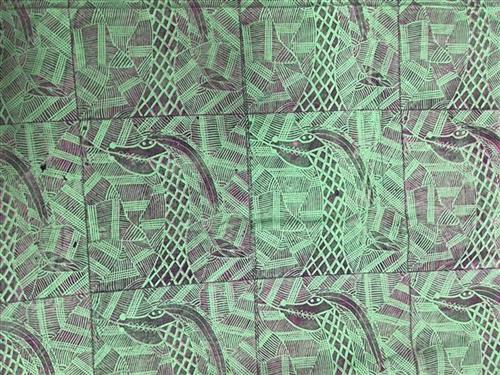
Ngalyod (Rainbow serpent)
Rainbow spirit coming from billabong.
Rainbow serpent dreaming. Coming from billabong, that place we call billabong where that ngalyod (rainbow serpent) lives.
All that wayuk (waterlily), all them kundalk (grass) and pandanus, making skirt.
That’s the story now. – Jennifer Wurrkidj
Rainbow serpent, daughter of the Mother One Rainbow Yingarna. The rainbow serpent is a central figure in traditional Bininj religion. She is the creator of places and is active during the wet season and is asssociated with rain and bodies of water. Rainbow serpents live in deep waterholes and rivers. Marrkidjbu are able to discern their presence and control them.’
Source – https://www.njamed.com/

377810582231405
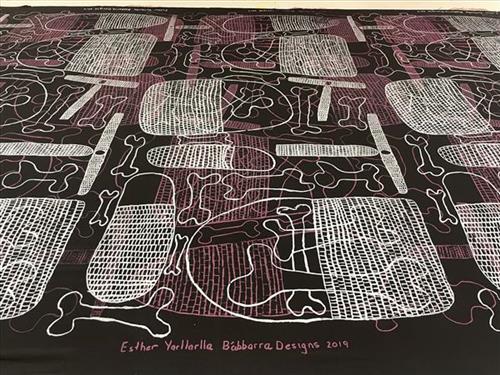
Mardarda and Njarlarla (Bones and Fire Sticks)
Designed 2019
In Esther’s first screen design, she depicts the story of Mardarda (bones) and Njarlarla (fire sticks) carried in a dilly bag, reminiscent of traditional ways of the Ndjebenna people.
‘Back in the old days, our people would use a ‘bush lighter’ for lighting fires, which was two pieces of special wood which would make fire easily. The old people carried a dilly bag containing the fire stick all times, when they moved camps.
Old people would always carry dilly bags, sometimes with water, honey, food or bones of our deceased people.
When someone passed away their body would be put on a high platform built from eucalyptus and paperbark. They would use a firestick to light a fire under the platform, and people would sing and dance around that platform to send the deceased’s spirit back to his or her country.
The body would then be left here for many months. When ready, the clan would return to collect the bones to take them back to the deceased’s homeland for burial.
To travel to the homeland, people would paint the bones with brown ochre and place them in a dillybag. When they reached the deceased’s homeland, people would sing together, place the bones in the lorrkkon and to leave them rest forever.”

377810582231403
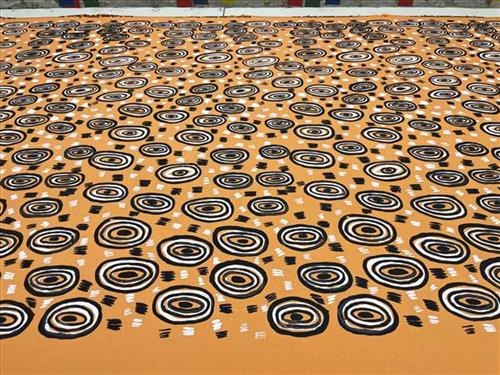
Dabuno (Brolga Eggs)
Emily’s first design depicting Dabuno (Brolga Eggs). Emily is the younger sister of renowned Maningrida artists, Jennifer Wurrkidj and Deborah Wurrkidj.
This fun design is an all over repeat or spot design that can be used for fashion or soft furnishing projects.

377810582231402
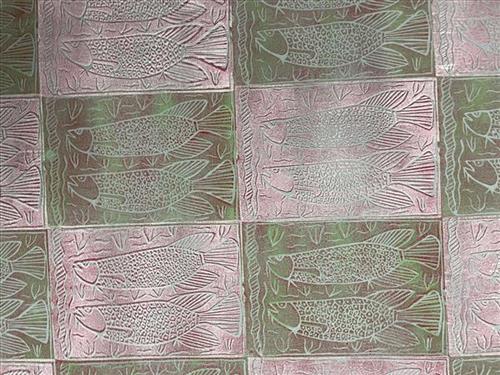
Ngaldadmurrng (Saratoga)
This design tells the story of Saratoga dreaming, a freshwater fish that swims on the edge of creeks and rivers. This design is the Saratoga dreaming from the Mularra songline. Where the Saratoga we call Murdulngu, Danguny travelled from Malmyangarnak billabong to Mirrigatja.
This Billabong was owned by Murdulngu (Saratoga) before the water was taken over by shark Barlangu he came all the way from east to north then to west. He was travelling when that water level was high he went up the stream but he couldn’t make it. This Barlangu came from Murruggun clan but really this shark came from long way all the way south. This story is connected through Mularra songline it represents many clans.
With permission from clan elders, Carol is able to pass on this family knowledge through her passion in textile and art.
‘I am proud of my first design, I want to keep this design for future, for my children and grandchildren so they remember this story, this story is a big part of the mularra songline’ Carol Liyawanga Campion

377810582231400
Dabuno (Brolga Eggs)
Emily’s first design depicting Dabuno (Brolga Eggs). Emily is the younger sister of renowned Maningrida artists, Jennifer Wurrkidj and Deborah Wurrkidj.
This fun design is an all over repeat or spot design that can be used for fashion or soft furnishing projects.
359709482228516
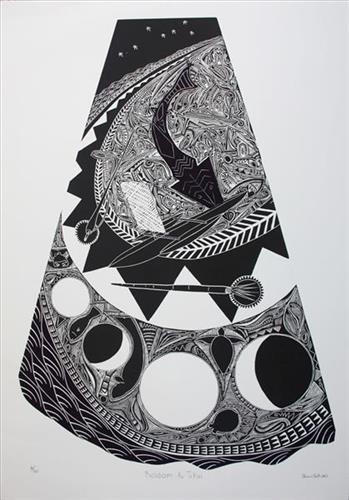
Baidam Au Titui 2012
From the time of our forefathers, astrology has always been a significant factor in our existence in Zedath Kes (Torres Strait).
The constellation depicted in my artwork is taught from our forefathers as the Baidam Au Titui. This constellation only appears in ours skies for six months of the year from April-November. It is used as a seasonal calendar to guide the hunting of traditional seafood and acts in sync with the phases of the moon.
Also depicted is a dugong platform called a noat (sea-going mat-sail canoes), harpoons were once used by our ancestors as traditional methods when hunting for dugong. I have also shown my totem, the shovel-nose shark.
With printmaker: Andrew Sinclair
115682230930
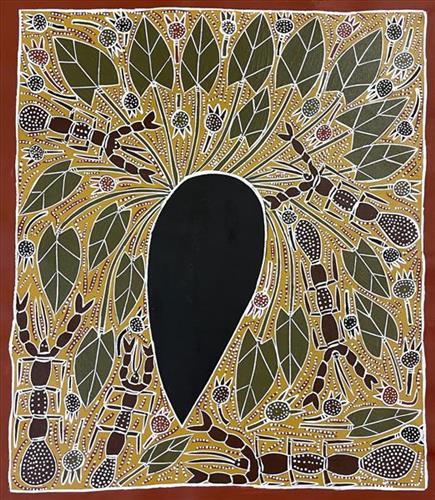
Baltji (Yam)
This painting depicts Baltji (Yam) which has been a reliable food source for Yolngu people for many centuries. Baltji can be found across the different landscapes of East Arnhem Land and are only harvested seasonally.
115682231074
JB Fisher – Narrgi’ṉarrgi (possum- sugar glider)
JB paints stories from his Dhuwa homeland in northeast Arnhem Land. Stories are passed on either paternally or maternally, and JB would have learnt these stories from his ancestors. The cross-hatching style is a traditional painting style of this area and can represent elements such as water, air and wind.
His paintings often feature totemic animals of the fresh waters of north east Arnhem Land.