111982230949


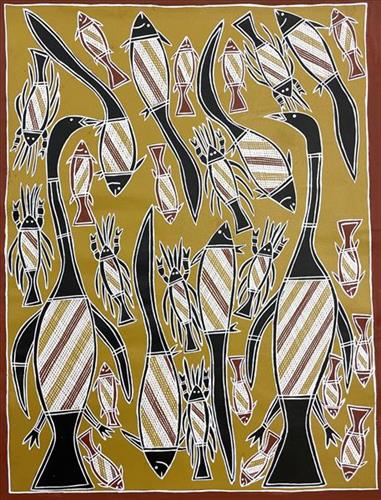
Kunkale Wobe (Fishtrap Fence)

In the past, people made kunkarlewobe (stick fence fish trap) at a place called Kukadjdjerre. There’s a little fish there called ngadjbel (mouth almighty) that would travel far up the river and bring back all the larger fish: bilmu (barramundi), barrhmanj (saratoga) and bikkurr (catfish). When there were no fish, people would do a painting of ngadjbel on a tree behind the fence, leave it overnight, and the next morning there would be plenty of fish. As custodians for Kukadjdjerre, wurum (fish-increasing spirits) look after the area and also call out for fish when people ask.

115682230931


Burala (Diving Ducks]

This painting depicts diving ducks, both realistically and symbolically. A particular clan group uses the object in the painting during a hollow log ceremony (traditional funeral ceremony). The rrark (cross hatching) is the water. One group will perform the catfish dance whilst another performs as diving ducks. The object is whirled above the head to make a noise that emulates the ducks “roar”. The dance crescendos into the catfish coming closer to the diving ducks allowing them to eat the catfish in a frenzy.


377810582230826


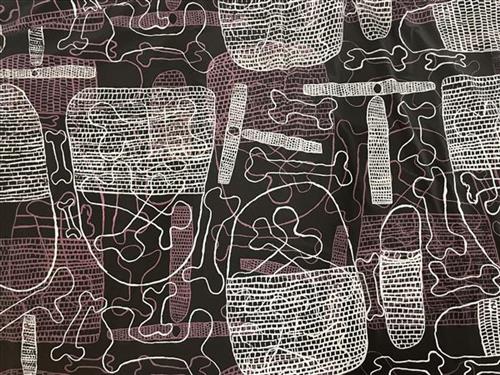
Mardarda and Njarlarla (Bones and Fire Sticks)

Cotton jersey (stretch)

In Esther’s first screen design, she depicts the story of Mardarda (bones) and Njarlarla (fire sticks) carried in a dilly bag, reminiscent of traditional ways of the Ndjebenna people.

‘Back in the old days, our people would use a ‘bush lighter’ for lighting fires, which was two pieces of special wood which would make fire easily. The old people carried a dilly bag containing the fire stick all times, when they moved camps.

Old people would always carry dilly bags, sometimes with water, honey, food or bones of our deceased people.

When someone passed away their body would be put on a high platform built from eucalyptus and paperbark. They would use a firestick to light a fire under the platform, and people would sing and dance around that platform to send the deceased’s spirit back to his or her country.

The body would then be left here for many months. When ready, the clan would return to collect the bones to take them back to the deceased’s homeland for burial.

To travel to the homeland, people would paint the bones with brown ochre and place them in a dillybag. When they reached the deceased’s homeland, people would sing together, place the bones in the lorrkkon and to leave them rest forever.”
377810582230824


Mardarda and Njarlarla (Bones and Fire Sticks)

Cotton jersey (stretch)

In Esther’s first screen design, she depicts the story of Mardarda (bones) and Njarlarla (fire sticks) carried in a dilly bag, reminiscent of traditional ways of the Ndjebenna people.

‘Back in the old days, our people would use a ‘bush lighter’ for lighting fires, which was two pieces of special wood which would make fire easily. The old people carried a dilly bag containing the fire stick all times, when they moved camps.

Old people would always carry dilly bags, sometimes with water, honey, food or bones of our deceased people.

When someone passed away their body would be put on a high platform built from eucalyptus and paperbark. They would use a firestick to light a fire under the platform, and people would sing and dance around that platform to send the deceased’s spirit back to his or her country.

The body would then be left here for many months. When ready, the clan would return to collect the bones to take them back to the deceased’s homeland for burial.

To travel to the homeland, people would paint the bones with brown ochre and place them in a dillybag. When they reached the deceased’s homeland, people would sing together, place the bones in the lorrkkon and to leave them rest forever.”
377810582230822


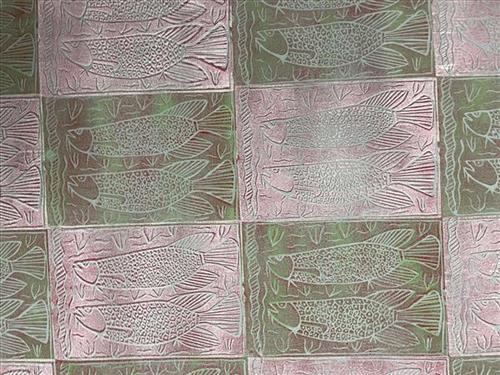
Ngaldadmurrng (Saratoga)

This design tells the story of Saratoga dreaming,  a freshwater fish that swims on the edge of creeks and rivers. This design is the Saratoga dreaming from the Mularra songline. Where the Saratoga we call Murdulngu, Danguny travelled from Malmyangarnak billabong to Mirrigatja.

This Billabong was owned by Murdulngu (Saratoga) before the water was taken over by shark Barlangu he came all the way from east to north then to west. He was travelling when that water level was high he went up the stream but he couldn’t make it. This Barlangu came from Murruggun clan but really this shark came from long way all the way south. This story is connected through Mularra songline it represents many clans.

With permission from clan elders, Carol is able to pass on this family knowledge through her passion in textile and art.


‘I am proud of my first design, I want to keep this design for future, for my children and grandchildren so they remember this story, this story is a big part of the mularra songline’ Carol Liyawanga Campion