22024001582


Status: Stock


Puli Puli Pencil Box

Keturah depicts the puli puli (rocks) at two different sites: the landscapes at Haasts Bluff and also Karrkurrutintja (Lake McDonald). Keturah depicts her childhood memories of both places.
“The sand hills I paint are my mother’s story and the rocks I paint are my own story. My paintings are about my story and my mother’s. When I look at my paintings I feel happy. My Grandmother used to say to me when I was younger: “One day you will paint.”

22024001062


Status: Stock


Bushfire Salad Bowl

This bowl is part of the fair trade relationship between Better World Arts and Ikuntji Artists.

About the Artwork

This painting is about three massive bushfires that burned parallel to each other, across the landscape scarring the land. It started at Warlungurru, near Kintore.

Better World Arts has been operating for over two decades.

They work with traditional artisans from remote regions in Kashmir, Peru, West Bengal, Uttar Pradesh and Nepal (Tibetan refugees). They work with Australian Aboriginal artists from remote communities across Australia, from Arnhem Land to Central and the Western Desert regions, from rural locations and from cities.

Better World Arts are endorsed members of the Fair Traders Association of Australia and New Zealand.

22024000720


Status: Stock


Puli Puli Magnetic Bookmark (Plastic)

This beautiful magnetic bookmark features work by Keturah Zimran, and has been made with our ethical partners, Better World arts.

22024000715


Status: Stock


Watiya Tjuta Extra Large Wool Rug (152x244cm) – Black on White

Watiya (tree) Tjuta (many) is the artist’s iconic rendering of her late father’s Tjukurrpa (Dreaming). In this design, the artist depicts the ceremonial spear straightening in Uwalkari country (Gibson desert region). The spear straightening is part of restricted men’s business. Mitjilli was given the right to depict the source of the spears by her father, however, the ceremony cannot be revealed in her works. Uwalkari is abundant with Watiya Tjuta and other plants that grow in a landscape dominated by sandhills. Mitjilli came from an acclaimed family of artists and the imagery of Watiya Tjuta is a recurring motif in her artwork. 

22023999624


Status: Stock


Watiya Tjuta Coaster Set

Beautiful set of lacquerware coasters made by Better World Arts, featuring ‘Watiya Tjuta’ by Mitjili Napurrula.

Artwork Story:

‘Watiya Tjuta’

Napurrula’s father, Tupa Tjakamarra gave her the right to paint works related to Ilyingaungau in the Gibson Desert. This site, south of Walungurru (Kintore), some 520 kilometres west of Mparntwe (Alice Springs), is where the artist’s Mutikatjirri ancestors assembled their kulata (spears) for a conflict with the Tjukula men. Allusive works that refer to the straightening of kulata by Tjupurrula are among the landmark paintings of the Ikuntji Artists movement’s 30-year history.

The paintings of Napurrula and her husband, Long Tom Tjapanangka, have come to be understood as archetypical of Ikuntji art since they began to work with the arts centre in 1993. Napurrula remembers, ‘ … After I got married, my mother taught me my father’s Tjukurrpa in the sand, that’s what I’m painting on the canvas’. The white pigment eddies around abstract forms that refer to the spearwood trees. The tightly structured patterning of the key motifs and bold use of colour demonstrates the artist’s confidence in her individual artistic vision within a family of superlative artists – and the cultural heritage that continues to inform the myriad expressions of Western Desert artists.


220982352302


Dakota Ngwarraye Petrick – Mwanyen (Bush Tomato)

My twin sister Latoya and myself have just started painting bush flowers.  Our grandmother Elizabeth Ngwarraye Bonney shows us the good way.

This is the first time I have ever printed using a lino carving.  I did the mwanyen (bush tomato) plant because it is sweet tasting fruit that we find in creek beds after the rain.

111582396122


Untitled

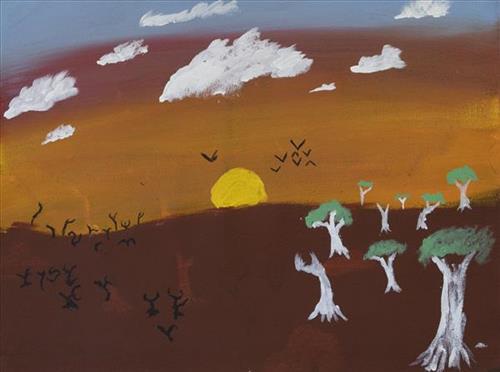
This work portrays an area known to the artist, painted here from memory. During the pujiman (traditional, desert dwelling) era one’s survival depended on their intimate knowledge of the location of resources; thus physical elements of Country, such as sources of kapi (water), tali (sandhills), and different varieties of warta (trees, vegetation) were carefully observed and remembered. Today, this relationship with Country remains equally strong, despite the movement of Martu out of the desert and into remote Aboriginal communities, towns and cities.

Also visible may be traces of life cycles based around kalyu (rain, water) and waru (fire). A thousands of year old practice, fire burning continues to be carried out as both an aid for hunting and a means of land management today. As the Martu travelled and hunted they would burn tracts of land, ensuring plant and animal biodiversity and reducing the risk of unmanageable, spontaneous bush fires. The patchwork nature of regrowth is visible in many landscape works, with each of the five distinctive phases of fire burning visually described with respect to the cycle of burning and regrowth.  

Finally, metaphysical information relating to a location may also be recorded; Jukurrpa (Dreaming) narratives chronicle the creation of physical landmarks, and can be referenced through depictions of ceremonial sites, songlines, and markers left in the land.