377810582217542


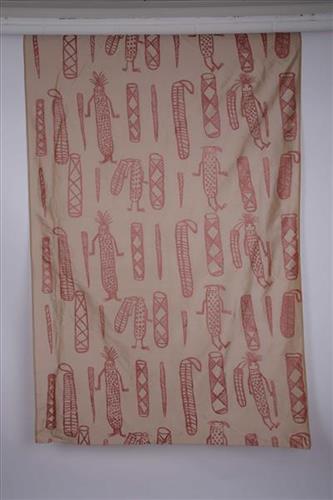
Bawáliba (Stone Country Mimih)

‘Bawáliba is the djang (Dreaming) of my mother and my uncles. They are good spirits, they protect us and they recognise families. They are really tall- just like human beings, like us. They dance late at night and have a lot of hair.

In olden times, long long long time ago Bawáliba were here, before people were on the land. Bawáliba used to go out hunting and care for country. They hunt carrying fish traps and digging sticks, near the homeland Djinkarr. They go out hunting on the floodplains with dilly bags and digging sticks. They collect a lot of bush foods, and sleep together with one bark shelter.
Sometimes now they still come alive when we sleep, they might come to our houses and peep through the window. At night, they cover themselves with white clay and red cloth tied around their waist. If we hear them, we jump out of bed and get up to look -but they have disappeared, they’re just too quick. Bawáliba might knock on the window to remind us they are there looking out for us.If you listen deeply you can hear them whisper, sometimes they talk about us and might say, ‘why are those people making camp here?’ then they realise ‘Oh they are family from here, it’s ok, they are just sleeping here for the night’.

During the day they always turn into stone and they sleep. We still know that green rock covered in moss near Djinkarr, that’s Bawáliba sleeping.
Some of my ancestors used to speak the same language as the Bawaliba, but all those old people are passed away now. It’s a little bit sad for us, because no one now can speak that Bawaliba language anymore.’ Lucy Yarawanga 2019

377810582217538


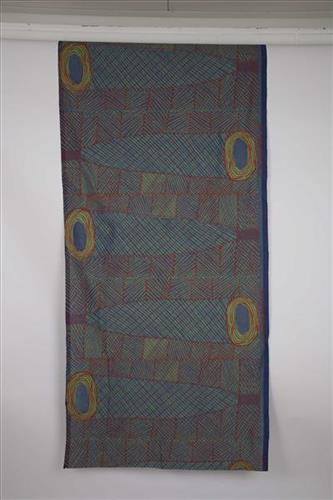
Mandjabu (Fish Trap) – Helen Lanyinwanga

In old times people would make these mandjabu (fish traps) to go fishing. They are made with vine we find in the jungle. That old man, Anchor [Gulunba], he showed me how to make these fish traps. I would sit there and watch him making them. We catch barramundi, catfish, all kinds of fish.

Helen Lanyinwanga

Kuninjku people traditionally make two sorts of conical fish traps. One is called mandjabu and is made from a strong, durable vine called milil, and a smaller one is called manylik mandjabu, and made from the grass manylik. The mandjabuconical fish trap is bigger and stronger and used in tidal reaches of creeks to catch large fish. The smaller, lighter manyliktrap is used in freshwater flowing creeks to catch smaller fish and freshwater prawns. In earlier times, only men were involved in the construction of the large fish traps, but children would often crawl inside and assist.

To make mandjabu, weavers firstly harvest milil (burney vine, Malaisia scandens) and put it in water overnight to make it soft. Then they start weaving it; they make rings for the inside to keep the fish trap’s shape. People also make string from the bark of burdaga (kurrajong) to attach the bardainy (hibiscus) rings and to tie the conical end of the fish trap. It’s hard work and it can take three or four weeks to make a fish trap. People also use fish-net fences called kunkarlewabe. They would put the kunkarlewabe  across rivers and creeks. In the middle they would place the mandjabu. They also used small things like sticks, rocks, mud and grass to block the fish from going through. This way we would catch fish such as saltwater barramundi rajarra, ngaldadmurrng (freshwater barramundi), small black freshwater catfish (buliya), bonefish (an-guwirrpiya), and sand bass (dalakan) in the mandjabu.

377810582217535


River and Rocks

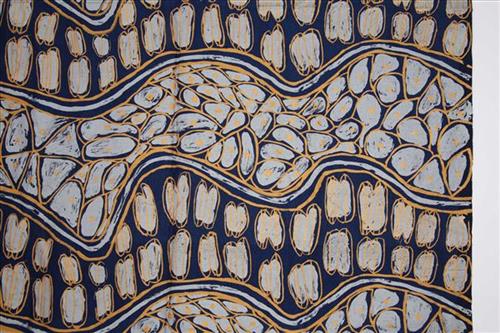
“This river we call Mangabo. It is near Gudjarrngarrl homeland of my daughters, Deborah and Jennifer Wurrkidj. We cross that river when travelling to Munmoy outstation. In the wet season, that water comes up and covers over those rocks, and when you look down there are rocks all under the water.” 

– Helen Lanyinwanga

377810582217526


Kunngol (cloud)

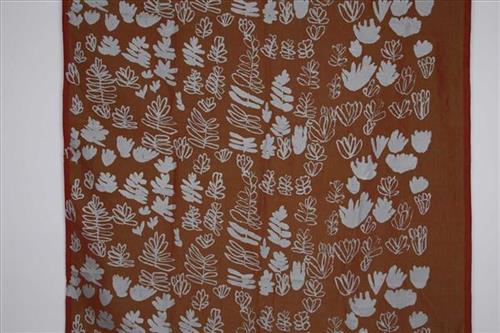
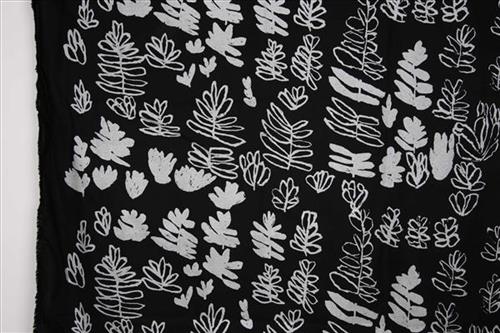
This design depicts certain Kunngol (cloud) that signal to people of central Arnhem Land that the end of the wet season is approaching. After months of daily monsoonal rain in Arnhem Land, these clouds are light and fluffy, not like the dark, heavy clouds of the monsoonal sky. At the time of the kunngol clouds, people know the country will soon dry up and the cold season (dry season) will arrive. When the kunngol clouds appear, all of the billabongs are already filled, the rivers are high and the country is brimming with life and fresh new growth after months of fresh water pouring from the sky.

377810582217522


Kunngol (cloud)

This design depicts certain Kunngol (cloud) that signal to people of central Arnhem Land that the end of the wet season is approaching. After months of daily monsoonal rain in Arnhem Land, these clouds are light and fluffy, not like the dark, heavy clouds of the monsoonal sky. At the time of the kunngol clouds, people know the country will soon dry up and the cold season (dry season) will arrive. When the kunngol clouds appear, all of the billabongs are already filled, the rivers are high and the country is brimming with life and fresh new growth after months of fresh water pouring from the sky.

111982217515


Jima Jima (Waterlily)

Jimi jima is one of Tommy Gondorra Steele’s personal dreamings. It is similar to what is commonly known as a waterlily (monochoria australasica). Jimi jima is mainly associated with a waterhole named Yalija, but also other sacred waterholes in the Wurdeja area. Tommy’s painting of jima jima depicts the lily as it exists naturally in wet water areas at Wurdeja. They have an edible root, which is brownish and bitter when raw, but once roasted on coals it is deliciously sweet. They are only found in sacred waterholes in the Wurdeja area, including Yalija, and humans and spirits live off them. They are a bright blue flowering plant.

Tommy Gondorra Steele is the last male member of the Garnawula Niya clan. He lives at Wurdeja outstation, about four kilometres east of the Blyth River. He is the traditional owner of that area. Wurdeja is surrounded by a series of sacred waterholes and it is these waterholes, which provide the subject matter for Steele’s art.

377810582217513


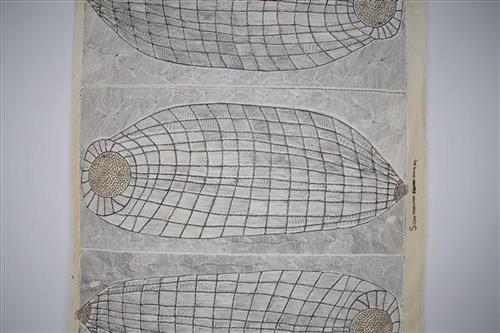
Mandjabu (Fish Trap) – Susan Marawarr

“In old times people would make these mandjabu (fish traps) to go fishing. They are made with vine we find in the jungle. That old man, Anchor Gulunba, he showed me how to make these fish traps. I would sit there and watch him making them. We catch barramundi, catfish, all kinds of fish.” – Helen Lanyinwanga

Kuninjku people traditionally make two sorts of conical fish traps. One called mandjabu made from a vine called milil, and another smaller one called manylik mandjabu, made from the grass manylik. The mandjabu conical fish trap is bigger and stronger and used in tidal reaches of creeks to catch large fish. The smaller, lighter manylik trap is used in freshwater flowing creeks to catch smaller fish and freshwater prawns. Traditionally, only men were involved in the construction of the large fish traps, but children would often crawl inside and assist.

To make fish traps and fish net fences artists firstly get vine (milil) from the jungle and they put it in water for one night to make it soft. Next they start weaving it; they make rings for the inside to keep the fish trap’s shape. Artists work for three or four weeks on the fish trap. They also make string from kurrajong (burdaga) to attach the hibiscus (bardainy) rings and to tie the conical end of the fish trap. This fish trap is used in saltwater and freshwater. People also use fish net fences called mun-dirra. A long time ago they would put the mun-dirra across rivers and creeks. In the middle they would place the an-gujechiya. They also used small things like sticks, rocks, mud and grass to block the fish from going through. People would then catch fish like saltwater barramundi rajarra, freshwater barramundi (janambal), small black freshwater catfish (buliya), bonefish (an-guwirrpiya), and sand bass (dalakan) in these fish traps.

111982217512


Bark Painting

Aboriginal bark paintings have a long cultural tradition, believed to extend back many thousands of years.
In northern Australia, paintings on bark shelters in the Kimberley and Arnhem Land were stylistically similar to rock shelter paintings. The Aboriginal bark paintings were used to convey and illustrate stories which were told to the clan when holed up in the shelter for long periods in the wet season. In Kimberly, the Aboriginal bark paintings by Lily karadada resemble ancient rock art Wandjina paintings which are themselves many, many thousands of years old.

Bark paintings with deep cultural and ritual significance still feature in the Aboriginal sacred ceremonies of northern Australia and they, along with some coastal inhabitants are the only indigenous Aborigines still making traditional bark paintings.

The process of making a bark painting begins with choosing a suitable stringybark eucalyptus tree, preferably in the wet season when the sap is rising and the bark is fairly supple and easy to grip. After finding a section of bark that is devoid of knots and termite damage, cuts are made top and bottom and after some encouragement by tugging and prying, a hollow open cylinder of bark is removed. The bark sheet is trimmed and a fire made ready, over which the bark will be cured to drive out any moisture. The bark is then flattened to the ground with feet and then held down with heavy weights to ensure that it doesn’t curl or warp.

The Aboriginal bark painters of Arnhem Land adhere to four basic pigments – red, black, white and yellow. The reds and yellows come from ochres, crushed and powdered rocks. White comes from pipeclay and black generally comes from charcoal. Sometimes natural fixatives are mixed in to bind the pigments and which includes wax, yolk of eggs, resins and the sap of orchid plants. The paint can then be applied to the bark with perhaps a rarrk design by using a wood comb, or with brushes made from human hair or even feathers.

111982217510


Bark Painting

Aboriginal bark paintings have a long cultural tradition, believed to extend back many thousands of years.
In northern Australia, paintings on bark shelters in the Kimberley and Arnhem Land were stylistically similar to rock shelter paintings. The Aboriginal bark paintings were used to convey and illustrate stories which were told to the clan when holed up in the shelter for long periods in the wet season. In Kimberly, the Aboriginal bark paintings by Lily karadada resemble ancient rock art Wandjina paintings which are themselves many, many thousands of years old.

Bark paintings with deep cultural and ritual significance still feature in the Aboriginal sacred ceremonies of northern Australia and they, along with some coastal inhabitants are the only indigenous Aborigines still making traditional bark paintings.

The process of making a bark painting begins with choosing a suitable stringybark eucalyptus tree, preferably in the wet season when the sap is rising and the bark is fairly supple and easy to grip. After finding a section of bark that is devoid of knots and termite damage, cuts are made top and bottom and after some encouragement by tugging and prying, a hollow open cylinder of bark is removed. The bark sheet is trimmed and a fire made ready, over which the bark will be cured to drive out any moisture. The bark is then flattened to the ground with feet and then held down with heavy weights to ensure that it doesn’t curl or warp.

The Aboriginal bark painters of Arnhem Land adhere to four basic pigments – red, black, white and yellow. The reds and yellows come from ochres, crushed and powdered rocks. White comes from pipeclay and black generally comes from charcoal. Sometimes natural fixatives are mixed in to bind the pigments and which includes wax, yolk of eggs, resins and the sap of orchid plants. The paint can then be applied to the bark with perhaps a rarrk design by using a wood comb, or with brushes made from human hair or even feathers.

377810582217509


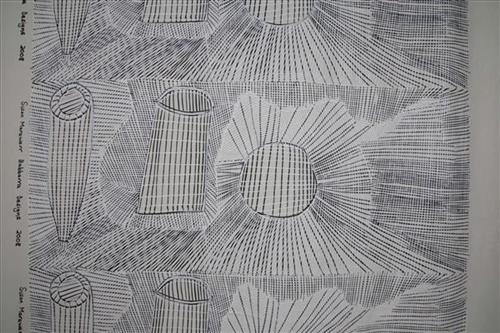
Ka-milemarnbun (Weaving Story)

The Kuninjku term ka-milemarnbun refers to the weaving and production of goods from pandanus leaves and natural fibres. This design specifically depicts the fish trap, basket and pandanus mat.

These three objects and ancestral spirits are significant to the artist as together they relate to her djang (dreaming). Fish traps are woven by hand using the milirl (burney vine, Trophis scandens) from the jungle, which is soaked overnight to make it soft. Fish traps are used by both saltwater and freshwater hunters. Billy-can baskets and pandanus mats are made from pandanus leaves, which are collected using long hooks, stripped, dried, boiled in natural dye, then woven.