377810582213916


Mimih Dancing

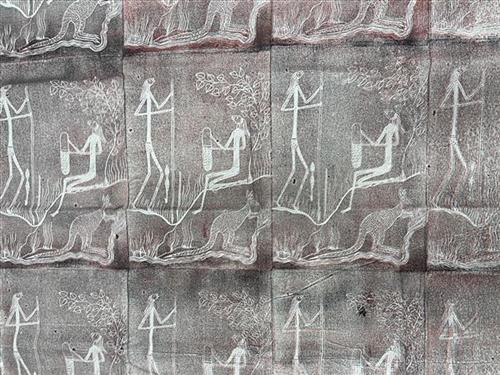
This is an artwork about a dancing Mimih. It’s based on a song line from Korlobididah. My fathers eldest brother used to sing this song line and Unkle Dennis he was a dancer. My real father, Jacky was a dancer as well and he was from Korlobididah.


377810582213855


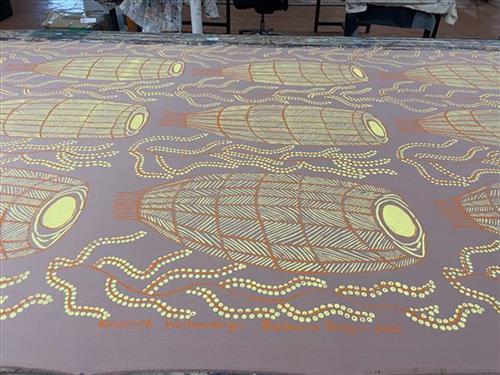
Au-gujechiya (fishtrap)

Au-gujechiya (fishtrap) sometimes portrayed with an-maka (cowtail stingray), rajarra (barramundi) and other fish inside. 

Elizabeth has permission from her djunkay to draw this historic and important object traditionally used to trap fish in rivers, creeks and estuaries. In the early wet season they swim upstream for breeding in creeks and billabongs, then downstream to spend the dry season in larger rivers. The traps would be set to face the oncoming fish, with woven fencing either side. Within the mouth of the trap is a woven funnel that guides the fish in and prevents their escape. The clever design ensures that only adult fish are caught as smaller fish can escape through the weaving or even through the funnel. The fish that are caught can survive in the trap for up to two months. Once the trap is removed, the end is untied to remove the fish. This sustainable design means the trap can be used again and again.


Elizabeth is from the Burrarra language group and her homeland is Gupanga, Arnhem Land.  

377810582213853


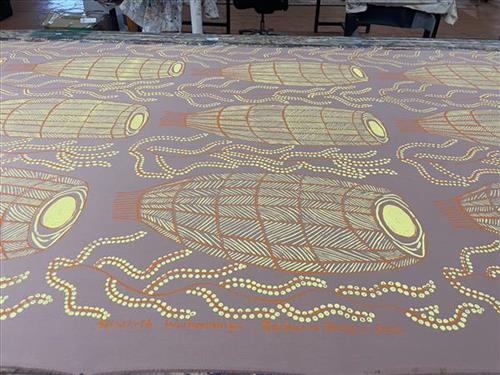
Au-gujechiya (fishtrap)

Au-gujechiya (fishtrap) sometimes portrayed with an-maka (cowtail stingray), rajarra (barramundi) and other fish inside. 

Elizabeth has permission from her djunkay to draw this historic and important object traditionally used to trap fish in rivers, creeks and estuaries. In the early wet season they swim upstream for breeding in creeks and billabongs, then downstream to spend the dry season in larger rivers. The traps would be set to face the oncoming fish, with woven fencing either side. Within the mouth of the trap is a woven funnel that guides the fish in and prevents their escape. The clever design ensures that only adult fish are caught as smaller fish can escape through the weaving or even through the funnel. The fish that are caught can survive in the trap for up to two months. Once the trap is removed, the end is untied to remove the fish. This sustainable design means the trap can be used again and again.


Elizabeth is from the Burrarra language group and her homeland is Gupanga, Arnhem Land.  

377810582213852


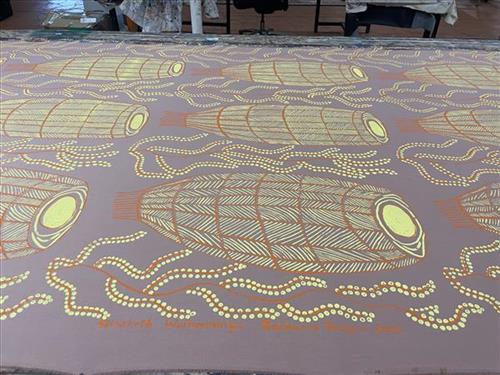
Au-gujechiya (fishtrap)

Au-gujechiya (fishtrap) sometimes portrayed with an-maka (cowtail stingray), rajarra (barramundi) and other fish inside. 

Elizabeth has permission from her djunkay to draw this historic and important object traditionally used to trap fish in rivers, creeks and estuaries. In the early wet season they swim upstream for breeding in creeks and billabongs, then downstream to spend the dry season in larger rivers. The traps would be set to face the oncoming fish, with woven fencing either side. Within the mouth of the trap is a woven funnel that guides the fish in and prevents their escape. The clever design ensures that only adult fish are caught as smaller fish can escape through the weaving or even through the funnel. The fish that are caught can survive in the trap for up to two months. Once the trap is removed, the end is untied to remove the fish. This sustainable design means the trap can be used again and again.


Elizabeth is from the Burrarra language group and her homeland is Gupanga, Arnhem Land.  

115682213574


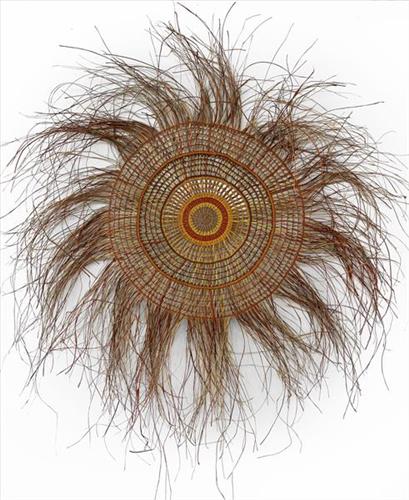
Woven Mat

Traditionally, Nganiyal (conical mats) were used as an insect screen when erected, and as a sitting mat when folded. They are used in Ceremony as well as a functional item. 

Nowadays, artists weave many different shapes including flat, round and oblong. 

115682213565


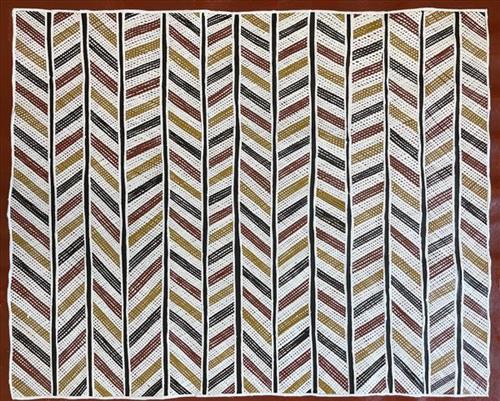
Gapu (water)

The intricate rarrk technique is used by Aboriginal people in Northern Territory, particularly in Arnhem Land. Artists use the weight of the paint soaked in the fine brush to delicately produce his fine, straight lines.

Traditionally, differing crosshatched layering of lines and shapes can give identity and ownership to specific Yolngu groups. As well as the pattern containing deep cultural significance, the patterns can represent wind, water, brilliance, energy and power to ancestral designs.

In this instance, it is representing water.

115682213564


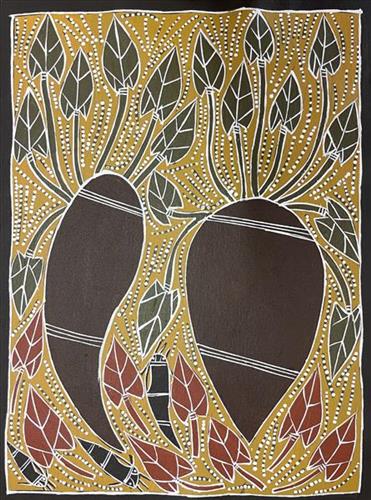
Baltji (Yam)

This painting depicts Baltji (Yam) which has been a reliable food source for Yolngu people for many centuries. Baltji can be found across the different landscapes of East Arnhem Land and are only harvested seasonally. 

115682213563


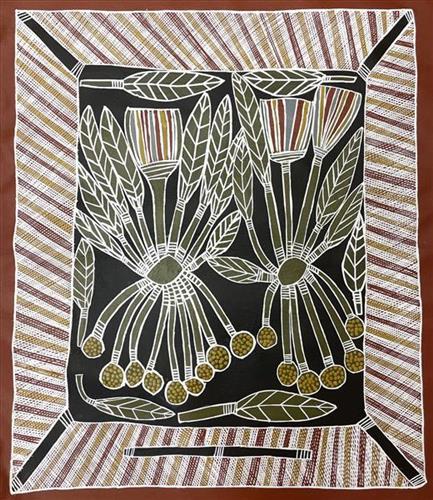
Dhulumburrk (Waterlily)

This painting depicts Dhulumburrk (Nymphaea violacea), a fresh waterlily. The flowers and lily pads of fresh waterlilies can be seen far and wide across the Arafura wetlands, providing coverage for many animal species including Banda (long-necked turtle) and Baru (crocodile). The flowers come in many beautiful colours, in particular a vibrant purple. 

115682213492


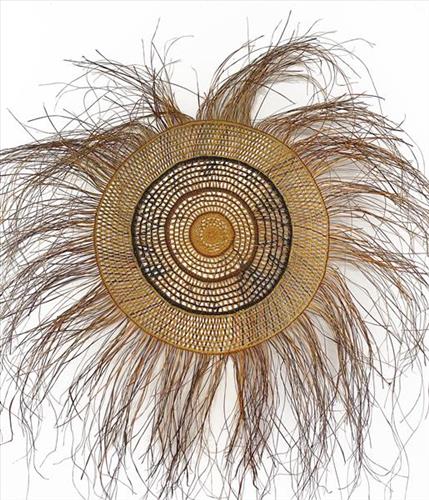
Woven Mat

Traditionally, Nganiyal (conical mats) were used as an insect screen when erected, and as a sitting mat when folded. They are used in Ceremony as well as a functional item. 

Nowadays, artists weave many different shapes including flat, round and oblong. 

377810582213491


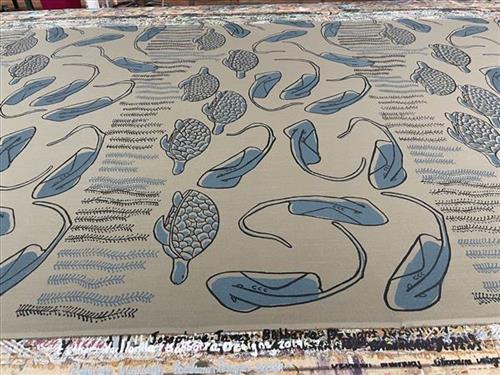
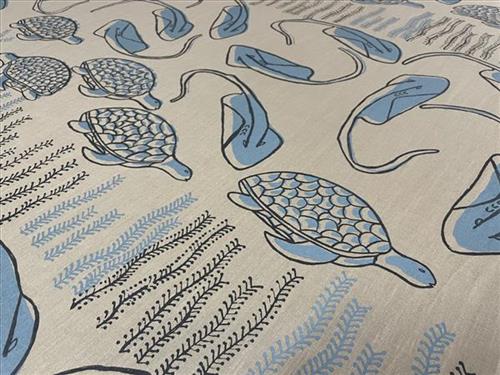
Mabbúlarr

Mabbúlarr is the Ndjébbana word describing calm and stillness – both regarding people and the ocean.

This design tells the story of underwater life in the shallows. The turtle we call marláddja (green turtle, Chelonia mydas) and the stingray we call marnandjúbba (Cowtail Stingray, Pastinachus sephen).

‘When strong wind blows the sea is rough, when there’s no wind the sea is calm. We call that mábbularr. You can see through the water and look at the turtle and stingray eating karlómerr (sea grass) and dancing underwater to find their mate. When we go on the boat hunting, we go at times of mábbularr.

In the old days men used to hunt with a canoe and with traditional made harpoon.  Guided by our ancestors’ spirits they would paddle all day to find sea turtle and dugongs in the right places. The men had to be smart for the tide and know the weather to balance their canoes. They would go at times of mábbularr (calm), early morning in daytime or at night-time when there is no moon and the water glows. We call the night-time glimmer of phosphorescence mílarrng-milarrng. Today people still go hunting, it brings a lot of families together and they share eating down the beach.

We have songline for sea turtle, also men paint turtle on their back and dance turtle in the Míddjarn the same way turtle dance underwater. It is very important we look after our country and songline passed on from many generations’. Josephine James 2021