Midnight
Woka energy at midnight.
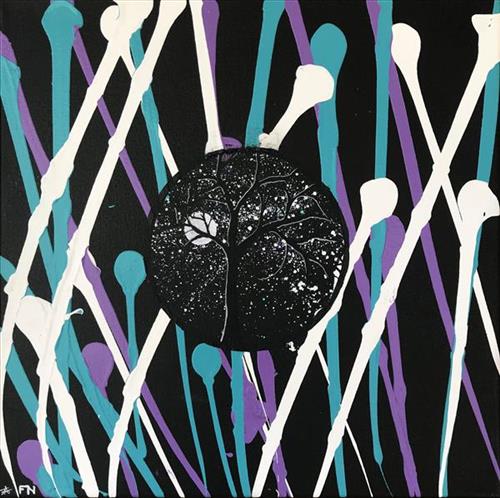
Woka energy at midnight.
Works in fibre from the Maningrida region are widely recognised as some of the finest in Australia. Artists confidently push the boundaries of fibre craft and cultural expression, adapting traditional techniques and forms to produce strikingly inventive and aesthetically exquisite artworks.
Artists usually use kundayarr, pandanus spiralis, to weave decorative round or oblong mats, as well as the less common triangular and conical shapes. Weaving is physically hard work, now done only by women. They colour the pandanus using natural dyes made from the roots, leaves or flowers of plants within the weaver’s clan estate.
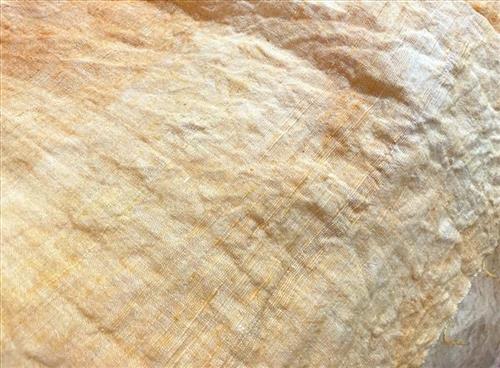
Deborah has used the root of Man-Kurdudjumuk (coelospermun reticulatum) to dye the fabric a beautiful yellow. This fabric has been dyed on country in the outstation of Kakodbubuldi.
100% Tussar Silk (Hand Loom) Priced without print
Works in fibre from the Maningrida region are widely recognised as some of the finest in Australia. Artists confidently push the boundaries of fibre craft and cultural expression, adapting traditional techniques and forms to produce strikingly inventive and aesthetically exquisite artworks.
Artists usually use kundayarr, pandanus spiralis, to weave decorative round or oblong mats, as well as the less common triangular and conical shapes. Weaving is physically hard work, now done only by women. They colour the pandanus using natural dyes made from the roots, leaves or flowers of plants within the weaver’s clan estate.
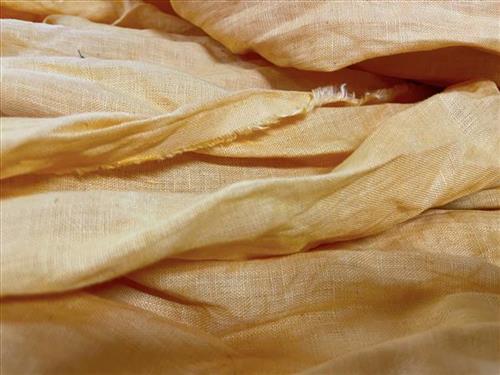
Deborah has used the root of Man-Kurdudjumuk (coelospermun reticulatum) to dye the fabric a beautiful yellow. This fabric has been dyed on country in the outstation of Kakodbubuldi.
100% Linen Priced without print
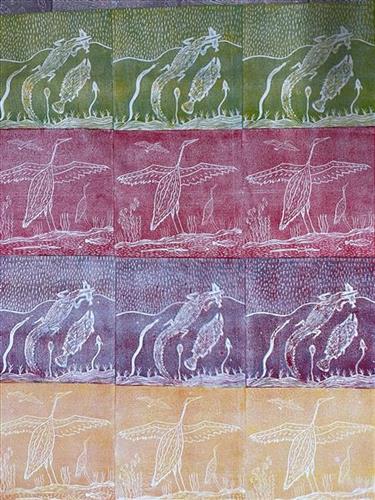
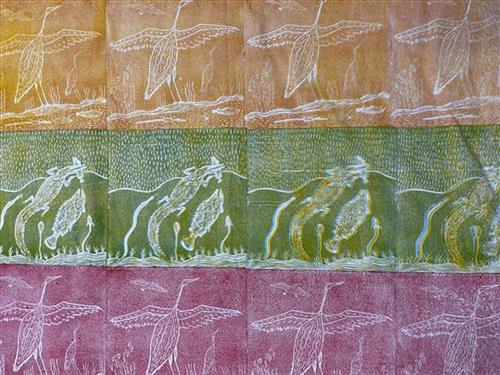
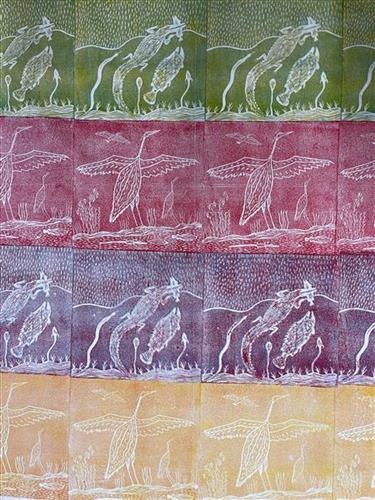
Jay depicts the Jabiru in her country of Korlobididah with her beautiful, hand-printed Lino design.
This work features stripes of harmonious colours, Jay’s Jabiru and Modjarriki ( fresh water crocodile) print.
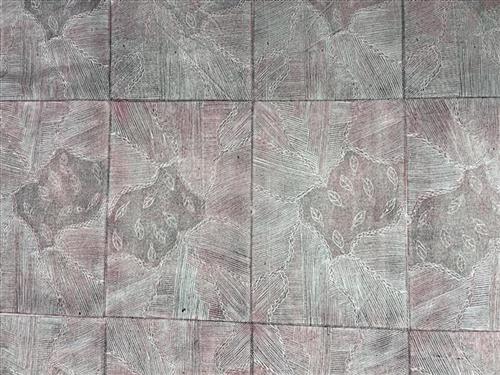
The artist, Janet Marawarr calls this design Kunred Kunkurra in her language, Kuninjku. Kunred means country, kunkurra refers the spiralling wind associated with the mini cyclones that occur around several sites in the Kardbam clan during the build up to the wet season. Marawarr often shares different versions of Kunkurra in her Lino print and Screen Print designs, the story or djang (dreaming) can be heard across the Kardbam clan groups Eastern Kunwinjku and Kuninjku people of the Yirridja moiety. This particular artwork describes the underground lightening that occurs during Kunkurra, in the build up to a storm in Mankorlod, Marawarr’s clan estate in West Arnhem Land.
‘The round shapes in the design mean flashing lightening. The lines beside those shapes are foot tracks, human foot tracks. When the rain falls it makes mud and underground lightening. When the sky is really red and black, we see the build up to a storm and we call that Kakodjngolbalabalahmen. That means that the clouds are forming. So that’s the one you see in this artwork. You can also see the leaves on top of the mud when the rain stops.’ Janet Marawarr 2023
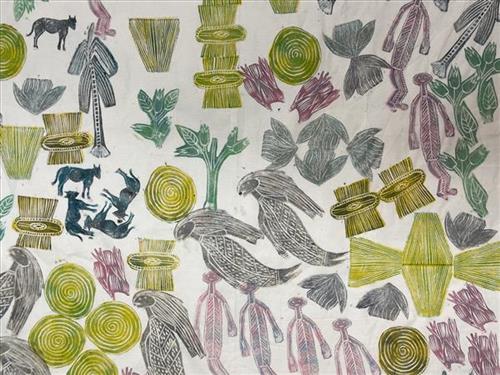
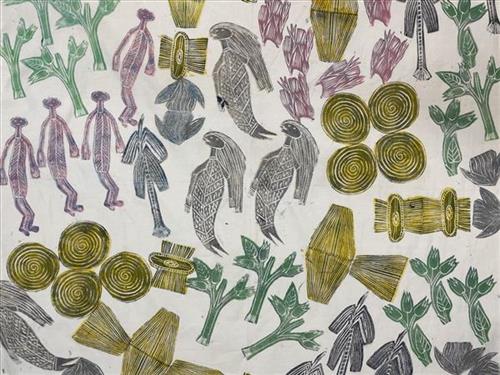
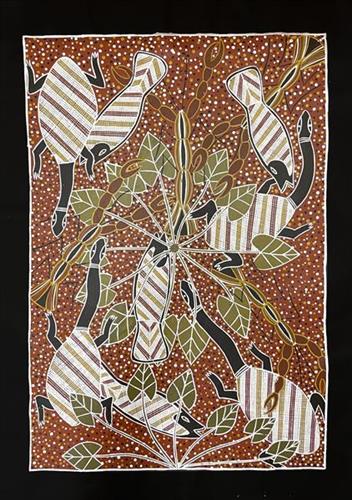
‘Yawkyawk swim underneath the rock. They always stay there. When the sun comes out they come out from underneath the river, make themselves warm. They sit and they look around. When they sit, they cry to themselves. Ngaldjorlhbo (mother of everything) she created them – yawkyawk and the other one [Ngalng].
The Mimih one is a long way from the stone country. He is from my uncles country Bardijokhang. My uncle is the famous artist Crusoe Kurddal and he carves and paints Mimih.
Sometimes yawkyawk sit inside the rock. Sometimes they go out to find the food manme and the mankung (sugarbag). Also they can sing inside the rock cave. Sometimes yawkyawk will see the big rain. When the big rain comes they start looking and when the rain comes they go inside and hide themselves.
Some yawkyawk stay on the dry land in a special place inland from Bardijolhwang.
Some of the stones get stuck on the breasts of the yawkyawk.
There are two yawkyawk in this artwork. One, the wet season yawkyawk has a round face and long hair. The dry season yawkyawk has short hair. There are lots of different yawkyawk in the water.
In my fabric they are all coming together with the grass trees and leaves and the blowing wind. Some of the leaves will fall onto the water. All the round shapes are kunred (rocky country) with dry grass.
This country is called Gamadery (sp), which is located near Mankorlod and Korlobididah, Arnhem Land.’
Janet Marawarr 2022
All Aboriginal people originate from a spiritual source, fixed in a particular place in their land or the sea. These ‘spiritual reservoirs’ are often in the form of special waterholes made by Wangarr (creative spirits) that were created long ago close to the beginning of time. These creator beings moved across the countryside, shaping the land and implanting in each tract of country, the spiritual life force for the people who were to own it. These creative spirits took many forms and when they gave the land to each group, they also gave songs, dances, ceremony, the associated laws and language.
The creation story for Ganalbingu people took place near the middle section of the Glyde River where it becomes the Goyder River. Their land, Ngaliyindi, sits astride the Arafura Swamp in Central Arnhem Land. Many Ganalbingu artists paint totemic species significant to their clan. These can include baru (crocodile), banda (long necked turtle), buliya (catfish), yalman (waterlilies), gumang (magpie geese), dakawa (fresh water yabby), ratjuk (barramundi), warrnyu (flying fox) and more.
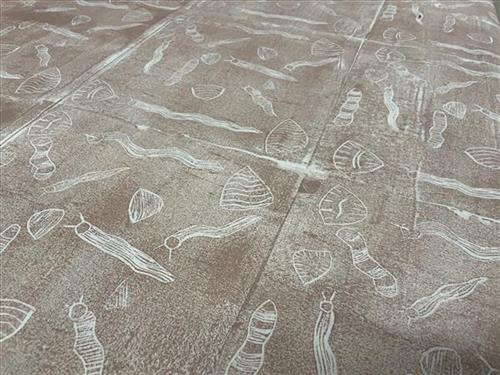
This design has lots of types of bush tucker including njanamaya(mud Muscle), kangodjbaya (mangrove worm) and warrangarla (caterpillar). The latter can be eaten cooked or raw.
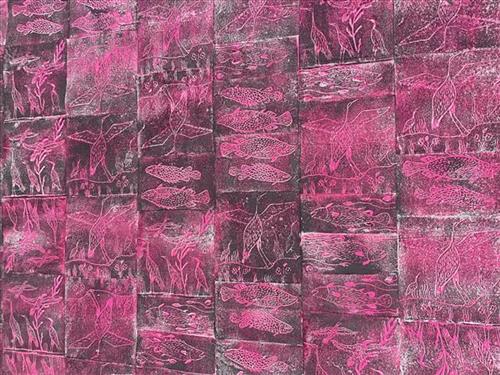
Kuninjku people call mermaids yawkyawk but in my language, Kune we call them Ngalkunburriyaymi (pronuced Ngaal gun borro yay mee). The Ngalkunburriyaymi depicted in my artworks is from a place called Marra-yii (sp?). There are too many Ngalkunburriyaymi living at this place. They are always there and have been there forever. We can go camping and fishing at this place. Marar-yii is a place in the river. They are freshwater. They are Duwa moiety. Same as the freshwater crocodile.
My mum told me her story. Ngalkunburriyaymi gave her a baby. Ngalkunburriyaymi came to her in a dream. They gave her my brother. In my mother’s dream she went fishing Marra-yii and Ngalkunburriyaymi came to her to tell her she was having a baby. She said to her I will give you a baby. In a couple of months, you will be pregnant.
Ngalkunburriyaymi eat fish and waterlilies.
Owen Yalandja is my cousin from my father’s side and Lulu is my grandmother also from my father’s side. They are from different outstations, but we are family. My Ngalkunburriyaymi story is connected to them but different.
I love my mother’s story and it is why I made a lino plate and I print it on different colour fabrics – silk, linen and cotton. I like using lots of different colours. I come from a family who have made artwork on bark and hollow logs using ochre. Black, yellow, red and white. But at Babbarra Designs we can use bright colours for our fabric.
Modjarrkki
Modjarrkki is the freshwater crocodile only eats little fish like barramundi and saratoga. He doesn’t eat big things like kangaroo.
Namurre Boko (Two Brother’s Story)
‘Bini-murreko means two brothers – big brother and little brother.
Two brothers were really strong leaders and good hunters, sharing animals with different tribes.
With those different tribe there were jealousy going on.
Little brother went walkabout and heard the different tribe was talking about his tribe.
They said ngarribin manre djed-djedme bokko
Meaning: will make spear for them
Ngarrbin danj-bun, ngarrbinbun
Meaning: will spear them kill them
little brother turn around went back tell his brother
Namurre bokko kadi marne djed-djedme Karre wonens, kardi-djal danjbun
Meaning: they making spear for us, they gonna spear us
Couple of months they saw different tribe
They changed their attitude
They been bringing lots of animals to them and start asking for women
And that tribe realise that’s how those brothers died.
They kill them
This Why? They got jealous because two brothers was a good hunter.
This story written on the rock art and it stays forever.’
This story was transcribed by Jay Jurrupula Rostron. Her lino designs illustrate the different scenes in this ancestral story. Jay is a meticulous artist with a fine lino carving technique and beautiful colour combinations that reflect the Arnhem Land environment and her homeland near Korlobididah.
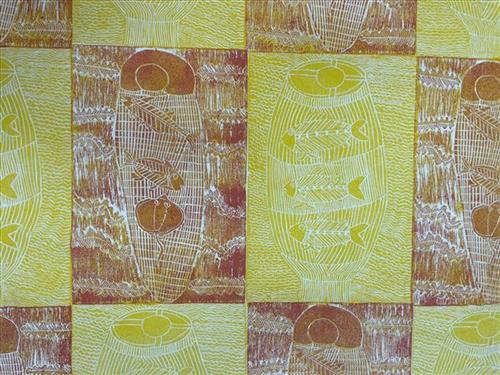
Au-gujechiya (fishtrap) sometimes portrayed with an-maka (cowtail stingray), rajarra (barramundi) and other fish inside.
Elizabeth has permission from her djunkay to draw this historic and important object traditionally used to trap fish in rivers, creeks and estuaries. In the early wet season they swim upstream for breeding in creeks and billabongs, then downstream to spend the dry season in larger rivers. The traps would be set to face the oncoming fish, with woven fencing either side. Within the mouth of the trap is a woven funnel that guides the fish in and prevents their escape. The clever design ensures that only adult fish are caught as smaller fish can escape through the weaving or even through the funnel. The fish that are caught can survive in the trap for up to two months. Once the trap is removed, the end is untied to remove the fish. This sustainable design means the trap can be used again and again.
Elizabeth is from the Burrarra language group and her homeland is Gupanga, Arnhem Land.